
Have you ever wondered what happens when a book is so controversial that governments, religions, or institutions try to make it disappear?
History shows that banning a book often has the opposite effect. Censorship sparks curiosity. The forbidden is alluring. And what someone tries to silence often ends up becoming a legend.
Over the centuries, numerous books have been persecuted, burned, removed from libraries, or blacklisted. Some questioned political power. Others challenged religious beliefs. There are also manuscripts shrouded in mystery and legend that have fueled tales of cursed books for generations.
In this guide, you’ll discover the 30 most famous banned books in history, the reasons for their censorship, and the stories surrounding them.
What are banned books?
Banned books are works whose reading, distribution, or possession has been restricted by a political, religious, or social authority.
The reasons have been varied:
- Ideas considered dangerous.
- Criticism of those in power.
- Sexual content.
- Religious heresy.
- Occultism.
- Questioning of social norms.
In many cases, the ban ended up increasing its popularity.
Why are books banned?
The most common reasons are:
- Ideological control.
- Protection of religious beliefs.
- Political censorship.
- Public morality.
- Fear of the spread of new ideas.
Paradoxically, many banned works ended up transforming culture, science, or literature.
The 30 most famous banned, censored, and condemned books in history
The Book of Enoch
One of the best-known apocryphal texts.
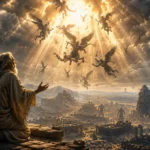
It describes fallen angels, giants, and heavenly visions that were not included in the official biblical canon.
Its exclusion has fueled debate for centuries.
Gospel of Judas
It presents a completely different view of Judas Iscariot.
Far from portraying him as a traitor, it depicts him as a necessary collaborator in the divine plan.
Gospel of Mary Magdalene
It assigns Mary Magdalene a much more significant role than that depicted in the canonical gospels.
For this reason, it became a controversial work.
Gospel of Thomas
It contains more than a hundred teachings attributed to Jesus.
Many of them differ from traditional Christian doctrine.
The Apocalypse of Peter
It describes heaven and hell with striking imagery.
For a time, it was considered for inclusion in the Bible.
Gospel of Philip
A text associated with Gnostic Christianity.
It is notable for its references to Mary Magdalene and esoteric teachings.
Malleus Maleficarum
Known as the “Hammer of Witches.”
It was one of the most influential books during the persecution of alleged witches in Europe.
Picatrix
A medieval treatise on astrology and magic.
For centuries, it was considered dangerous by religious authorities.
The Clavicula of Solomon
One of the most famous grimoires in the world.
It describes rituals, symbols, and supposed methods for summoning supernatural entities.
Book of Thoth
A legendary text attributed to the Egyptian god Thoth.
According to tradition, it contained knowledge capable of granting extraordinary powers.
Codex Gigas
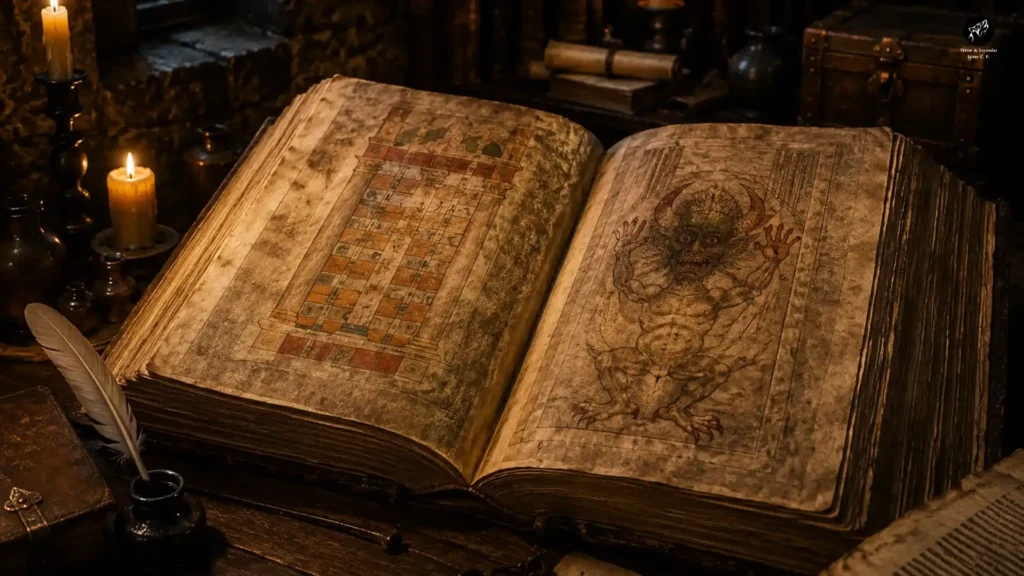
Known as “The Devil’s Bible.”
Legend has it that it was written in a single night with demonic assistance.
Although it was never officially banned, it is one of the most disturbing manuscripts in history.
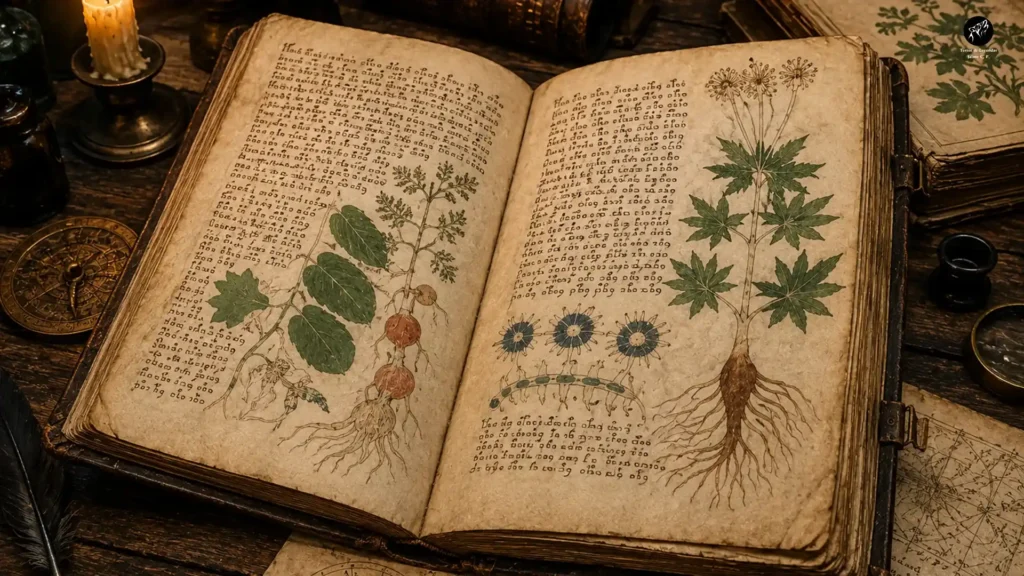
The Voynich Manuscript
No one has yet managed to decipher it.
It is written in an unknown language and contains illustrations that are impossible to interpret with certainty.
Rohonc Codex
Another mysterious manuscript whose writing remains an enigma.
The Great Grimoire
A book of ceremonial magic associated with demonic pacts.
Its reputation made it a sought-after work for centuries.
The Book of Abramelin
An esoteric manual that influenced numerous modern occultists.
Necronomicon
The most famous cursed book in popular culture.
It was invented by H. P. Lovecraft, but many people came to believe that it actually existed.
1984
George Orwell’s novel depicts a society under the watchful eye of a totalitarian regime.
His critique of state control led to bans in various political contexts.
Animal Farm
Another work by Orwell.
It uses animals to criticize the abuses of political power.
Fahrenheit 451
The story of a future where books are burned by the government.
A historical irony: the novel was also censored in some places.
Brave New World
Aldous Huxley imagined a seemingly perfect society based on absolute control.
Doctor Zhivago
The Soviet Union banned this novel because it considered it to be critical of the revolution.
The Gulag Archipelago
Aleksandr Solzhenitsyn exposed the Soviet labor camp system.
The book was banned for years.
The Satanic Verses
Salman Rushdie’s novel sparked one of the greatest literary controversies of the 20th century.
It even led to death threats against the author.
The Origin of Species
The theory of evolution challenged deeply held beliefs.
For this reason, it was rejected and censored in various places.
Ulysses
James Joyce’s masterpiece was considered obscene due to its content and narrative style.
Lolita
Vladimir Nabokov created one of the most controversial novels in modern literature.
Its subject matter led to bans in several countries.
Lady Chatterley’s Lover
D. H. Lawrence’s work was the subject of lawsuits and censorship due to its sexual content.
Tropic of Cancer
Henry Miller broke numerous social and literary taboos.
Madame Bovary
Gustave Flaubert faced legal proceedings over this novel.
The authorities considered it an affront to public morality.
The Flowers of Evil
Charles Baudelaire’s work was persecuted for alleged immorality.
Some poems remained censored for decades.
Books banned by the Catholic Church
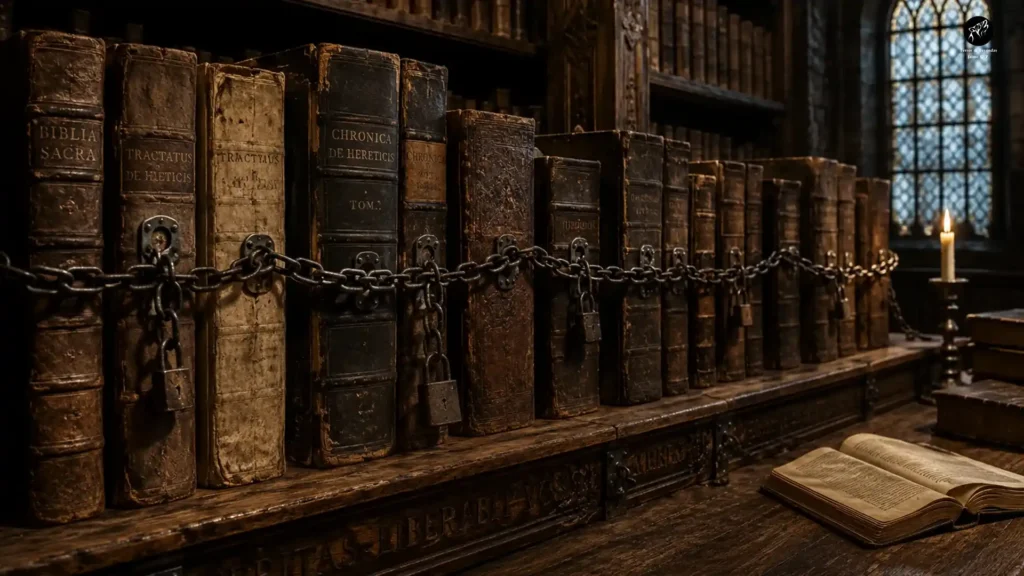
For centuries, there was an official list known as the Index Librorum Prohibitorum.
Its purpose was to prevent the faithful from reading works considered dangerous to the faith.
It included such important authors as:
- Galileo Galilei.
- René Descartes.
- Voltaire.
- Victor Hugo.
- Jean-Paul Sartre.
The index remained active until 1966.
Its existence demonstrates the enormous power that books have had to challenge established ideas.
Do banned books really exist?
It depends on how you interpret the term.
There is no evidence that a book possesses supernatural powers.
However, some manuscripts have given rise to so many stories and legends that they have earned the label “cursed.”
The most famous cases are:
- Codex Gigas.
- The Voynich Manuscript.
- The Great Grimoire.
- Book of Thoth.
- Necronomicon.
What is fascinating is that most of its mysteries continue to fuel debates today.
Where can banned books be read today?
Most of these works are legally available.
You can find them at:
- Public libraries.
- Specialty bookstores.
- Universities.
- Digital archives.
- Annotated editions.
Many of these texts, which were once persecuted, are now part of humanity’s cultural heritage.
Frequently Asked Questions About Banned Books
What is the most famous banned book?
Probably 1984, due to its enormous cultural and political impact.
Which books did the Catholic Church ban?
Thousands of works were included in the Index Librorum Prohibitorum between the 16th and 20th centuries.
What are the apocryphal books?
They are religious texts that were excluded from the official canon of the Bible.
Does the Necronomicon really exist?
No. It was a literary creation by H. P. Lovecraft.
What is the world’s most mysterious manuscript?
Many researchers believe that the Voynich Manuscript holds that distinction.
Conclusion
Banned books have something in common: someone wanted to prevent them from being read.
However, history shows that ideas are hard to lock away. Many of the persecuted works went on to become classics, changed the way millions of people think, or fueled some of humanity’s greatest mysteries.
Perhaps that is the greatest paradox of censorship: the more one tries to hide a book, the more interest it arouses.
YOU MAY BE INTERESTED IN: HORROR BOOKS (Spanish Edition)