
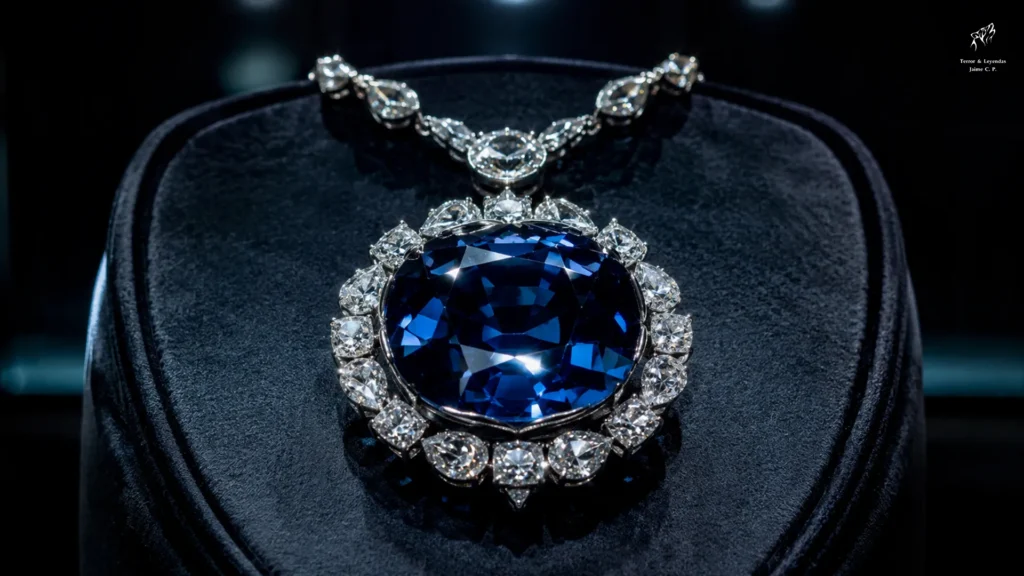

Can a piece of jewelry change the fate of those who own it?
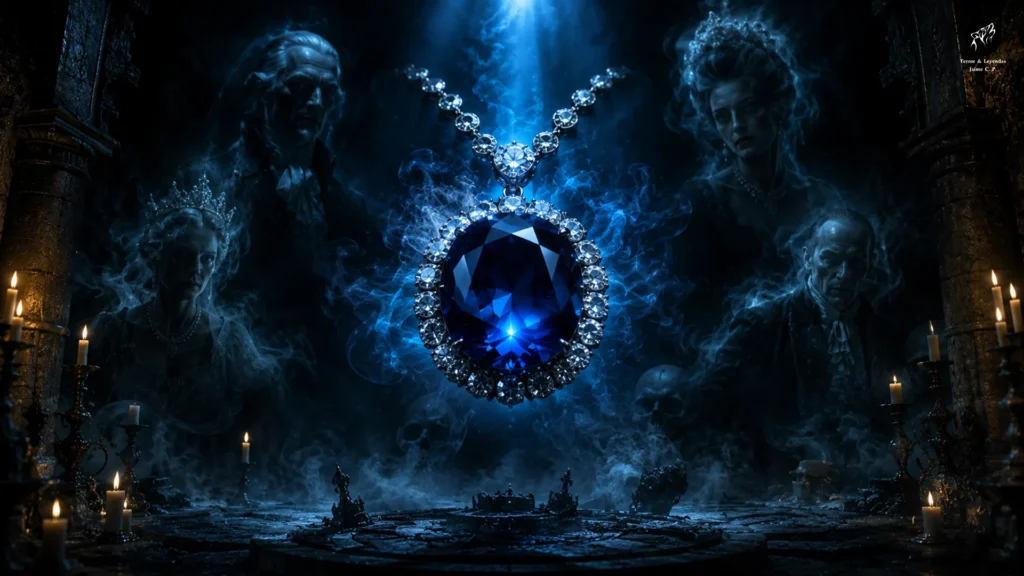
For more than three centuries, that question has surrounded the Hope Diamond, a spectacular blue gem that has passed through the hands of kings, aristocrats, millionaires, and collectors. Stories have been woven around it—tales of unexpected deaths, financial ruin, revolutions, and family tragedies—that have earned it a reputation as one of the most famous cursed objects on the planet.
However, behind the legend lies an even more fascinating true story. Historical documents, scientific research, and gemological studies have made it possible to reconstruct much of this extraordinary stone’s history, separating the verified facts from the myths that have emerged over time.
So, is the Hope Diamond truly cursed, or is it all just a series of coincidences?
In this article, you’ll discover its true origin, learn about its most famous owners, explore the tragedies that fueled its legend, and analyze why it remains one of the world’s most mysterious jewels.
What is the Hope Diamond?
The Hope Diamond, known internationally as the Hope Diamond, is one of the most famous and valuable diamonds in history.
It currently weighs 45.52 carats and is distinguished by an intense, deep blue color that makes it a virtually one-of-a-kind gem.
Its color is not the result of any artificial treatment. Scientists have shown that the color comes from small amounts of boron present in the diamond’s crystalline structure, an extremely rare phenomenon that occurs in only a small fraction of natural diamonds.
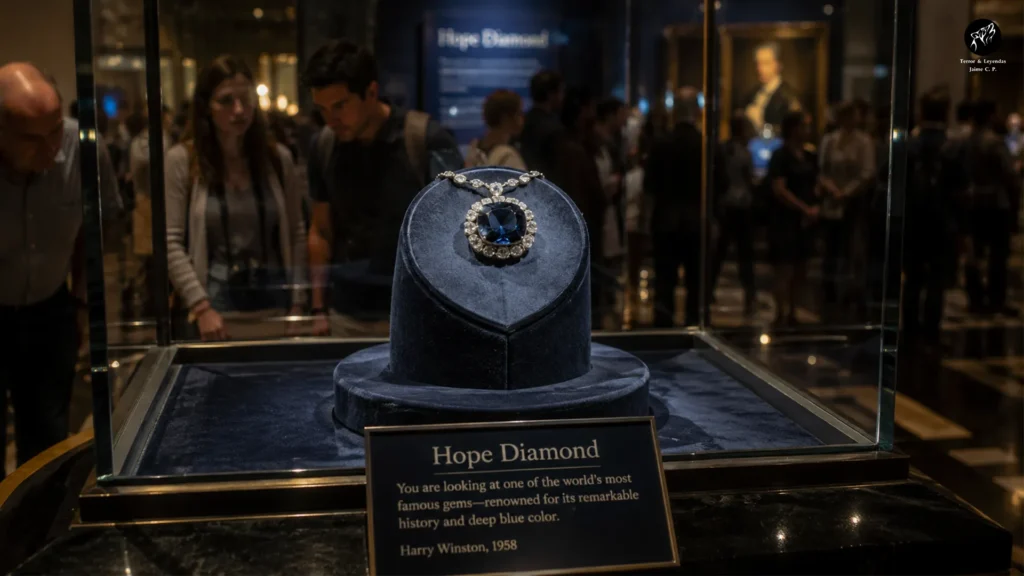
Today, it is housed at the Smithsonian National Museum of Natural History in Washington, D.C., where millions of people admire it every year.
Although its beauty is extraordinary, that is not the reason it achieved worldwide fame.
What truly made the Hope Diamond a legend was the long list of misfortunes attributed to many of its owners.
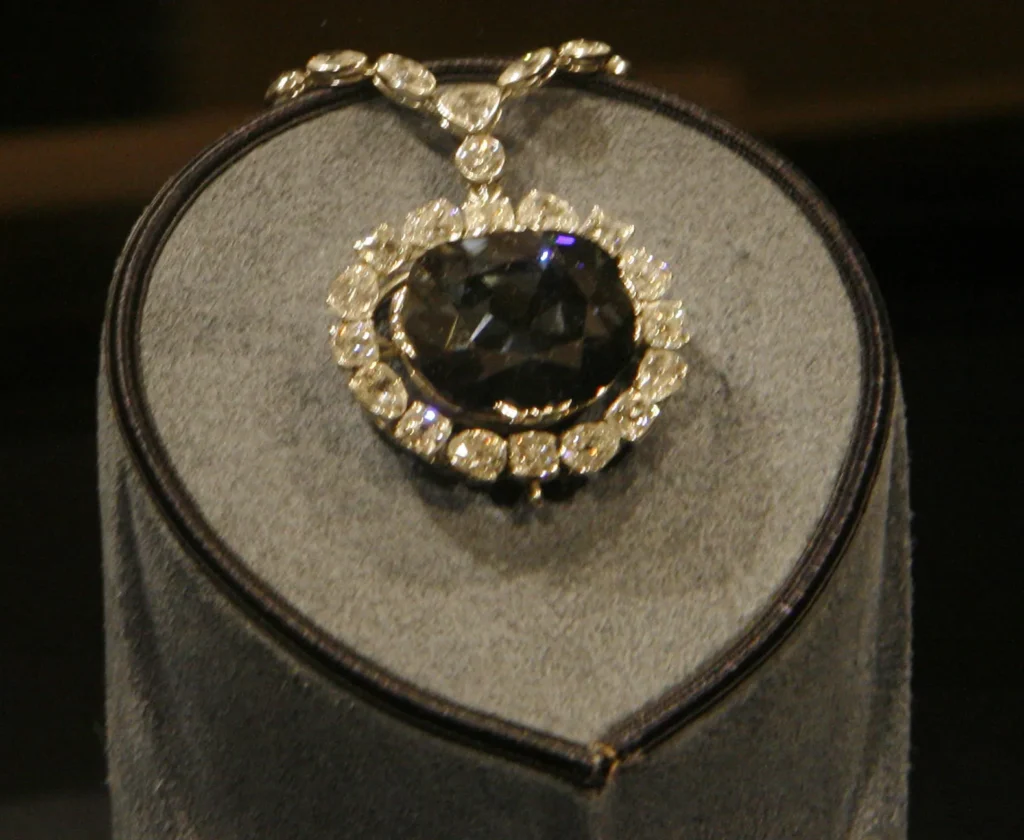
Characteristics of the Hope Diamond
Before learning about its history, it’s worth discovering what makes this gem so special.
| Característica | Información |
| Nombre actual | Diamante Hope |
| Nombre original | Diamante Azul de Francia |
| Peso | 45,52 quilates |
| Color | Azul intenso |
| Tipo | Diamante natural tipo IIb |
| Origen | Minas de Golconda (India) |
| Ubicación actual | Museo Nacional de Historia Natural del Smithsonian |
| Propiedad | Smithsonian Institution |
One of its most surprising characteristics is that, when exposed to ultraviolet light, it continues to emit an intense reddish glow for a few seconds.
This phenomenon, known as phosphorescence, is extremely rare and is one of the Hope Diamond’s defining characteristics.
Furthermore, its extraordinary clarity has allowed researchers to study the formation of natural blue diamonds in detail, making the gem a subject of immense scientific interest.
Why is the Hope Diamond so famous?
Unlike other historic jewels, the Hope Diamond combines three elements that rarely appear together.
- Exceptional beauty.
- A history documented over more than three centuries.
- One of the world’s best-known legends of a curse.
Its history encompasses some of the most significant events in modern history.
The stone passed through the hands of adventurous merchants, became part of the French monarchy’s jewelry collection, disappeared during the French Revolution, mysteriously reappeared in England, and eventually became one of the Smithsonian’s main attractions.
Each change of ownership was accompanied by new rumors.
Some people died prematurely.
Others lost their fortunes.
There were also executions, accidents, and family conflicts.
Over time, these events began to be linked to a supposed curse that haunted anyone who possessed the gem.
But how did that story come about?
The Legend of the Hope Diamond’s Curse
The most well-known version claims that the diamond was stolen from a temple in India.
According to popular tradition, the stone was part of a statue dedicated to the god Vishnu. Whoever stole it committed a sacrilege that unleashed an eternal curse.
From that moment on, all owners of the diamond were said to be doomed to suffer misfortune.
Among the events attributed to the curse are:
- Violent deaths.
- Financial ruin.
- Fatal accidents.
- Illnesses.
- Loss of power.
- Executions.
- Suicides.
- Family ruin.
However, there is one important detail.
No contemporary historical document confirms the alleged theft from the temple.
Most historians believe that this story began to circulate many years later to enhance the jewel’s aura of mystery.
Even so, the legend lives on.
And it continues to fascinate millions of people.
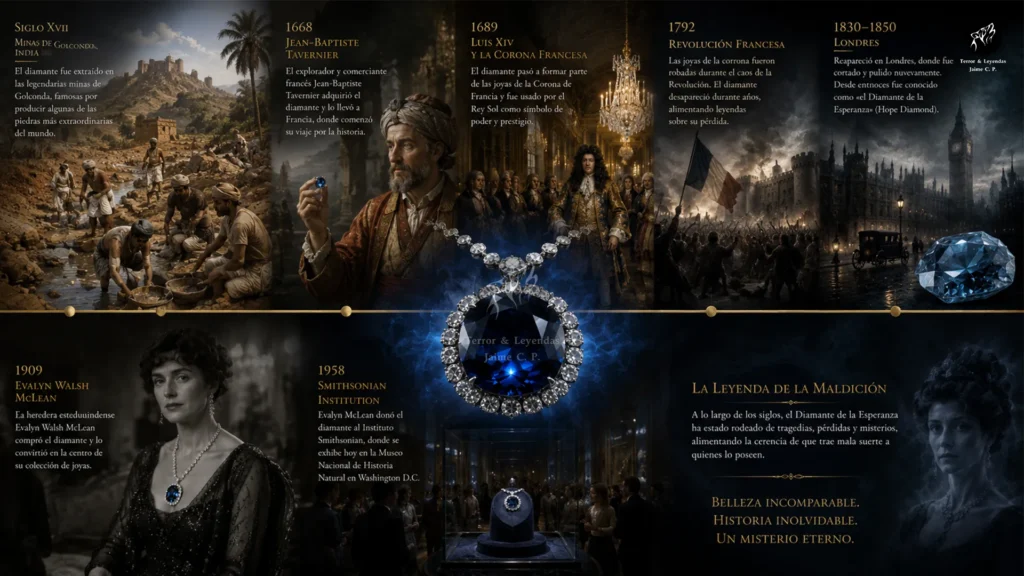
A Brief History of the Hope Diamond
Before delving into each stage of its history, here is an overview of its journey.
| Año | Acontecimiento |
| Siglo XVII | Descubrimiento en las minas de Golconda, India |
| 1668 | Jean-Baptiste Tavernier vende la gema a Luis XIV |
| 1673 | Se talla el Diamante Azul de Francia |
| 1792 | Robo durante la Revolución Francesa |
| 1812 | Reaparece misteriosamente en Londres |
| 1839 | La familia Hope le da su nombre actual |
| 1911 | Evalyn Walsh McLean adquiere el diamante |
| 1949 | Harry Winston compra la joya |
| 1958 | Donación al Smithsonian Institution |
| Actualidad | Expuesto permanentemente en Washington D. C. |
This timeline shows that the Hope Diamond has survived wars, revolutions, thefts, and political upheavals for more than three hundred years.
The Origin of the Hope Diamond: A Treasure Born in India
The story of the Hope Diamond begins several centuries before it received that name. To trace its origins, we must travel to southern India, a region that for centuries was famous for being home to some of the world’s most important diamond mines.
Most historians and gemologists agree that the gem comes from the legendary Golconda mines, located in what is now the state of Telangana. During the 16th and 17th centuries, these mines produced some of the most famous diamonds in history, such as the Koh-i-Noor, the Orlov, and the Regent.
At that time, Golconda was synonymous with wealth. Merchants from Europe, Persia, and the Ottoman Empire traveled thousands of kilometers to purchase precious stones intended for kings, emperors, and nobles.
Among those extraordinary gems was a massive blue diamond that, centuries later, would become known as the Hope Diamond.
The Golconda Mines: The Origin of Legendary Jewelry
Long before modern mining operations existed in Africa or Russia, India was the world’s leading producer of diamonds.
The Golconda mines enjoyed an exceptional reputation for several reasons:
- They produced diamonds of exceptional purity.
- They produced stones of extraordinary sizes.
- They were famous for the quality of their colored diamonds.
- They supplied jewelry to the world’s leading courts.
Although these mines are now depleted, their legacy lives on thanks to the historic stones still preserved in museums and collections.
Experts believe that the Hope Diamond was discovered during the first half of the 17th century and that, before it was cut, it weighed approximately 112 carats.
Its original size was more than double its current size.

Jean-Baptiste Tavernier: the man who brought the diamond to Europe
The first documented owner of the Hope Diamond was Jean-Baptiste Tavernier, a French merchant born in Paris in 1605.
Tavernier was no ordinary adventurer.
Throughout his life, he undertook six major expeditions to the East, traveling through territories that today form part of Turkey, Iran, India, and other Asian countries.
Thanks to those journeys, he became one of the most important gem merchants of his time.
During one of his stays in India, he acquired a spectacular blue diamond weighing about 112 carats, whose description matches that of the future Hope Diamond.
In his memoirs, he documented numerous gemstones he had purchased, making his account one of the primary historical sources on the gem’s origin.
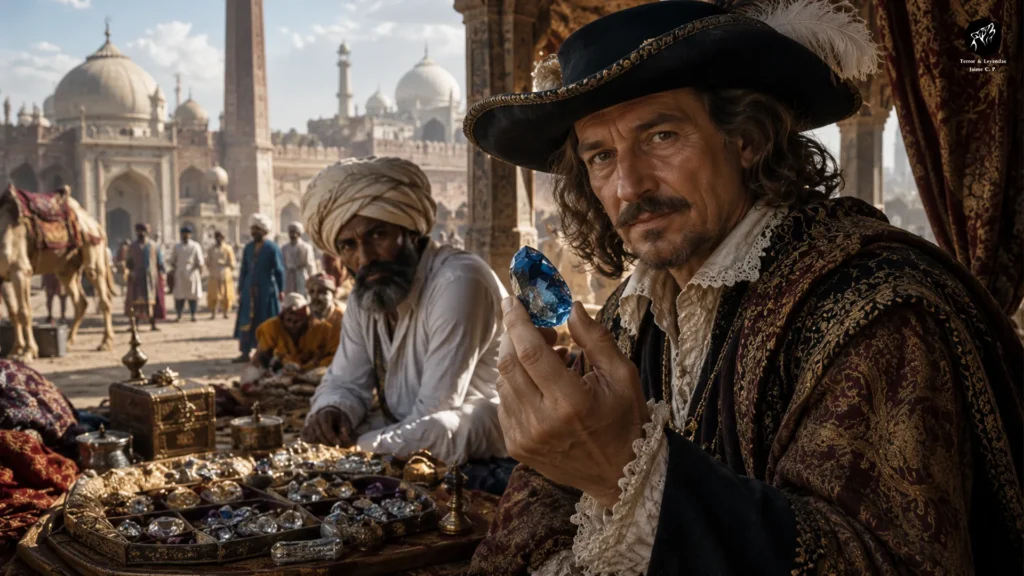
Did he buy the diamond or steal it?
This is where the most famous part of the legend begins.
According to a widely circulated account dating back to the late 19th century, Tavernier stole the diamond from the eye of a statue dedicated to the god Vishnu in a temple in India.
That desecration is said to have provoked the wrath of the deity.
As punishment, the merchant and all future owners would be marked by a terrible curse.
The story is fascinating.
However, when historians analyzed the documents from that period, they encountered a problem.
There was no evidence.
Not even Tavernier ever mentioned a temple.
Nor are there any Native American records documenting the alleged theft.
Nor did the French chroniclers of the time make any reference to such an event.
Everything suggests that this story emerged many years later, when the diamond was already famous and some merchants began to use the legend to increase its appeal.
The Birth of One of the World’s Greatest Legends
If the story of the temple hasn’t been proven, why do so many people still believe it?
The answer lies in the immense power of legends.
In the late 19th and early 20th centuries, newspapers competed to attract readers with sensational stories.
At the same time, major jewelers realized that a gem shrouded in mystery sparked far more interest than a simple gemstone.
The more tragic the story, the greater the public’s fascination.
That is how increasingly dramatic tales about the diamond’s supposed curse began to emerge.
Some accounts claimed that Hindu priests had cast a spell on the stone.
Others claimed that anyone who possessed it would end up losing their family, their fortune, or even their life.
Although none of these claims can be proven, they all contributed to the myth that has survived to this day.
How did Jean-Baptiste Tavernier really die?
This is one of the areas where history and legend diverge most clearly.
The most popular version claims that Tavernier was devoured by a pack of wild dogs during one of his journeys.
For decades, this story appeared in books, magazines, and even documentaries.
However, historical documents tell a very different story.
After selling the diamond to King Louis XIV of France, Tavernier continued to travel and trade in precious stones.
He eventually died in Russia in 1689, at over eighty years of age—a very advanced age for that time.
He did not die a violent death.
Nor is there any evidence that he was attacked by animals.
This case shows how the legend gradually incorporated fictional elements to reinforce the supposed curse of the Hope Diamond.
From a rough diamond to a jewel for a king
In 1668, Tavernier returned to France with an extraordinary collection of precious stones.
Among them, the enormous blue diamond acquired in India stood out.
The merchant sold it to King Louis XIV, known as the Sun King, who was impressed by the gem’s beauty.
From that moment on, a new chapter in the diamond’s history began.
Louis XIV ordered that the stone be cut by the court’s finest artisans to further enhance its color and brilliance.
The result was a completely different piece of jewelry.
The enormous 112-carat diamond was reduced to about 67 carats, but it acquired exceptional elegance and brilliance.
The stone was renamed the French Crown Blue Diamond and became one of the most valuable jewels in the royal treasury.
Without realizing it, the king had just begun the most famous chapter in the history of the Hope Diamond.
The tragedies associated with the French monarchy, the Revolution, and the mysterious theft of the gem would be the events that ultimately cemented its reputation as the world’s most famous cursed object.
The Blue Diamond of France: The Sun King’s Jewel
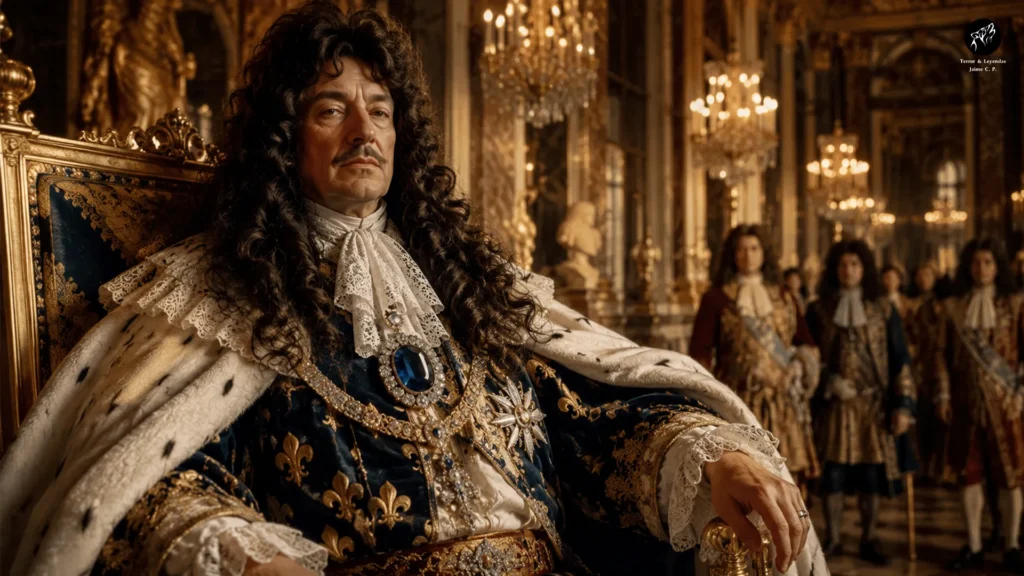
When Louis XIV acquired the enormous blue diamond from Jean-Baptiste Tavernier in 1668, he did more than simply add a gemstone to the royal collection. He also ushered in a new chapter in the history of one of the world’s most famous jewels.
The monarch, who had a passion for luxury and art, ordered that the diamond be cut to enhance its brilliance and highlight its extraordinary color.
The work was entrusted to the court jeweler, Jean Pittan, who spent nearly two years transforming the original stone.
The result was a true masterpiece.
The diamond went from weighing approximately 112 carats to about 67.12 carats, taking on a triangular shape with a cut that was highly innovative for its time.
From then on, it was known as the Blue Diamond of the French Crown (Bleu de France).
Louis XIV used to wear the jewel suspended from a ceremonial ribbon during grand celebrations at the court of Versailles, where it drew admiration from ambassadors and members of the European nobility.
Its intense blue color was so unusual that many visitors thought it was a gigantic sapphire.
However, no one could have imagined that this jewel would eventually disappear during one of the greatest revolutions in history.
Did Louis XIV fall victim to the supposed curse?
It is often claimed that the curse began to take effect on Louis XIV himself.
The historical reality is quite different.
The Sun King ruled France for more than seventy years, the longest reign in French monarchy.
During his final years, he suffered from various health problems and died in 1715 from gangrene caused by an infection.
Although some authors link his death to the supposed curse of the diamond, there is no evidence to support that idea.
Illnesses were common in the 18th century, even among Europe’s most powerful monarchs.
Even so, the king’s death was the first in a long chain of events that would fuel the legend.
The jewel is passed down from generation to generation
After the death of Louis XIV, the Blue Diamond remained part of the French Crown Jewels.
It was inherited by his successors and used in various official ceremonies.
Over the years, France’s political and economic situation began to deteriorate.
Constant wars, the court’s excessive spending, and poor harvests led to growing discontent among the population.
Decades later, the diamond would end up in the hands of Louis XVI and Marie Antoinette, the last monarchs of the French Ancien Régime.
It was they who would become forever linked to the supposed curse.
Louis XVI and Marie Antoinette
When Louis XVI ascended to the throne in 1774, he inherited a complex economic situation.
The country was burdened with enormous debts, and the population was suffering through a severe crisis.
Meanwhile, the court at Versailles continued to be seen as a symbol of luxury and privilege.
Although many of the stories about Marie Antoinette’s alleged extravagance were exaggerated by revolutionary propaganda, the queen’s public image was seriously damaged.
In that context, the Crown Jewels, including the Blue Diamond, represented the absolute power of the monarchy.
No one could have imagined that just a few years later, that power would vanish forever.
The French Revolution Changes the Diamond’s Fate
In 1789, the French Revolution broke out—one of the most significant events in modern history.
The monarchy gradually lost control of the country.
Many palaces were looted, and royal properties passed into the hands of the new revolutionary government.
The Crown Jewels were moved to the Garde-Meuble de la Couronne, a building in Paris where they were kept under guard.
But this security would not last long.
The Spectacular Theft of the Crown Jewels
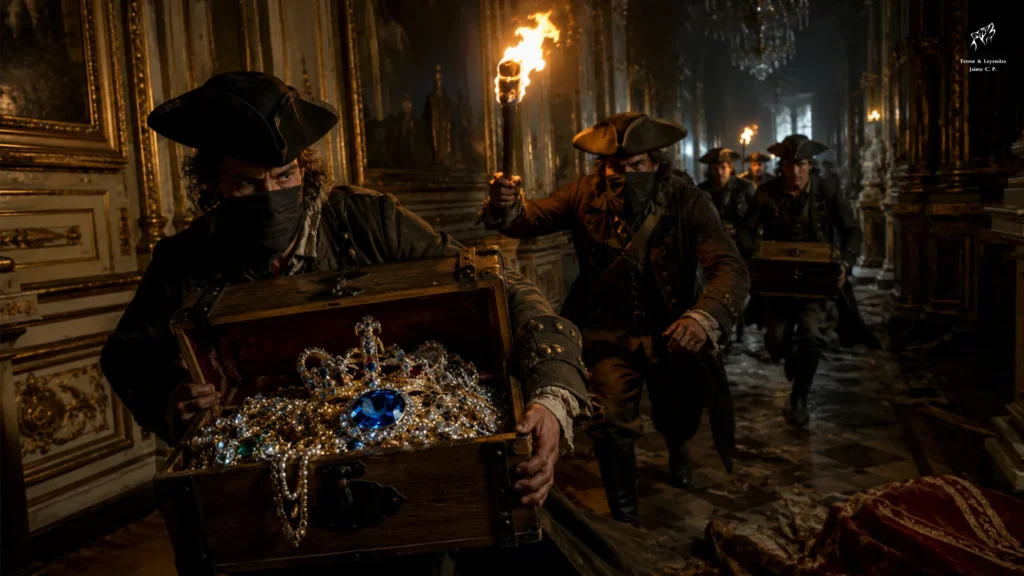
Between September 11 and 17, 1792, one of the most famous heists of all time took place.
Over the course of several days, a group of thieves managed to gain repeated access to the building where the French Crown Jewels were kept.
Taking advantage of the political chaos and lax security, the thieves stole hundreds of precious stones, crowns, necklaces, and other objects of immense value.
Among the missing items was the Blue Diamond of France.
The news sent shockwaves throughout Europe.
Although many of the jewels were recovered months later, the Blue Diamond never turned up.
All traces of it were lost.
That disappearance gave rise to countless theories.
The execution of the kings fuels the legend
While the diamond remained missing, the royal family’s situation became irreversible.
In January 1793, Louis XVI was convicted of treason and executed by guillotine.
Months later, in October of that same year, Marie Antoinette met the same fate.
To those who believed in the legend, those deaths seemed to confirm that the curse was still at work.
However, from a historical perspective, the executions were a direct consequence of the French Revolution and the profound political transformation the country was undergoing.
Linking them to the diamond has more to do with popular tradition than with verifiable facts.
Even so, the story began to spread rapidly throughout Europe.
Each new tragedy made the story even more fascinating.
Twenty Years of Mystery
After the theft in 1792, the Blue Diamond vanished without a trace.
For more than two decades, no one knew where it was.
It did not appear in any inventories.
It was not listed in any private collections.
No dealer admitted to having seen it.
That long silence gave rise to numerous hypotheses.
Some thought it had been destroyed to prevent it from being identified.
Others believed it remained hidden in the hands of some European aristocrat.
Over time, a theory emerged that is now widely accepted among experts.
The diamond is believed to have been recut to completely alter its appearance.
By reducing its size and changing its shape, it would be much more difficult to link it to the stolen jewel from the French Crown.
Decades later, a 45.52-carat blue diamond with remarkably similar characteristics would turn up in London.
Modern research, supported by digital models and gemological studies, indicates that this stone was, almost certainly, the transformed former Blue Diamond of France.
That diamond would be given a new name.
A name that would eventually become legendary.
TheHope Diamond.
The Diamond’s Rebirth: From France to England
After disappearing for more than twenty years, the former French Blue Diamond reappeared unexpectedly in London.
It was the year 1812.
The stone no longer looked the way it had when it was displayed at the French court.
It now weighed 45.52 carats, nearly a third less than the diamond stolen during the French Revolution.
Its new cut made it virtually impossible to recognize with the naked eye.
For a long time, it was believed to be an entirely different gem.
However, research conducted by specialists at the Smithsonian Institution showed that the proportions of the new diamond matched those of the original French Blue Diamond perfectly once certain sections had been removed through a new cut.
The most widely accepted theory is that the thieves altered the stone to conceal its true origin and sell it without arousing suspicion.
From that moment on, a new chapter in its history would begin.
The Hope Family and the Birth of a Legendary Name
In the 1830s, the diamond became part of the collection of the prestigious London banker Henry Philip Hope.
Hope was one of Europe’s greatest collectors of art and jewelry.
His collection included hundreds of exceptional pieces from different continents.
In 1839, a detailed description of the diamond was published for the first time in the catalog of her private collection.
From that time on, it became known as the Hope Diamond.
That name would stick forever.
Did the curse befall the Hope family?
Over the years, stories emerged claiming that the Hope family’s fortune began to decline because of the diamond’s curse.
It is true that financial problems and disputes over the family inheritance arose.
However, historians attribute these events to much more mundane causes.
The great European fortunes of the 19th century were plagued by frequent inheritance disputes, failed investments, and economic upheavals that affected numerous aristocratic families.
There is no evidence that the diamond was to blame.
Even so, the legend continued to grow.
Each new owner seemed to add another chapter to the story.
Pierre Cartier: the jeweler who turned a piece of jewelry into a legend
At the beginning of the 20th century, a key figure emerged who is essential to understanding the Hope Diamond’s enormous popularity.
That figure was the prestigious French jeweler Pierre Cartier.
Cartier was an excellent businessman.
He knew that an exceptional piece of jewelry needed an equally extraordinary story.
While searching for a buyer for the diamond, he began to compile ancient legends about tragedies involving its owners.
Many of them were true.
Others were exaggerated.
Some, quite simply, lacked historical evidence.
But they all had a very clear objective:
To create a story capable of captivating potential buyers.
Their strategy worked.
The Hope Diamond ceased to be merely a precious stone and became the world’s most mysterious jewel.
Evalyn Walsh McLean: the owner who fueled the legend
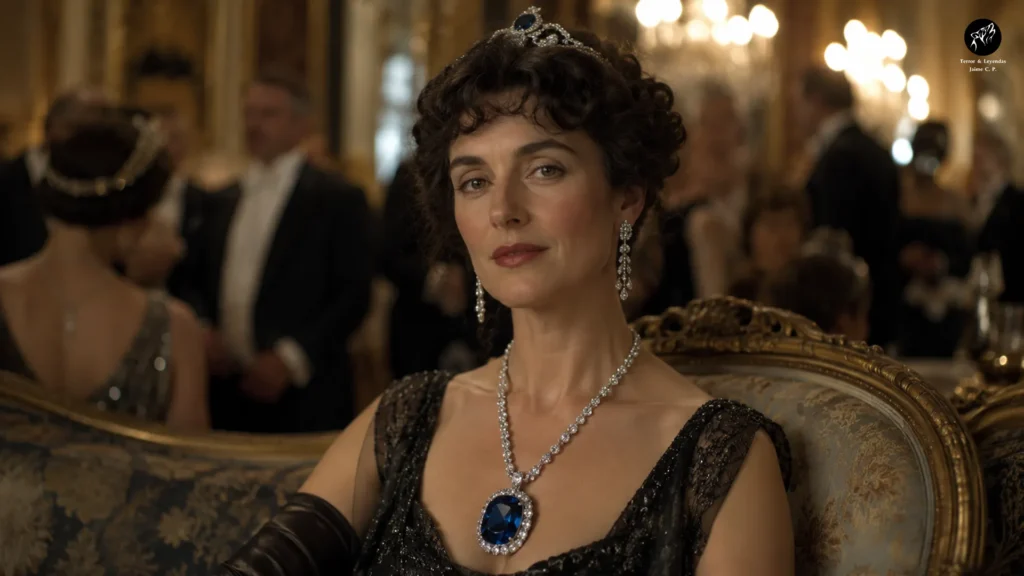
In 1911, Cartier managed to sell the diamond to Evalyn Walsh McLean, one of the wealthiest women in the United States.
Evalyn was a member of Washington’s high society and enjoyed collecting extraordinary jewelry.
Far from being intimidated by the supposed curse, she found all those stories amusing.
In fact, she went so far as to say that superstitions had never influenced her decisions.
She used to wear the Hope Diamond at receptions, gala balls, and social gatherings.
She even allowed some guests to try on the diamond during parties held at her residence.
She seemed convinced that the curse did not exist.
However, a few years later, a series of tragedies began to unfold that would mark her life forever.
The Misfortunes of Evalyn Walsh McLean
The events that affected Evalyn are real and are well documented.
Among them are:
- Her son Vinson was struck and killed by a car when he was only nine years old.
- Her daughter, Evalyn, died years later from a drug overdose.
- Her husband, Edward Beale McLean, suffered from severe alcoholism and mental health issues that led to his admission to a psychiatric hospital.
- The marriage ended in divorce.
- The family’s fortune dwindled considerably.
- Evalyn died in 1947, facing significant financial difficulties.
These tragedies greatly enhanced the fame of the Hope Diamond.
For many, these were no longer mere coincidences.
The curse seemed to have claimed new victims.
However, from a historical perspective, none of these misfortunes proves the existence of supernatural phenomena.
Experts point out that the lives of many wealthy families of that era were also marked by illness, accidents, and personal conflicts.
Harry Winston: The Man Who Defied the Curse
Following the death of Evalyn Walsh McLean, the famous American jeweler Harry Winston acquired a large portion of her jewelry collection.
Among them, the Hope Diamond stood out.
Unlike other owners, Winston never claimed to have experienced any strange occurrences related to the gem.
For several years, he organized charity exhibitions throughout the United States with the aim of bringing the jewel closer to the public and raising funds for various social causes.
Finally, he made a decision that would change the diamond’s fate forever.
The Surprising Journey to the Smithsonian
In 1958, Harry Winston decided to donate the Hope Diamond to the Smithsonian’s National Museum of Natural History, where it remains on display to this day.
The most surprising thing was the method chosen to ship it.
Instead of using an armored convoy or a complex security system, Winston placed the diamond inside a carefully protected box and sent it by certified mail.
The package traveled hundreds of kilometers to reach the museum without any incidents.
Since then, the Hope Diamond has been admired by tens of millions of visitors from all over the world.
And, curiously, during all that time, there has been no series of tragedies comparable to the one described in ancient legends.
This fact leads many researchers to believe that the supposed curse belongs more to the realm of folklore than to reality.
However, the mystery remains.
Because every generation asks itself the same question all over again.
Was it all just an extraordinary series of coincidences… or is the Hope Diamond still hiding a secret we haven’t yet managed to understand?
Is the curse of the Hope Diamond real?
After more than three centuries of history, the question remains the same:
Is the Hope Diamond really cursed?
The answer depends on who you ask.
For mystery lovers, the number of tragedies linked to the gem is far too high to be a mere coincidence.
For historians, gemologists, and scientists, however, most of these events can be perfectly explained by the historical context of each era.
The reality is that there is no scientific evidence to prove that the Hope Diamond possesses supernatural powers.
In fact, many of the most famous stories emerged decades after the events they describe.
Researchers specializing in the history of the gem have pointed out that several of these anecdotes were exaggerated or even fabricated by journalists and dealers to generate public interest.
One of the main figures responsible for popularizing the legend was Pierre Cartier, who understood that a piece of jewelry shrouded in mystery aroused far more desire than a simple gemstone.
Since then, the Hope Diamond’s fame has grown from generation to generation.
Documented Facts vs. Legends
One of the best ways to understand the history of the Hope Diamond is to separate the verified facts from popular lore.
| Hechos históricos | Leyendas |
| Procede de las minas de Golconda (India). | Fue robado del ojo de una estatua de Vishnú. |
| Jean-Baptiste Tavernier compró el diamante en la India. | Tavernier murió devorado por perros salvajes. |
| Luis XIV adquirió la gema en 1668. | El rey murió por culpa de la maldición. |
| Fue robado durante la Revolución Francesa. | La Revolución fue consecuencia del diamante. |
| La piedra fue retallada antes de reaparecer en Londres. | La maldición sobrevivió al nuevo tallado. |
| Actualmente se conserva en el Smithsonian. | El museo mantiene la maldición bajo control. |
As can be seen, many of the most popular stories belong to the realm of folklore and lack documentary evidence.
However, that hasn’t stopped the myth from continuing to grow.
What does science say about the Hope Diamond?
In addition to its historical value, the Hope Diamond is a true marvel from a scientific standpoint.
Its intense blue color has sparked the interest of researchers for decades.
Analyses conducted by specialists at the Smithsonian have provided a better understanding of its composition.
Its notable characteristics include:
- It is a Type IIb natural diamond, one of the rarest on the planet.
- It contains small amounts of boron, which is responsible for its characteristic blue color.
- It possesses extraordinary clarity.
- It was formed approximately one billion years ago at enormous depths beneath the Earth’s surface.
But there is one property that continues to amaze even the experts.
The mysterious red glow
When the Hope Diamond is exposed to ultraviolet light, something extraordinary happens.
For a few seconds, it continues to glow an intense red.
This phenomenon is called phosphorescence.
Only a very small number of natural diamonds exhibit this characteristic.
Thanks to this, scientists can confirm the stone’s authenticity and better study its crystalline structure.
Paradoxically, a completely natural property has helped reinforce the idea that the gem possesses some kind of supernatural energy.
How much is the Hope Diamond worth?
It is practically impossible to calculate the price of the Hope Diamond.
There is no comparable piece of jewelry.
Its immense historical significance means that its value goes far beyond the diamond’s weight or quality.
Various experts estimate that, if it were ever to go up for auction, it could fetch between 200 and 350 million dollars.
However, many experts believe its true value would be even higher.
The reason is simple.
It wouldn’t just be a diamond being sold.
One of the most famous historical artifacts on the planet would be sold.
The Hope Diamond in Popular Culture
The Hope Diamond’s fame has extended far beyond the realms of history and gemology.
It appears constantly in books, documentaries, video games, and movies.
Its influence has been enormous.
One of the best-known examples can be found in the movie *Titanic* (1997).
Although the famous “Heart of the Sea” necklace never actually existed, James Cameron acknowledged that the design was clearly inspired by the Hope Diamond.
Thanks to the film’s success, millions of people learned of the existence of this legendary jewel.
Since then, the Hope Diamond has continued to appear in mystery novels, television shows, and productions about cursed objects.
Its history continues to inspire new versions of the legend.
Other diamonds shrouded in mystery
Although the Hope Diamond is the most famous, it is not the only one to have given rise to unsettling stories.
Koh-i-Noor
Also from India, the Koh-i-Noor is another of the world’s most legendary jewels.
According to an ancient tradition, any man who possesses this diamond will suffer misfortune.
For that reason, for generations it has been worn exclusively by the queens of the British monarchy.
Orlov Diamond
Another gemstone originating in India.
Like the Hope Diamond, one legend claims that it was stolen from a sacred statue.
Although historians consider that story to be unsubstantiated, the similarities with the Hope Diamond are evident.
Orlov Black Diamond
Also known as the Eye of Brahma, this spectacular black diamond is shrouded in stories of suicides and misfortune.
Its legend shares many elements with that of the Hope Diamond.
Why do we continue to believe in cursed objects?
Stories about cursed objects have been around for thousands of years.
Swords.
Mirrors.
Dolls.
Books.
Paintings.
Jewelry.
They all share a common element.
They force us to ask ourselves whether there are forces we do not yet understand.
Psychology offers an interesting explanation.
Human beings tend to look for patterns even when events are completely unrelated.
When several misfortunes seem to be related to the same object, our brain interprets this as a connection.
This phenomenon is known as confirmation bias.
That doesn’t mean legends lose their value.
On the contrary.
Their ability to stir emotions is precisely what keeps them alive from generation to generation.
And few stories have managed to survive as long as that of the Hope Diamond.
Beyond the historical truth, its true power lies in the mystery that continues to surround it.
Frequently Asked Questions About the Hope Diamond
Where is the Hope Diamond currently located?
The Hope Diamond is on permanent display at the Smithsonian’s National Museum of Natural History in Washington, D.C. It is one of the institution’s most visited exhibits and attracts millions of people from around the world each year.
How much does the Hope Diamond weigh?
It currently weighs 45.52 carats (9.10 grams). Before it was cut in the 17th century, the original diamond, mined in India, weighed approximately 112 carats.
Why is the Hope Diamond blue?
Its distinctive deep blue color is due to the presence of small amounts of boron in its crystal structure, an extremely rare characteristic in natural diamonds.
What does it mean for a diamond to be Type IIb?
Type IIb diamonds account for less than 0.1% of all known diamonds. They contain very little nitrogen and small amounts of boron, which give them their blue hue and unusual electrical properties.
Is the Hope Diamond really cursed?
There is no scientific evidence to confirm the existence of a curse.
Most historians believe that many of the tragedies associated with the diamond were exaggerated or added over time to heighten the mystery surrounding the gem.
However, the number of stories related to its owners continues to fuel the debate.
Who was the first known owner?
The first documented owner was the French merchant Jean-Baptiste Tavernier, who acquired the stone in India during the 17th century before selling it to King Louis XIV of France.
How much is the Hope Diamond worth?
It has no official price because it belongs to the Smithsonian and has never been put up for sale.
Various experts estimate that, if it were to go up for auction, it could easily fetch over $300 million, although its immense historical value makes it very difficult to put an exact figure on it.
Did it inspire the necklace in the movie *Titanic*?
Yes.
The famous “Heart of the Sea” necklace from the movie *Titanic* was clearly inspired by the Hope Diamond, although the piece of jewelry featured in the movie is fictional.
What was the greatest tragedy associated with the Hope Diamond?
There is no single answer.
Among the best-known events are:
- The execution of Louis XVI.
- The execution of Marie Antoinette.
- The death of Evalyn Walsh McLean’s son.
- The financial ruin of several landowners.
Although these events are documented, there is no evidence that they were caused by the diamond.
Can you visit the Hope Diamond?
Yes.
It is part of the permanent collection of the Smithsonian National Museum of Natural History and can be viewed during the museum’s regular hours.
Final Thoughts
Few jewels have sparked as much fascination as the Hope Diamond.
Its extraordinary beauty, its journey through some of Europe’s most powerful courts, and the long list of tragedies attributed to its owners have made this gem one of the greatest icons of mystery.
History shows that many of the legends have been embellished over the centuries. However, it also shows that the Hope Diamond has been present in some of the most important episodes of modern history.
We may never know if the curse really exists.
What we do know is that this jewel has achieved something reserved for very few historical objects: it has remained alive in the collective imagination, generation after generation.
As long as it continues to spark questions and inspire books, documentaries, and theories, the Hope Diamond will remain much more than just a diamond.
It will be one of the most fascinating legends ever told.