


What is the Gospel of Judas?
What if one of Christianity’s most controversial figures hadn’t been the traitor we all know him to be?
That is the question posed by the Gospel of Judas, an ancient Christian text that offers a completely different interpretation of Judas Iscariot. While the New Testament gospels portray him as the disciple who betrayed Jesus for thirty pieces of silver, this text asserts that his actions were part of a much deeper plan.
Since the manuscript came to light in 2006, it has sparked enormous interest among historians, archaeologists, theologians, and curious readers. However, it has also given rise to numerous misunderstandings. Some people believe it completely rewrites the story of Jesus, while others consider it proof that Judas was never a traitor.
The reality is far more complex.
The Gospel of Judas does not rewrite the history of Christianity nor does it replace the canonical gospels. It is an apocryphal gospel linked to Gnostic thought that reflects the beliefs of a second-century Christian community. Its value lies in showing the diversity of ideas that existed during the early centuries of Christianity and in helping us better understand the religious context of that era.
In this guide, you’ll discover what the Gospel of Judas is, who wrote it, what it actually says about Judas Iscariot, why it isn’t part of the Bible, and what its historical significance is.
History of the Gospel of Judas
For centuries, it was believed that this gospel had been lost forever.
Its existence was known only through references by some early Christian writers, who mentioned a text used by certain Gnostic groups. However, no one knew where it was or whether a copy still existed.
Everything changed at the end of the 20th century.
When was it written?
Although the surviving manuscript is from a later period, most scholars believe that the original text was written sometime between 150 and 180 AD.
This means it was composed several decades after the four canonical Gospels.
The document that has survived to this day is written in Sahidic Coptic, a variant of the Coptic language used in Egypt. Researchers believe it is a translation of a work originally written in Greek.
This dating is significant because it places the Gospel of Judas in an era when numerous Christian movements coexisted, each with very different interpretations of the figure of Jesus.
The Discovery of the Tchacos Codex
The manuscript was found in Egypt during the 1970s, probably near the town of El Minya.
After its discovery, it began a long journey through the antiquities market. For years, it was stored under unsuitable conditions and changed hands several times.
This situation caused severe deterioration of the papyrus.
Many pages were fragmented, others were torn, and some were nearly lost forever.
Finally, the codex was acquired by the Maecenas Foundation for Ancient Art, which launched an ambitious restoration and translation project in collaboration with international experts.
The manuscript was named the Codex Tchacos, in honor of the antiquities dealer Frieda Nussberger-Tchacos.

The Restoration of the Manuscript
The restoration of the Gospel of Judas was a true labor of precision.
Experts had to piece together hundreds of papyrus fragments, stabilize the material, and decipher a severely deteriorated text.
In addition to conservators, linguists, historians, papyrologists, and specialists in early Christianity were involved.
Tests conducted using carbon-14 dating and ink analysis confirmed that the manuscript was authentic and had been produced between the 3rd and 4th centuries.
After several years of work, the Gospel of Judas was officially unveiled to the world in April 2006.
The news made headlines in numerous international media outlets and sparked enormous interest in learning about the contents of this ancient gospel.
Who wrote the Gospel of Judas?
One of the most frequently asked questions is whether Judas Iscariot was actually the author of the text.
The answer is no.
The title “Gospel of Judas” does not imply that Judas wrote the manuscript. As with many apocryphal gospels, the name was used to lend authority to the account.
Historical studies agree that it was written by a Christian community linked to Gnosticism, a religious movement that became widespread during the 2nd and 3rd centuries.
These groups maintained that Jesus had imparted secret teachings reserved for a select few disciples capable of understanding the true nature of the universe and of God.
From that perspective, Judas held a privileged position.
He was not the disciple who betrayed Jesus out of financial greed, but rather the only one capable of understanding his spiritual mission.
This interpretation explains why the Gospel of Judas differs so greatly from the accounts included in the New Testament.
What does the Gospel of Judas actually say?
The content of the Gospel of Judas is surprising because it completely reverses the traditional image of Judas Iscariot.
In the Gospels of Matthew, Mark, Luke, and John, Judas hands Jesus over to the religious authorities, an act that leads to his crucifixion.
However, the Gospel of Judas offers a different interpretation.
According to this text, Judas acts in accordance with a special revelation received from Jesus. It is important to note that this is the perspective of the Gnostic text itself and does not represent the historical consensus or the doctrine of the major Christian churches.
In the account, Jesus speaks privately with Judas and imparts teachings to him that remain hidden from the rest of the disciples.
While the others interpret Jesus’ words literally, Judas understands the spiritual meaning of his mission.
As a result, Jesus’s surrender is no longer understood as a betrayal but is instead presented as a necessary action for the fulfillment of the divine purpose described in the text itself.
This is the central idea that has made the Gospel of Judas one of the most debated documents of early Christianity.
But why is this interpretation so different from the one conveyed by the canonical gospels?
The answer lies in the religious tradition to which its author belonged: Gnosticism, a movement that developed a completely different view of Jesus, the material world, and salvation.

The Gospel of Judas and Gnosticism
To understand the Gospel of Judas, it is essential to understand Gnosticism, a religious movement that exerted a great influence during the early centuries of Christianity.
The word “gnosis” means knowledge. However, it does not refer to intellectual knowledge, but rather to a spiritual revelation that, according to the Gnostics, enabled human beings to attain salvation.
Unlike traditional Christian doctrine, Gnosticism held that the material world was imperfect and that the true destiny of human beings was to return to the spiritual world.
In this context, Jesus did not come merely to teach or to die for humanity. His mission was to impart a secret knowledge that only a few could understand.
This idea explains why the Gospel of Judas presents such a different relationship between Jesus and Judas.

Jesus and Judas in the Gnostic Vision
In this gospel, Jesus is shown conversing alone with Judas on several occasions.
While the other disciples do not understand the true meaning of his teachings, Judas receives revelations reserved exclusively for him.
According to the account, Jesus explains to him aspects related to:
- The origin of the universe.
- The nature of the soul.
- The different levels of the spiritual world.
- The ultimate destiny of human beings.
For this reason, Judas is portrayed as the disciple who best understands Jesus’ mission.
This portrayal stands in stark contrast to the tradition recorded in the canonical Gospels.
The Main Teachings of the Gospel of Judas
Although the text is incomplete due to the deterioration of the manuscript, scholars have identified several fundamental ideas.
Knowledge Leads to Salvation
The Gospel of Judas maintains that salvation does not depend solely on faith or works, but on access to a spiritual knowledge reserved for a select few.
This idea is one of the pillars of Gnostic thought.
The material world is imperfect
The text describes the physical universe as an inferior reality compared to the spiritual world.
In Gnosticism, the goal of human beings is to free themselves from the limitations of the body and return to the true divine reality.
Judas fulfills a special mission
The best-known aspect of the Gospel of Judas is its reinterpretation of the figure of Judas Iscariot.
According to the text, Judas betrays Jesus because Jesus asks him to do so as part of a greater plan.
It is important to remember that this interpretation belongs exclusively to Gnostic tradition and does not represent the historical view accepted by most scholars or the doctrine of Christian churches.
The other disciples do not understand Jesus
Another characteristic feature of the gospel is its criticism of the other disciples.
In several scenes, they appear unable to grasp the true meaning of Jesus’ teachings.
Only Judas receives the full explanation.
This idea reinforces the Gnostic belief that only a select few possess the knowledge necessary to attain salvation.

YOU MAY BE INTERESTED IN
The Book of Enoch: The Forbidden Story of the Fallen Angels
Can you imagine discovering an ancient book that tells of rebellious angels, giants who walked the Earth, and heavenly secrets hidden for centuries?
That is precisely what makes the Book of Enoch one of the most fascinating and controversial texts in religious history.
Why Isn’t the Gospel of Judas Part of the Bible?
One of the most frequently searched questions on the Internet is why this gospel was not included in the New Testament.
The answer lies in several historical and theological factors.
It was written too late
The four canonical Gospels were written between the middle and the end of the first century.
In contrast, most scholars date the composition of the Gospel of Judas to around A.D. 150, several decades after the death of the apostles.
That fact alone represented a significant difference from the texts considered apostolic.
Its content reflects a different tradition
The Gospel of Judas does not seek to expand upon the New Testament accounts.
It presents a completely different interpretation of essential aspects such as:
- The nature of Jesus.
- The role of Judas.
- The meaning of salvation.
- The creation of the world.
- The authority of the apostles.
These differences led the majority of Christian communities to reject it as an authoritative source.
The early Christians were already familiar with this Gospel
In the late second century, Bishop Irenaeus of Lyon mentioned a text known as the Gospel of Judas in his work *Against Heresies*.
In it, he criticized certain Gnostic groups for using writings that, according to him, did not originate from the apostles and contained teachings incompatible with the Christian faith.
This reference shows that the Gospel of Judas was already circulating among some communities, although it was never recognized as part of the biblical canon.
The Process of Canon Formation
The Bible was not formed overnight.
During the first few centuries, Christian communities used numerous writings.
Over time, the Church began to distinguish those texts that it considered to be directly linked to the apostles and consistent with the teachings it had received.
The Gospel of Judas did not meet these criteria and was therefore excluded from the New Testament canon.
Differences between the Gospel of Judas and the canonical gospels
Although both speak of Jesus and Judas Iscariot, they belong to very different traditions.
| Evangelios canónicos | Evangelio de Judas |
| Judas entrega a Jesús por traición. | Judas cumple una misión revelada por Jesús. |
| La salvación se ofrece a toda la humanidad mediante Cristo. | La salvación depende del conocimiento espiritual reservado. |
| Jesús enseña públicamente a sus discípulos. | Jesús comunica secretos únicamente a Judas. |
| La creación es obra de un único Dios. | Presenta una compleja cosmología propia del gnosticismo. |
| Los doce apóstoles desempeñan un papel fundamental. | Los demás discípulos aparecen confundidos y limitados espiritualmente. |
These differences show that both texts stem from distinct religious contexts and pursue different objectives.

Is the Gospel of Judas authentic?
A very common question is whether the discovered manuscript is authentic.
The answer is yes, but it is important to make a key distinction.
The manuscript is indeed authentic
Scientific tests conducted on the papyrus, the ink, and the handwriting confirm that the codex dates back to antiquity.
Laboratory analyses date its creation to between the 3rd and 4th centuries.
Therefore, the preserved document is not a modern forgery.
Its content does not prove that the events occurred in this manner
The fact that the manuscript is authentic does not mean that the account of events described in it is historically accurate.
The Gospel of Judas reflects the beliefs of a specific Gnostic community.
Historians consider it a very valuable source for understanding the diversity of early Christianity, but not definitive proof regarding the life of Jesus or the behavior of Judas Iscariot.
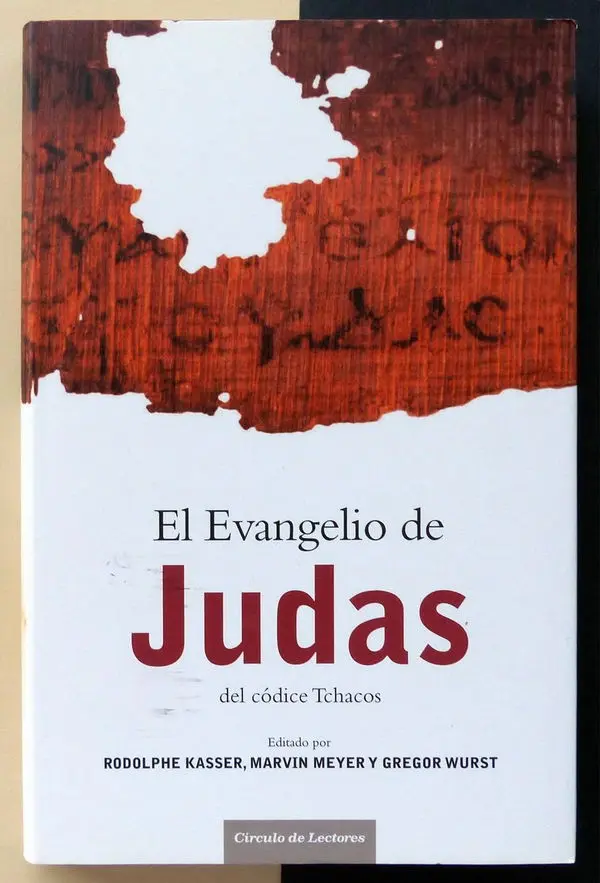
The Gospel of Judas from the Tchacos Codex
The Gospel of Judas, preserved in the Codex Tchacos, offers a surprising perspective on one of Christianity’s most controversial figures. Far from portraying Judas Iscariot solely as the disciple who betrayed Jesus, this ancient text proposes a different interpretation of his role within the divine plan.
Was he truly the betrayer of Christ, or a faithful disciple who accepted the burden of history’s scorn in order to fulfill Jesus’ redemptive mission?
Rescued from the sands of the Egyptian desert and restored after decades of deterioration, this manuscript was edited and translated from Coptic by an international team of specialists. Its publication has shed light on an apocryphal gospel that, beyond the controversy, constitutes a valuable source for understanding the diversity of beliefs in early Christianity.
This edition brings readers an exceptional historical document, inviting them to discover a different perspective on Judas Iscariot and the religious context in which this fascinating ancient text emerged.
What do historians say?
Today, there is broad academic consensus regarding the Gospel of Judas.
Researchers agree on several points:
- It is an authentic text from antiquity.
- It was written by a Gnostic community.
- It was not written by Judas Iscariot.
- It reflects a minority Christian tradition.
- It constitutes a historical source of great value for the study of early Christianity.
At the same time, scholars emphasize that the discovery of the Gospel of Judas does not require a rewriting of the history of Jesus nor does it alter the content of the canonical gospels.
Its main significance lies in showing that, during the 2nd and 3rd centuries, different interpretations of the figure of Jesus and the role of his disciples coexisted.
It is precisely this diversity that makes the Gospel of Judas one of the most studied manuscripts of recent decades.

Historical Significance of the Gospel of Judas
Although the Gospel of Judas is not part of the New Testament, its discovery was one of the most significant events in the study of early Christianity.
Its main value lies not in altering the history of Jesus or Judas Iscariot, but in offering a window into the diversity of beliefs that coexisted during the first centuries of our era.
Far from there being a single interpretation of Jesus’ message, historians know that numerous Christian communities coexisted, each with very different ideas about salvation, the nature of Christ, and the role of his disciples.
In this context, the Gospel of Judas stands as an exceptional testimony to Gnostic thought.
Furthermore, its discovery has provided a better understanding of how Christianity evolved before the biblical canon was definitively established.
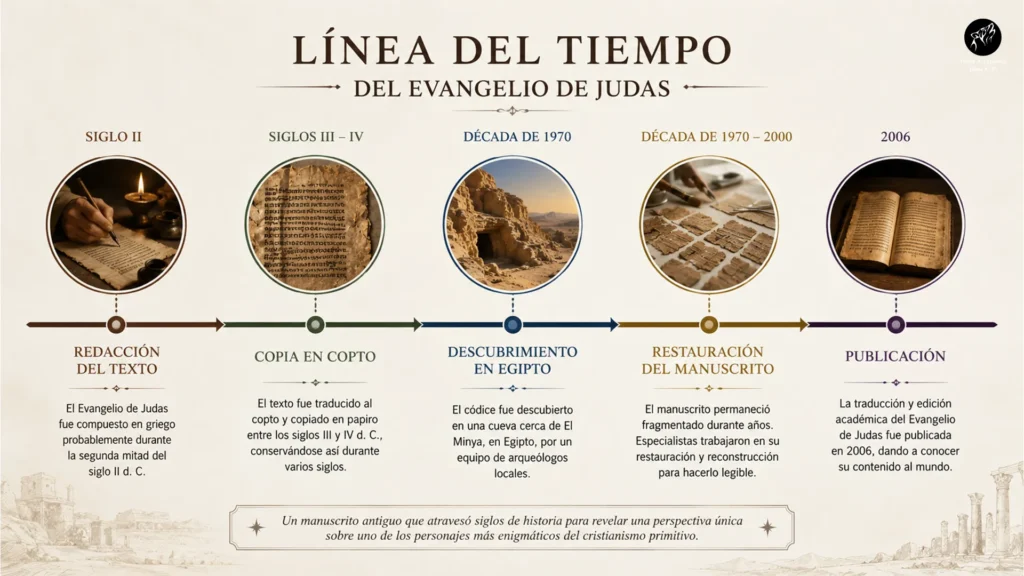
Chronology of the Gospel of Judas
Understanding the history of the manuscript is much easier if we look at the most important events in chronological order.
| Fecha | Acontecimiento |
| 150-180 d. C. | Se redacta el texto original en griego. |
| Siglos III-IV | Se copia y traduce al copto el manuscrito conservado. |
| Siglo II | Ireneo de Lyon menciona un «Evangelio de Judas» en Contra las herejías. |
| Década de 1970 | Descubrimiento del códice en Egipto. |
| 1980-2000 | El manuscrito permanece oculto y sufre un importante deterioro. |
| 2001-2006 | Restauración y traducción por un equipo internacional de especialistas. |
| Abril de 2006 | Publicación oficial del Evangelio de Judas. |
Myths and Realities About the Gospel of Judas
Since its publication, numerous claims have circulated that warrant clarification.
Myth 1: It proves that Judas was a hero
Reality: The Gospel of Judas presents this interpretation from a Gnostic perspective. However, there is no historical consensus confirming this view.
Myth 2: It completely changes the history of Christianity
Reality: The discovery expanded our knowledge of the different currents within early Christianity, but it did not alter the primary historical sources regarding the life of Jesus.
Myth 3: The Church concealed this gospel
Fact: The text was known to some Christian authors as early as the second century and was rejected because it represented a tradition distinct from the one that ultimately formed the biblical canon.
Myth 4: Judas personally wrote the gospel
Fact: Scholars agree that it was composed by a Gnostic community approximately one century after Judas’s death.
Myth 5: The Gospel of Judas contradicts the entire Bible
Fact: It offers a different interpretation of certain events, but its purpose was to convey the theology of a specific community, not to replace the canonical Gospels.
What can we learn from the Gospel of Judas?
Beyond the controversies, this text offers interesting insights from a historical perspective.
It helps us understand:
- How different interpretations of Jesus emerged.
- The influence of Gnosticism on some Christian groups.
- The process by which the New Testament was formed.
- The importance of preserving ancient manuscripts.
- The cultural richness of early Christianity.
For this reason, it continues to be a subject of study at universities, research centers, and specialized seminaries.
Frequently Asked Questions About the Gospel of Judas
Is the Gospel of Judas part of the Bible?
No. It is considered an apocryphal gospel and was never included in the New Testament canon.
Who wrote the Gospel of Judas?
Its author is unknown. Scholars believe it was written by a Gnostic community around the middle of the second century.
Where was the manuscript found?
It was discovered in Egypt during the 1970s.
What language is it written in?
The surviving manuscript is written in Sahidic Coptic and likely translates an earlier Greek text.
What is the Codex Tchacos?
It is the name given to the codex containing the Gospel of Judas and other ancient writings.
Does the Gospel of Judas state that Judas obeyed Jesus?
Yes. That is the interpretation presented by the Gnostic text itself. However, this view does not represent the historical consensus or the doctrine of the major Christian churches.
Why is this manuscript so important?
Because it provides a better understanding of the diversity of beliefs that existed during the early centuries of Christianity.
Is it authentic?
Yes. Scientific analyses confirm the authenticity of the ancient manuscript.
Where can it be read?
Translations into Spanish and other languages have been published by specialized publishers and research centers.
Is the Gospel of Judas worth reading?
Yes, especially if it is approached as a historical document that helps us understand the development of early Christianity and the various religious movements of the time.

Conclusion
The Gospel of Judas is one of the most fascinating manuscripts discovered in recent decades. Although it does not alter the history of Christianity or replace the canonical gospels, it offers a unique perspective on the diversity of ideas that existed during the early centuries of this religion.
Its true value lies in showing how different groups interpreted the figure of Jesus, the role of Judas Iscariot, and the path to salvation. Thanks to its discovery, we now have a better understanding of the complex religious landscape of early Christianity and a clearer grasp of the process that led to the formation of the biblical canon.
If you’re interested in the history of Christianity, the apocryphal gospels, or major archaeological discoveries, the Gospel of Judas is essential reading for understanding one of the most fascinating periods in the history of religion.