
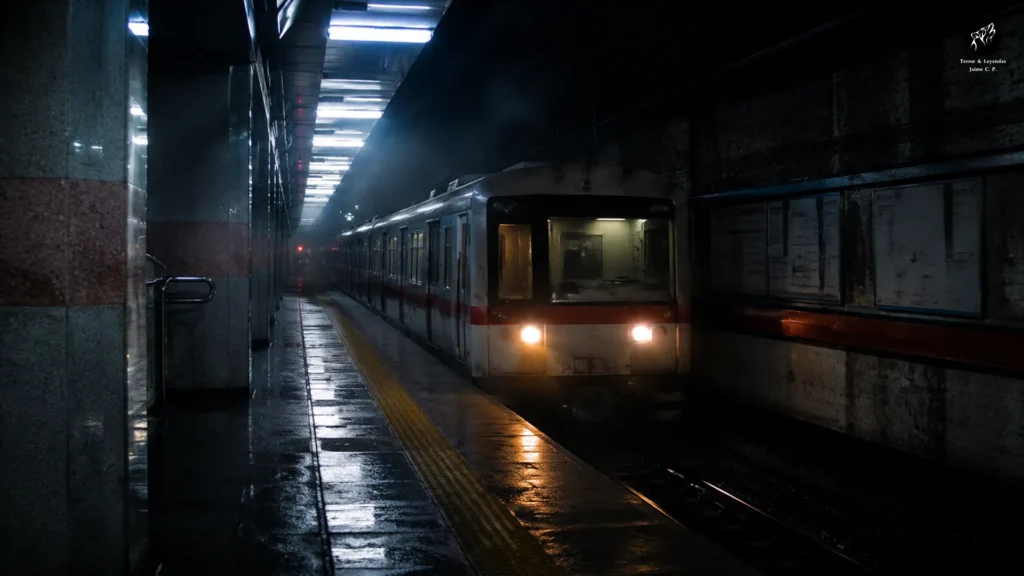

Would you dare to get on the last train of the night?
Every city has stories that its residents prefer to whisper. Some are about abandoned buildings. Others are about roads where impossible figures appear. In Beijing, one of the best-known urban legends takes place in a place where millions of people pass through every day: the subway.
The legend of the last train on the Beijing subway has been sparking the curiosity of commuters, mystery enthusiasts, and urban folklore researchers for decades. According to the story, during the last run of the night, some passengers dressed in ancient Chinese robes silently appear inside an almost empty car. Those unlucky enough to sit next to them disappear before the train reaches the next station.
The story has made the rounds on forums, in documentaries, on YouTube videos, and on websites specializing in paranormal phenomena. However, what makes this legend truly interesting is not just its plot, but the way it blends real places with elements from Chinese folk tradition.
Stations such as Pingguoyuan, the nearby Babaoshan Cemetery, and the enigmatic Fushouling Station actually exist and have helped fuel the myth for years.
But how did this story come about? Does it have any historical basis, or are we dealing with one of Asia’s most fascinating urban legends?
To answer those questions, we must first travel to the place where it all began.
The Beijing Metro: Much More Than Just a Mode of Transportation
When it opened in 1969, the Beijing Metro was a modest infrastructure project designed to connect various strategic points in the Chinese capital. Over the decades, it has grown into one of the world’s most extensive urban rail networks.
Today, it spans over 800 kilometers of track, has hundreds of stations, and transports millions of passengers every day. Its growth has kept pace with Beijing’s development, making it an integral part of the city.
However, not all of its stations share the same history.
While some stand out for their modern architecture or the volume of passengers they serve, others retain a much more enigmatic atmosphere.
And none has sparked as many stories as Pingguoyuan.
Pingguoyuan: The Station Where the Mystery Began
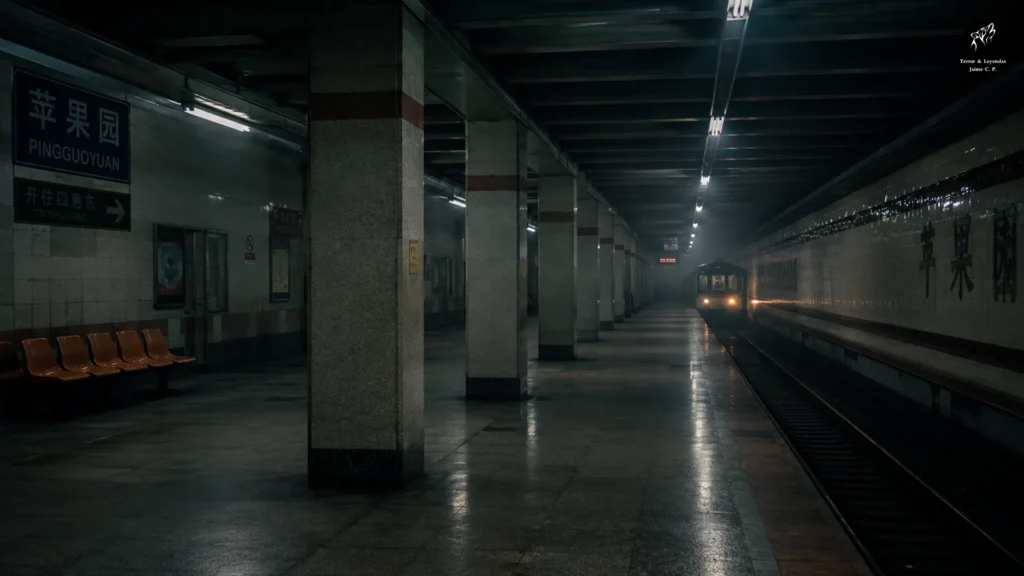
For many years, Pingguoyuan was the western terminus of Line 1, one of the oldest and most important lines on the Beijing Subway.
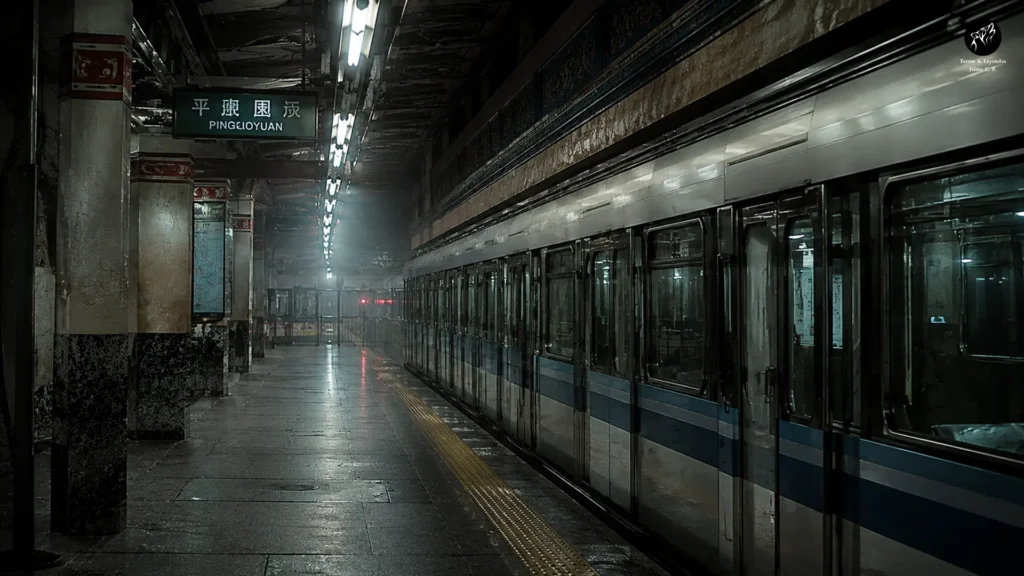
Opened in 1973, it remained virtually unchanged for decades. While other stations were renovated, Pingguoyuan retained its 1970s-era appearance.
The lighting was dim.
The platforms were spacious and quiet during the late hours of service.
Until its renovation, it was even one of the few stations on Line 1 that still lacked platform screen doors.
That aged appearance caught the attention of writer and rail enthusiast David Feng, who described the station as a place that seemed frozen in time. In one of his articles, he notes that its dark and nearly deserted atmosphere at night helped create a feeling that is hard to find at other subway stations in the capital.
It wasn’t long before rumors began to circulate.
Some passengers claimed to feel as if they were being watched while waiting for the last train.
Others claimed that the silence on the platforms was so absolute that even the slightest sound seemed to be amplified.
None of that proves that paranormal phenomena occurred.
But it does explain why Pingguoyuan ended up becoming the perfect setting for a legend.
The proximity of Babaoshan fueled the rumors
A few kilometers from Pingguoyuan lies one of Beijing’s best-known sites: the Babaoshan Revolutionary Cemetery.
This site is the final resting place of numerous prominent figures in modern Chinese history, including military leaders, politicians, and distinguished individuals.
The proximity of the station to the cemetery gave rise to a theory that began to circulate among some city residents.
According to this popular belief, the last train on Line 1 didn’t just carry passengers returning home after a long day.
It also carried the souls of those who no longer belonged to the world of the living.
Over time, that idea became more elaborate.
Some accounts claimed that the spirits used the subway to leave the cemetery at night.
Others claimed that the last train traveled along a route reserved exclusively for them.
Not a single piece of evidence ever emerged to support these claims.
Even so, the proximity of the two places was enough to keep the rumor growing.
Fushouling: The Station Almost No One Knew About
As if the story weren’t eerie enough, there’s another place that ended up reinforcing the myth.
Very close to Pingguoyuan lies Fushouling, a station built decades ago but which remained closed to the public for many years.
Its existence was little known even among many Beijing residents.
During that time, all sorts of speculation began to circulate.
Some claimed that trains were still stopping there in secret.
Others claimed that it was used only for official ceremonies related to the nearby Babaoshan Cemetery.
Although these stories were never confirmed, the mystery surrounding Fushouling eventually became part of the popular imagination.
When a station remains closed for years and there are hardly any photographs of its interior, the imagination finds fertile ground for creating new legends.
That is how Pingguoyuan, Babaoshan, and Fushouling came to be forever linked within the same story.
A legend that crossed China’s borders
For a long time, the story of the last train was passed down solely by word of mouth.
Later, it appeared on Chinese forums dedicated to mysteries.
With the advent of the Internet, it began to be translated into other languages.
Today, it’s possible to find dozens of different versions on blogs, videos, podcasts, and social media.
Each one adds new details.
In some, three passengers appear.
In others, there are four.
There are stories where the driver disappears.
Others claim that the train was found far beyond the end of the line.
However, they all share the same starting point.
It all begins when someone decides to board the last train on the Beijing Metro.
And it is precisely that story that has made this legend one of the most unsettling in Asia.
YOU MIGHT BE INTERESTED IN
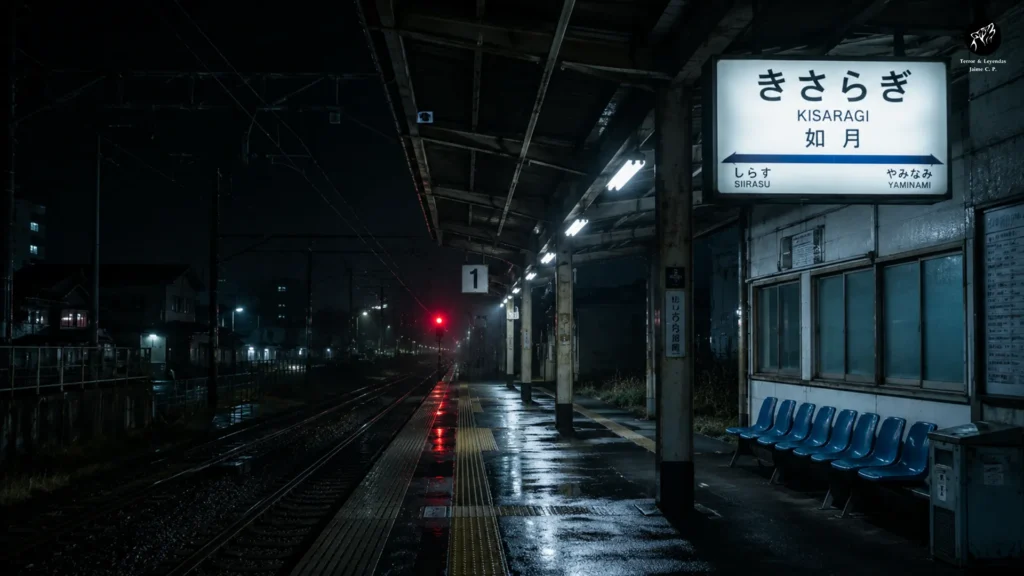
Kisaragi Station: The Unexplained Japanese Mystery
Japan is a country full of strange stories. Some stem from ancient traditions, while others emerge from much more modern sources, such as the internet. Among them, few have achieved the popularity ofKisaragi Station, an urban legend that began with a series of posts on a Japanese forum and, more than twenty years later, continues to spark debates, theories, and chills.
The Story of the Last Train: The Best-Known Version of the Legend
As with most urban legends, there is no single version of the story. Some details vary depending on who tells it or where it is heard. However, one version has become the most popular and is often repeated in books, forums, and collections dedicated to mystery.
It all begins on a night like any other.
A few minutes before midnight, a young man was running down the platform so he wouldn’t miss the last train on Line 1. The doors were about to close when he managed to get into the car.
He breathed a sigh of relief.
He thought he would be traveling practically alone.
When he looked up, he saw that there were only four other passengers.
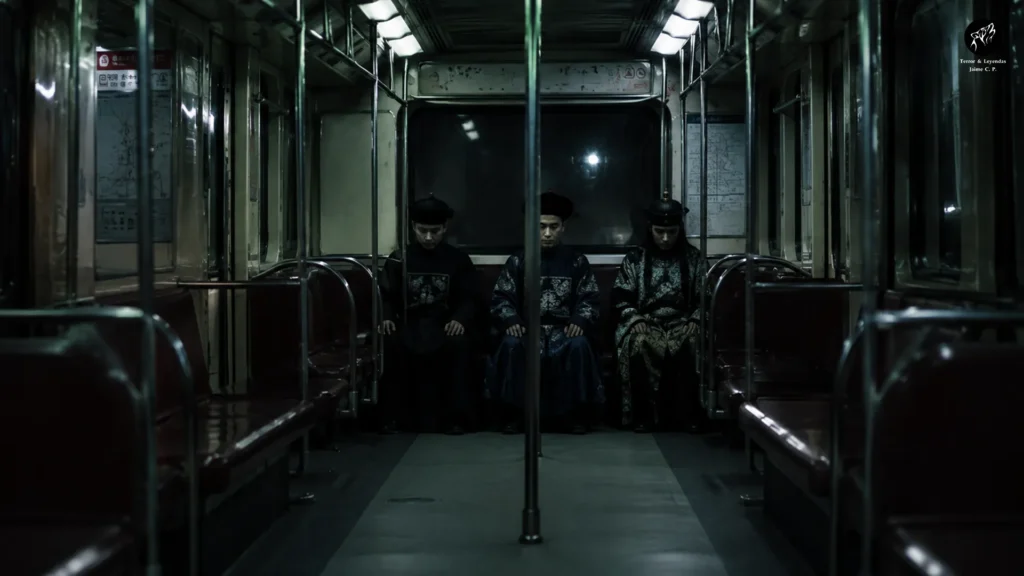
An elderly man was sitting by one of the windows, staring into space. At the back of the car were three people dressed in long, dark traditional robes.
The boy barely paid them any attention.
He assumed they might be returning from a theatrical performance or a traditional ceremony.
He sat down, and the train began to move.
For the first few minutes, everything proceeded as usual.
The train made its way through the tunnels as silence enveloped the car.
There was no conversation.
No cell phones rang.
All you could hear was the metallic clatter of the wheels on the tracks.
Then he began to notice something strange.
The three passengers in the back had remained in exactly the same position ever since he had boarded.
They didn’t exchange a word.
They didn’t turn their heads.
They didn’t even seem to be breathing.
He tried to convince himself that it was all just a result of exhaustion.
It had been a long day.
However, every time he looked at them, he felt a chill that was hard to explain.
Meanwhile, the old man seemed to be watching them with growing unease.
His expression had changed.
He was clutching the cane he held in his hands tightly and kept looking toward the back of the car.
The atmosphere began to feel uncomfortable.
That’s when something completely unexpected happened.
The old man stood up from his seat and pointed directly at the young man.
“You stole my wallet!” he shouted in a firm voice.
Surprised, the boy denied the accusation.
He tried to explain himself, but the old man kept insisting over and over again.
The argument caught the attention of the other passengers.
When the train arrived at the next station, they both got off onto the platform while continuing to argue.
The doors closed.
The train disappeared into the darkness of the tunnel.
For a few seconds, no one said a word.
The old man took a deep breath.
Then he looked at the young man and smiled with relief.
“Forgive me,” he said at last. “You never stole my wallet.”
The boy, still confused, took a few moments to react.
“Then… why did you do all this?”
The old man was silent for a moment before answering.
—Because I wanted to save you.
The young man frowned.
He didn’t understand a thing.
Then the old man pointed toward the tunnel where the train had just disappeared.
“Didn’t you notice those three people?”
The boy said he had.
“And didn’t you notice anything strange?”
The young man shook his head.
It was then that the old man confessed what, according to him, he had seen from the moment those figures boarded the train car.
He insisted that they weren’t walking.
They moved without barely moving their feet, as if they were floating above the ground.
He also stated that none of them cast a shadow in the light of the train car and that their faces remained completely motionless, without the slightest sign of life.
What unsettled him most was another detail.
When the train passed through a lit section of the tunnel, he thought he saw that the sleeves of their robes were concealing something.
He couldn’t make out any legs.
Just an empty space beneath the clothing.
The young man felt a chill run down his spine.
He then remembered that, throughout the entire trip, those people had never changed their posture.
Not even once.
The old man spoke again.
“I’ve been using this line for many years. I’ve never seen anything like this.”
The Unnerving Conclusion
The next morning, according to legend, several Beijing Metro employees noticed that the last train had never returned to the depot.
Communication with the driver had been lost hours earlier.
A search was launched along the line.
Finally, the train was located several kilometers beyond the end of its usual route, on a section of track where it should never have gone.
The doors remained open.
Inside, there was complete silence.
Accounts differ from this point on.
Some accounts claim that they found only the driver and a subway employee, both dead and with no apparent signs of violence.
Other accounts maintain that the car was completely empty.
There are even those who claim that no train ever turned up and that the whole story was made up by the subway workers themselves.
It is precisely this lack of a definitive account that is one of the reasons why the legend lives on.
Each person adds a new detail.
Each generation changes the ending.
And each storyteller decides how much mystery to leave in the story.
A legend that never stops changing
Over the years, numerous variations of the story have emerged.
In some versions, the passengers do not wear traditional robes, but rather old uniforms from the Qing Dynasty.
In others, there are four figures instead of three.
There is also a version in which the young man never manages to get off the train and disappears forever.
Another version claims that security cameras recorded the train throughout the night, but that only the driver appeared in the footage.
There was no trace of the alleged passengers.
None of these accounts has been verified.
However, they all share one common element.
Fear does not stem from a monster or a violent apparition.
It stems from something far more unsettling: the possibility that an everyday journey might suddenly turn into an experience that is impossible to explain.
That simplicity has allowed the legend of the last train on the Beijing subway to survive for decades and continue to capture the imagination of thousands of people both inside and outside China.
How much of this story is true?
After reading the legend, it’s natural to wonder if there was a real event that inspired it.
The short answer is no.
To date, there is no official report, police investigation, or Beijing Subway record confirming the disappearance of a train or its passengers under circumstances similar to those described in the legend.
However, that doesn’t mean the story came out of nowhere.
As with many urban legends, the story blends real places, historical events, and popular beliefs to create a narrative that is hard to forget.
To understand why this story lives on, it is helpful to distinguish between documented facts and elements of folklore.
The Reality Behind the Legend
Although the story has been widely circulated as an alleged paranormal event, most of the locations mentioned in it actually exist.
For decades, Pingguoyuan was a different station
Until its renovation, Pingguoyuan was one of the oldest stations on Line 1.
Its appearance stood in contrast to the rest of the subway system.
While other stations incorporated modern lighting, security gates, and new finishes, Pingguoyuan retained much of its original 1970s design.
That vintage atmosphere caught the attention of many rail enthusiasts.
Writer David Feng, an expert on the history of the Beijing Subway, described the station as a place with a unique atmosphere, almost frozen in time. As he explains, it was easy to see why many passengers associated it with ghost stories.
In other words, the setting was real.
The mystery arose later.
Babaoshan: The Cemetery That Fueled the Myth
Another element that often appears in the legend is the Babaoshan Revolutionary Cemetery.
It is one of China’s most important cemeteries, where numerous political and military leaders and prominent figures are buried.
Its proximity to Line 1 led, over the years, to rumors of supposed “trains of the dead” passing through the city at night.
There are no historical records linking the Beijing Subway to such practices.
However, popular tradition eventually linked the two places within the same story.
The Mystery of Fushouling
Perhaps the most intriguing element of the entire story is Fushouling.
This station remained closed to the public for decades, sparking all kinds of speculation.
Access was restricted, and there were hardly any photographs of its interior.
For many Beijing residents, it was simply a ghost station.
This lack of information fueled rumors claiming that some trains still stopped there in the early morning hours.
Over time, Fushouling became the stuff of legend, although no evidence was ever found linking it to paranormal events.
The “Train of Souls” Theory
There is a particularly popular version of the story that claims the last train on Line 1 would reduce its service or adjust its schedule to allow spirits to travel from Babaoshan undisturbed.
There are even accounts claiming that Taoist monks participated in rituals to appease the souls during the construction and expansion of the subway.
These stories are part of urban folklore.
They do not appear in official documents or in the Beijing Subway’s historical archives.
Even so, they continue to be shared because they resonate with ancient Chinese beliefs about wandering spirits and respect for the dead.
Documented Facts vs. the Legend of the Last Beijing Subway Train
| Hechos documentados | Lo que dice la leyenda |
| Pingguoyuan fue durante décadas la terminal occidental de la Línea 1. | Allí aparece el último tren de las almas. |
| Babaoshan se encuentra cerca de esa zona del metro. | Los espíritus utilizan el último convoy para abandonar el cementerio. |
| Fushouling permaneció cerrada al público durante muchos años. | Era una estación utilizada únicamente por pasajeros fantasma. |
| Pingguoyuan tenía un aspecto antiguo y diferente al resto de la red. | Esa atmósfera permitía la aparición de fenómenos paranormales. |
| No existe ningún informe oficial sobre desapariciones relacionadas con el metro. | El gobierno ocultó el incidente para evitar el pánico. |
It is precisely this blend of reality and fiction that makes the story so compelling.
Why do we believe stories like this?
Urban legends often draw on everyday settings.
An abandoned forest can be unsettling.
But a subway car is even more so.
We’ve all ridden in one.
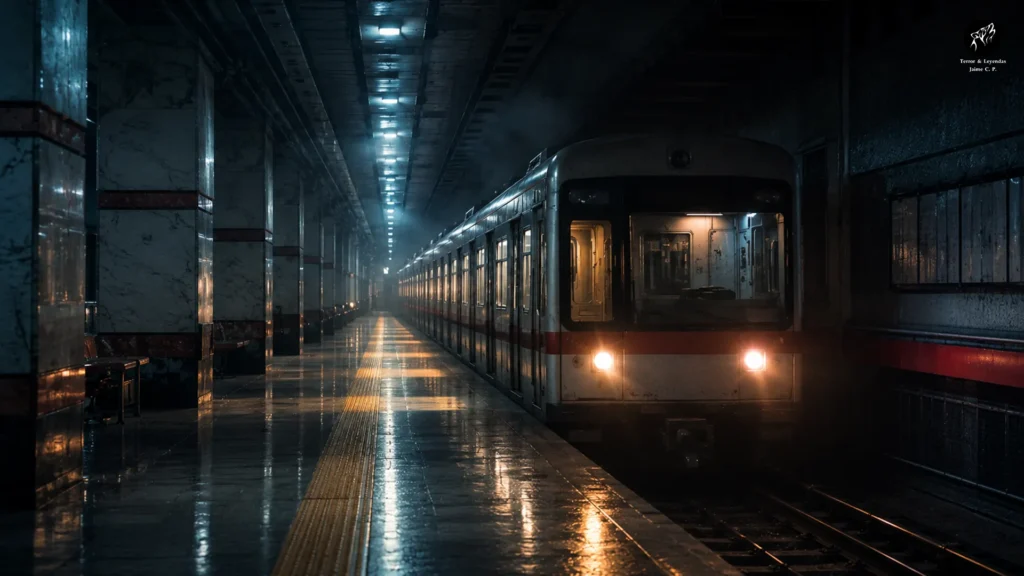
We all know what it feels like when the last train rolls by almost empty and silence takes over the platform.
Psychologists explain that, in situations like this, our brains pay much more attention to any stimulus that’s out of the ordinary.
A shadow.
A motionless person.
A passenger who doesn’t speak.
When we already know a mystery story associated with that place, we tend to interpret those details as confirmation of the legend.
This phenomenon is known as confirmation bias and helps explain why many people claim to have had unexplained experiences in places where paranormal stories already exist.
Interesting Facts About the Legend of the Last Train on the Beijing Subway
Over the years, numerous interesting facts related to this story have emerged.
- There is no official version of the legend; each storyteller adds their own twists.
- Some versions place the events on Line 1, while others never mention a specific line.
- The number of passengers varies depending on the account: three, four, or even five mysterious figures.
- In some stories, the train reappears days later; in others, it is never found again.
- Pingguoyuan ceased to be the western terminus of Line 1 following the network’s expansion, though it continues to be associated with the legend.
- The story has inspired videos, podcasts, novels, and discussions on mystery forums.
Frequently Asked Questions About the Legend of the Last Beijing Subway Train
Did the legend of the last Beijing subway train really happen?
There is no evidence to confirm the events. It is considered an urban legend.
Where did the story originate?
The exact origin is unknown, although many versions place the events at Pingguoyuan Station, and the story began to spread widely during the 1990s.
Is Pingguoyuan really near a cemetery?
Yes. The station is located relatively close to the Babaoshan Revolutionary Cemetery, a fact that contributed to the myth’s emergence.
Is Fushouling still closed?
For many years, it remained closed to the public, and this secluded nature fueled numerous speculations. Its history is part of what makes this area of the subway so intriguing.
Is there any official record of the alleged incident?
No. Neither the Beijing Subway nor the Chinese authorities have released any information supporting the disappearance of a train or its passengers under the circumstances described by the legend.
Myth or reality?
No evidence has ever been found to confirm that the events occurred as described in the legend. There are no official reports, Beijing Subway records, or verifiable testimonies to support the story. However, this lack of evidence has not prevented the story from continuing to be passed down from one generation to the next.
Perhaps that is the true power of urban legends. They don’t need to prove they happened to stay alive. All it takes is a combination of real places, a handful of rumors, and a good story to spark the imagination of those who hear them.
The legend of the last train on the Beijing subway continues to fascinate because it transforms an everyday commute into a setting where anything seems possible. Pingguoyuan, Babaoshan, and Fushouling exist and can be visited. The rest belongs to a story that has evolved over decades, adapting to each generation without losing its essence.
If you ever visit Beijing and decide to take the last train of the night, the trip will likely go by without a hitch. You’ll see workers heading home, students checking their phones, and tired commuters after a long day.
But perhaps, when the car is almost empty and silence takes over the ride, you’ll remember this story.
And, for a moment, you won’t be able to help but take a second look at the passengers sitting at the back.