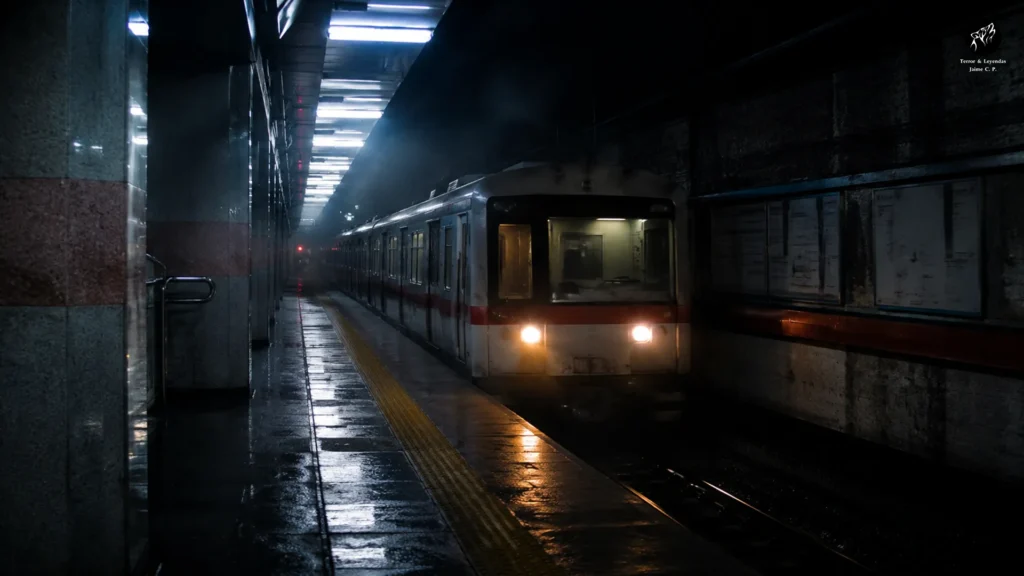

Would you dare to get on the last train of the night?
Every city has stories that its inhabitants prefer to tell in low voices. Some speak of abandoned buildings. Others, of roads where impossible figures appear. In Beijing, one of the best-known urban legends takes place where millions of people pass every day: the subway.
The legend of the last train of the Beijing metro It has been arousing the curiosity of travelers, mystery enthusiasts and researchers of urban folklore for decades. According to the story, during the last tour of the night some passengers dressed in ancient Chinese robes appear in silence inside an almost empty carriage. Those who are unlucky enough to sit next to them disappear before reaching the next station.
The story has gone through forums, documentaries, YouTube videos and pages specialized in paranormal phenomena. However, what makes this legend really interesting is not only its plot, but it mixes real places with elements of Chinese folk tradition.
Stations such as Pingguoyuan, the nearby Babaoshan Cemetery or the enigmatic station of Fushouling They really exist and have contributed to feeding the myth for years.
But how did this story come about? Does it have any historical basis or are we facing one of the most fascinating urban stories in Asia?
To answer those questions, you first have to travel to the place where it all began.
The Beijing Metro: much more than a means of transport
When it opened in 1969, the Beijing Metro was a modest infrastructure designed to connect different strategic points in the Chinese capital. Over the decades, it became one of the most extensive urban railway networks in the world.
Today it exceeds the 800 kilometers of tracks, has hundreds of stations and transports million passengers every day. Its growth has accompanied Beijing’s development to make it a fundamental part of the city.
However, not all of its stations have the same history.
While some stand out for their modern architecture or for the volume of travelers they receive, others retain a much more enigmatic air.
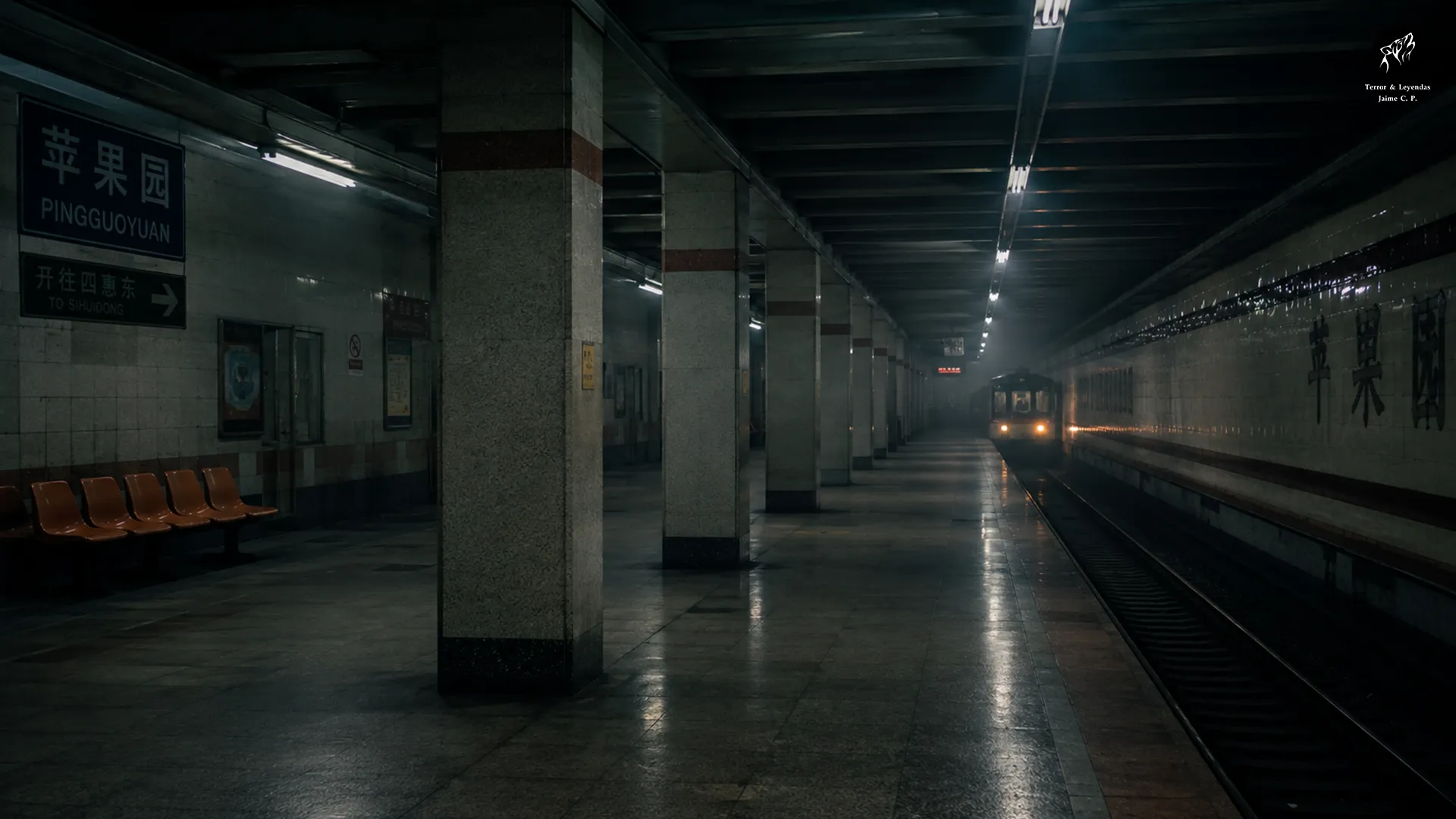
And none has sparked as many stories as Pingguoyuan.
Pingguoyuan: The Station Where the Mystery Was Born
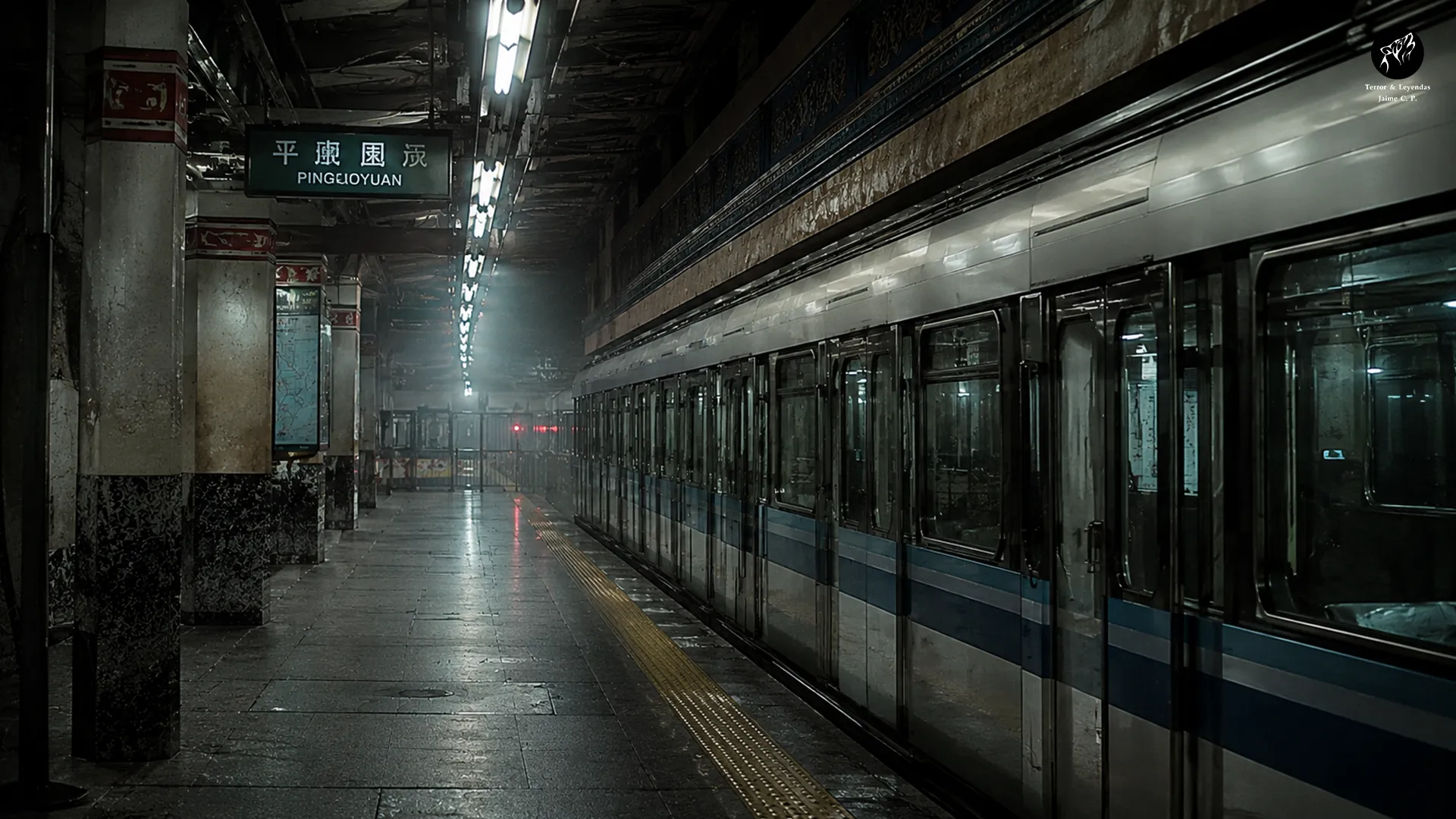
For many years, Pingguoyuan was the western terminus of Line 1, one of the oldest and most important lines of the Beijing Metro.
Opened in 1973, it remained virtually unchanged for decades. While other stations were renovated, Pingguoyuan retained a 1970s appearance.
The lighting was dim.
The platforms were wide and silent during the last hours of the service.
Until its remodeling, it was even one of the few stations on Line 1 that still lacked security gates next to the tracks.
That aged look caught the attention of the writer and rail transport enthusiast David Feng, who described the station as a place that seemed frozen in time. In one of his articles, he points out that its dark and almost deserted atmosphere at night contributed to creating a feeling difficult to find in other metro stations in the capital.
It didn’t take long for rumors to surface.
Some travelers said they felt watched when waiting for the last train.
Others claimed that the silence on the platforms was so absolute that any small sound seemed to be amplified.
None of this proves that paranormal phenomena occurred.
But it does explain why Pingguoyuan ended up becoming the perfect setting for a legend.
Babaoshan’s closeness fueled rumors
A few kilometers from Pingguoyuan is one of the most well-known places in Beijing: the Babaoshan Revolutionary Cemetery.
This enclosure houses the remains of numerous prominent figures in contemporary Chinese history, including military officers, politicians, and illustrious figures.
The proximity between the station and the cemetery gave rise to a theory that began to circulate among some inhabitants of the city.
According to that popular belief, the last train on Line 1 didn’t just transport passengers returning home after a long day.
He also carried with him the souls of those who no longer belonged to the world of the living.
With the passage of time, that idea was enriched.
Some versions claimed that the spirits used the subway to leave the cemetery during the night.
Others claimed that the last convoy was traveling a route reserved exclusively for them.
Not a single piece of evidence ever appeared to support these claims.
Even so, the proximity between the two places was enough for the rumor to continue to grow.
Fushouling: the station that almost no one knew about
As if the story wasn’t disturbing enough, there’s another place that ended up reinforcing the myth.
Very close to Pingguoyuan is Fushouling, a station built decades ago but which remained closed to the public for many years.
Its existence was little known even among many inhabitants of Beijing.
During that time, all kinds of speculations began to arise.
Some claimed that trains were still stopping there in secret.
Others claimed that it was only used during official ceremonies related to the nearby Babaoshan cemetery.
Although these stories were never confirmed, the mystery surrounding Fushouling ended up being integrated into the popular imagination.
When a station is closed for years and there are hardly any photographs of its interior, the imagination finds fertile ground to create new legends.
This is how Pingguoyuan, Babaoshan and Fushouling ended up united forever within the same story.
A legend that crossed China’s borders
For a long time, the story of the last train circulated only by word of mouth.
It later appeared on Chinese forums dedicated to mystery.
With the advent of the Internet, it began to be translated into other languages.
Today it is possible to find dozens of different versions in blogs, videos, podcasts and social networks.
Each one adds new details.
Some of them feature three passengers.
In others there are four.
There are stories where the driver disappears.
Others claim that the train was found well beyond the end of the line.
However, they all share the same starting point.
It all starts when someone decides to get on the last train of the Beijing Metro.
And it is precisely that story that has made this legend one of the most disturbing in Asia.
YOU MAY BE INTERESTED IN
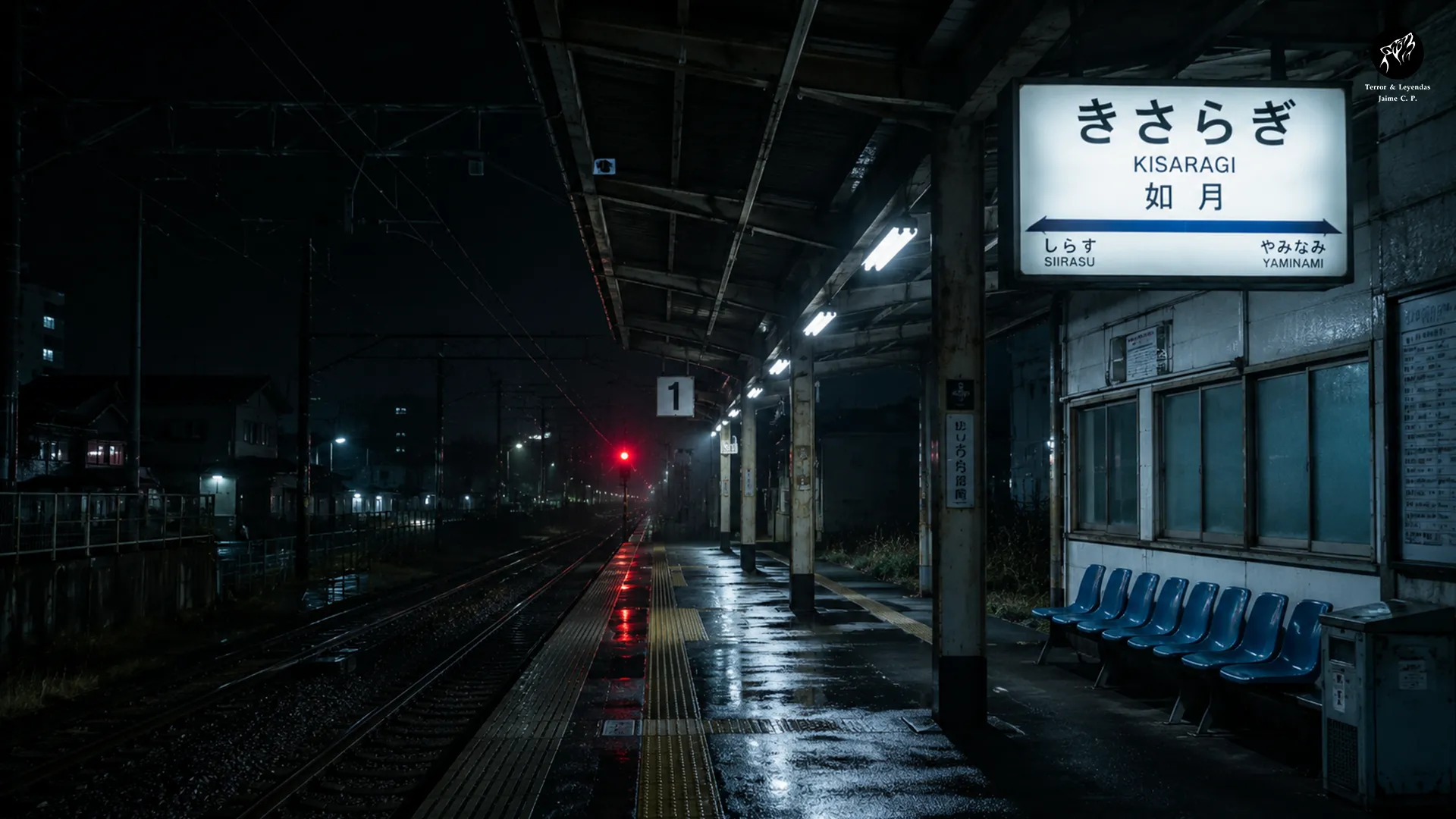
Kisaragi Station: The Unexplained Japanese Mystery
Japan is a country full of strange stories. Some are born from ancient traditions, while others emerge in much more modern places, such as the internet. Among all of them, few have reached the popularity of the Kisaragi Station, an urban legend that began with a series of messages posted on a Japanese forum and that, more than twenty years later, continues to generate debates, theories and chills.
The story of the last train: the best-known version of the legend
As with most urban legends, there is no single version of the story. Some details change depending on who is telling it or where it is heard. However, there is one narrative that has become the most popular and is often repeated in books, forums, and compilations dedicated to mystery.
It all starts on any given night.
A few minutes before midnight, a young man was running along the platform so as not to miss the last train on Line 1. The doors were about to close when he managed to get into the carriage.
He breathed a sigh of relief.
He thought he would travel practically alone.
When he looked up, he discovered that there were only four more passengers.
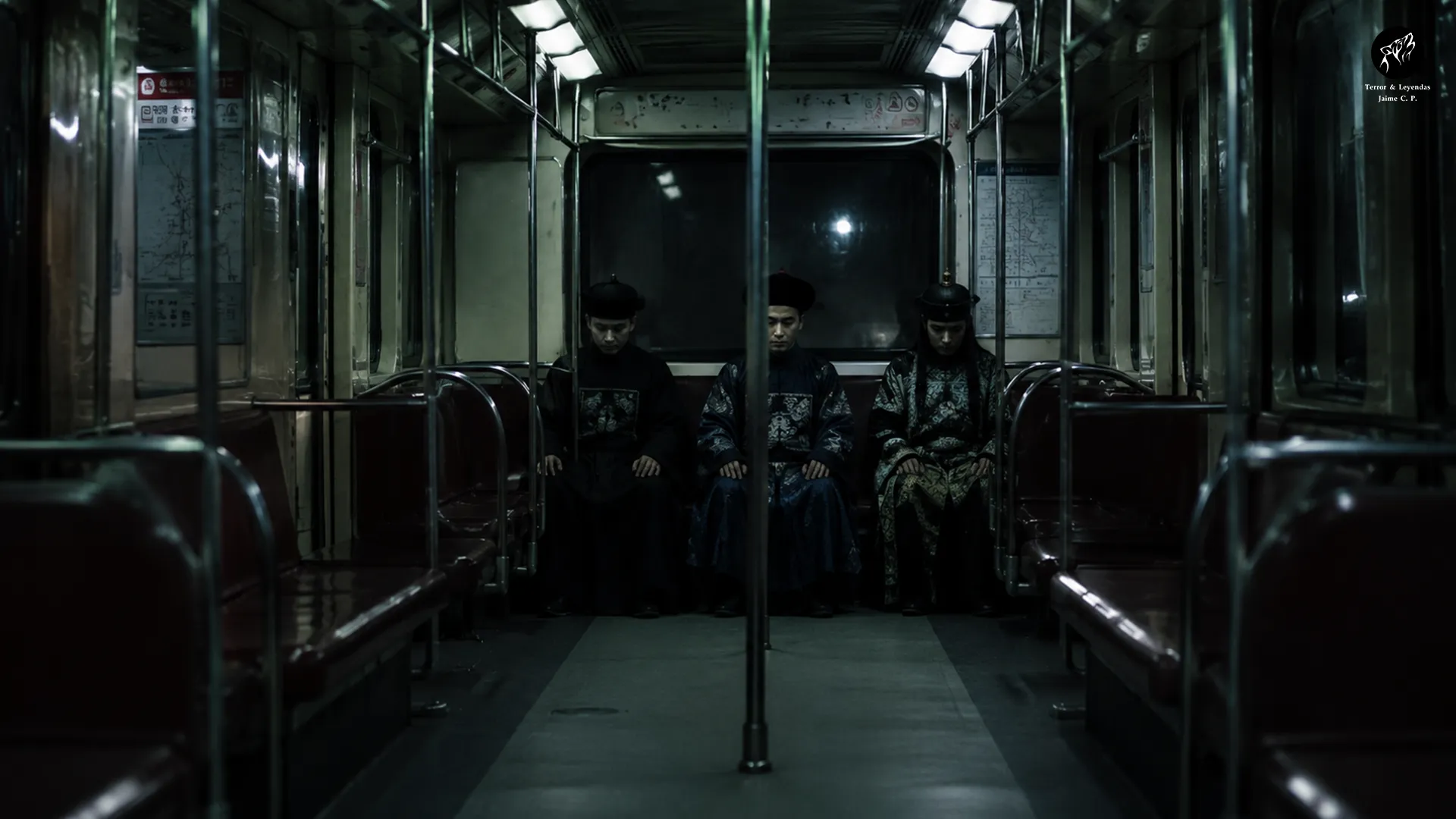
An old man sat by one of the windows, staring blankly. At the back of the carriage were three people dressed in long, traditional dark-colored robes.
The boy barely paid attention to them.
He assumed that they could return from a theatrical performance or a traditional ceremony.
He sat down and the train began to move.
During the first minutes, everything went on with absolute normality.
The convoy advanced through the tunnels while silence enveloped the car.
There were no conversations.
No cell phones rang.
Only the metallic rattle of the wheels on the rails could be heard.
Then he began to notice something strange.
The three passengers at the back remained in exactly the same position since he had boarded.
They did not exchange words.
They did not turn their heads.
They didn’t even seem to breathe.
He tried to convince himself that it was all the result of fatigue.
It had been a long day.
However, every time he looked at them he felt a chill that was hard to explain.
Meanwhile, the old man seemed to watch them with growing uneasiness.
His expression had changed.
He clenched tightly the cane he carried in his hands and kept looking towards the back of the car.
The atmosphere began to become uncomfortable.
That’s when something completely unexpected happened.
The old man got up from his seat and pointed directly at the young man.
“You stole my wallet!” he shouted in a firm voice.
Surprised, the boy denied the accusation.
He tried to explain himself, but the old man insisted again and again.
The argument caught the attention of the rest of the passengers.
When the train reached the next station, the two descended onto the platform while continuing to argue.
The doors closed.
The convoy disappeared into the darkness of the tunnel.
For a few seconds none of them said a word.
The old man took a deep breath.
Then he looked at the young man and smiled with relief.
“Forgive me,” he said finally. “You never stole my wallet.”
The boy, still confused, took a few moments to react.
“Then why did you do all this?”
The old man was silent before answering.
“Because I wanted to save you.
The young man frowned.
I didn’t understand anything.
Then the old man pointed to the tunnel through which the train had just disappeared.
“Didn’t you notice those three people?”
The boy answered yes.
“And you didn’t notice anything strange?”
The young man shook his head.
It was then that the old man confessed to him what he said he had seen from the moment those figures boarded the carriage.
He assured that they were not walking.
They moved without moving their feet at all, as if they were floating on the ground.
He also stated that none of them cast a shadow under the light of the carriage and that their faces remained completely motionless, without the slightest gesture of life.
What worried him most was another detail.
As the train passed a lighted area of the tunnel, he thought he saw that the sleeves of his robes were hiding something.
He could not distinguish legs.
Just an empty space under the clothes.
The young man felt a chill.
He remembered then that, during the entire trip, these people had never changed their position.
Not once.
The old man spoke again.
—I’ve been using this line for many years. I’ve never seen anything like it.
The disturbing outcome
The next morning, according to legend, several employees of the Beijing Metro detected that the last train had never returned to the depots.
Communications with the driver had been interrupted hours earlier.
A search was launched along the line.
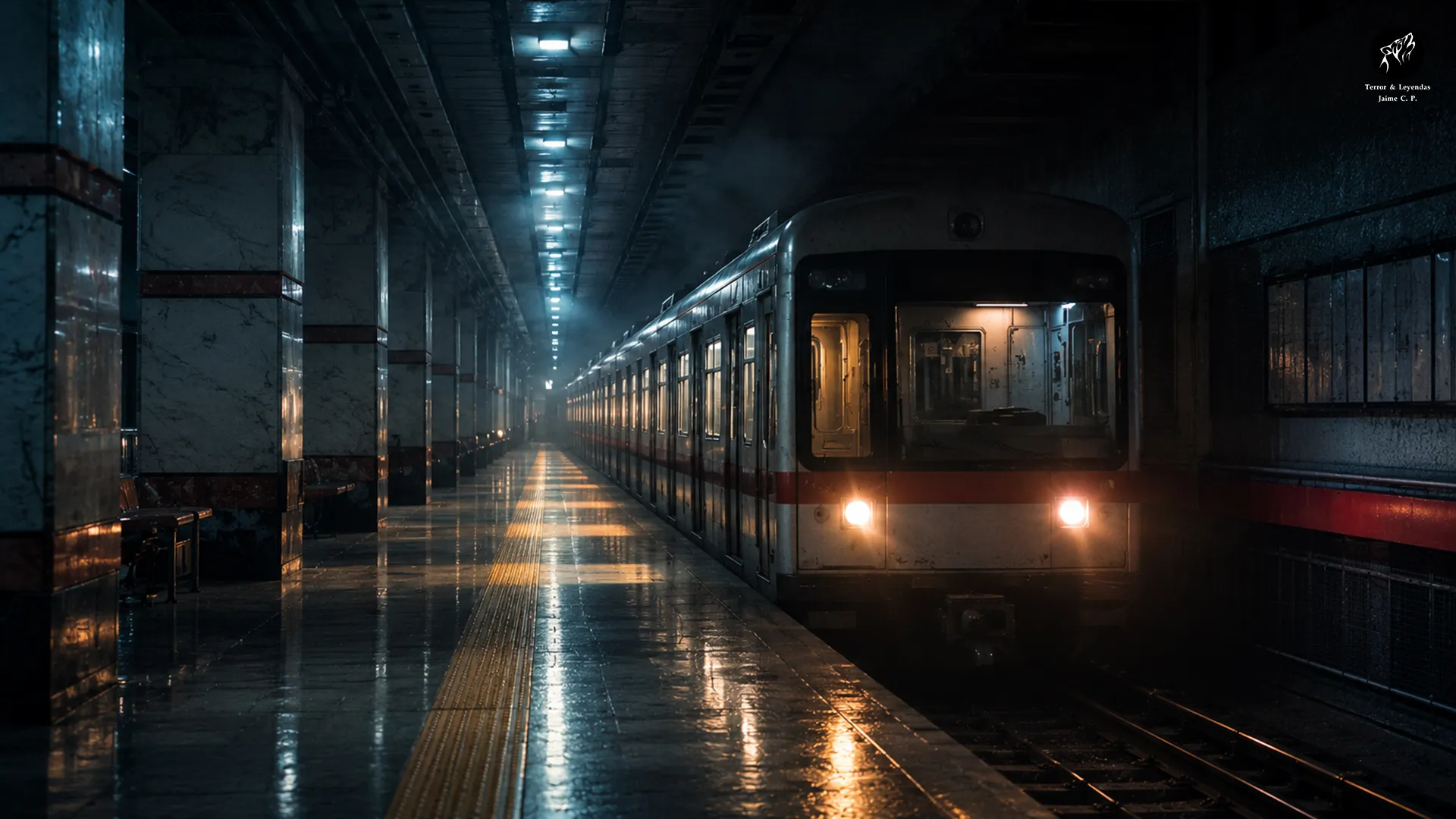
Finally, the convoy was located several kilometers beyond the end of the usual route, in a section where it should never have arrived.
The doors remained open.
Inside there was absolute silence.
The versions change from this point on.
Some accounts claim that they only found the driver and a subway employee, both lifeless and with no apparent signs of violence.
Other versions maintain that the car was completely empty.
There are even those who claim that no train ever appeared and that the whole story was invented by the underground workers themselves.
Precisely that lack of a definitive version is one of the reasons why the legend continues to live.
Each person adds a new detail.
Each generation modifies the ending.
And each narrator decides how much mystery they want to leave in the story.
A legend that never stops changing
Over the years, numerous variants of the story appeared.
In some, passengers are not wearing traditional robes, but rather old uniforms from the Qing Dynasty.
In others, there are four figures instead of three.
There is also a version in which the young man never manages to get off the train and disappears forever.
Another says that security cameras recorded the convoy throughout the night, but that only the driver appeared in the images.
There was no trace of the alleged passengers.
None of these versions have been verified.
However, they all share a common element.
Fear is not born of a monster or a violent apparition.
It arises from something much more disturbing: the possibility that an everyday journey suddenly becomes an experience that is impossible to explain.
This simplicity has allowed the legend of the last train of the Beijing metro survive for decades and continue to spark the imagination of thousands of people inside and outside China.
What is true in this story?
After reading the legend, it’s normal to wonder if there is any real event that inspired it.
The short answer is no.
To date, there is no official report, police investigation or record of the Beijing Metro that confirms the disappearance of a train or its passengers in circumstances similar to those described by the legend.
However, that doesn’t mean that the story came out of nowhere.
As with many urban legends, the story mixes real places, historical events and popular beliefs to build a narrative that is difficult to forget.
To understand why this story is still alive, it is useful to separate the documented facts from the elements of folklore.
The reality behind the legend
Although the story has been spread as a supposed paranormal event, most of the scenarios that appear in it actually exist.
Pingguoyuan was for decades a different station
Until its remodeling, Pingguoyuan it was one of the oldest stations on Line 1.
Its appearance contrasted with the rest of the metro.
While other stations incorporated modern lighting, security doors and new finishes, Pingguoyuan retained much of its original design from the 1970s.
That aging environment caught the attention of many rail transport enthusiasts.
The writer David Feng, who specializes in the history of the Beijing Metro, described the station as a place with a unique atmosphere, almost frozen in time. As he explains, it was easy to understand why many travelers associated it with ghost stories.
In other words, the scenario was real.
The mystery was born later.
Babaoshan: The Cemetery That Fueled the Myth
Another element that usually appears in the legend is the Babaoshan Revolutionary Cemetery.
It is one of the most important cemeteries in China, where numerous political and military leaders and prominent personalities rest.
Its proximity to Line 1 meant that, over the years, rumors arose about alleged “trains of the souls” that crossed the city during the night.
There are no historical documents linking the Beijing Metro to this type of practice.
However, popular tradition ended up uniting both places within the same story.
The Mystery of Fushouling
Perhaps the most intriguing element of the whole story is Fushouling.
This station remained closed to the public for decades, which caused all kinds of speculation.
Its access was restricted and there were hardly any photographs of its interior.
For many inhabitants of Beijing it was simply a ghost station.
This ignorance favored the appearance of rumors that assured that some trains continued to stop there during the early morning.
Over time, Fushouling became part of the legend, although no evidence was ever found linking her to paranormal events.
The theory of the “train of souls”
There is a particularly popular version that claims that the last train on Line 1 reduced its service or modified its schedules to allow spirits to travel from Babaoshan undisturbed.
There are even accounts that claim that Taoist monks would have participated in rituals to appease souls during the construction and expansion of the metro.
These stories are part of urban folklore.
They do not appear in official documents or in historical archives of the Beijing Metro.
Still, they continue to be shared because they connect with ancient Chinese beliefs about wandering spirits and respect for the deceased.
Documented facts vs. legend of the last train of the Beijing metro
| Documented facts | What the legend says |
| Pingguoyuan was for decades the western terminus of Line 1. | There appears the last train of souls. |
| Babaoshan is located near that area of the subway. | The spirits use the last convoy to leave the graveyard. |
| Fushouling remained closed to the public for many years. | It was a station used only by phantom passengers. |
| Pingguoyuan had an ancient look and different from the rest of the network. | That atmosphere allowed the appearance of paranormal phenomena. |
| There are no official reports of subway-related disappearances. | The government hid the incident to avoid panic. |
It is precisely this mixture of reality and fiction that makes the story so compelling.
Why do we believe stories like this?
Urban legends often take advantage of everyday scenarios.
An abandoned forest can be unsettling.
But a subway car is even more so.
We have all traveled in one.
We all know what it feels like when the last convoy circulates almost empty and silence takes over the platform.
Psychologists explain that, in situations like this, our brain pays much more attention to any unusual stimulus.
A shadow.
A motionless person.
A passenger who does not speak.
When we already know a mystery story related to that place, we tend to interpret those details as a confirmation of the legend.
This phenomenon is known as Confirmation bias and it helps explain why many people claim to have lived unexplained experiences in places where paranormal stories already exist.
Curiosities about the legend of the last train in the Beijing metro
Over the years, numerous curious facts have emerged related to this story.
- There is no official version of the legend; each narrator introduces changes.
- Some versions place the events on Line 1, while others never mention a specific line.
- The number of passengers changes depending on the story: three, four and even five mysterious figures.
- In some stories the train appears days later; in others, it is never found again.
- Pingguoyuan ceased to be the western terminus of Line 1 after the expansion of the network, although it continues to be associated with the legend.
- The story has inspired videos, podcasts, novels and debates in forums specialized in mysteries.
Frequently Asked Questions About legend of the last train of the Beijing metro
Did the legend of the last train in the Beijing subway really happen?
There is no evidence to confirm the facts. It is considered an urban legend.
Where did the story originate?
An exact origin is not known, although many versions place the events at Pingguoyuan Station and began to be widely disseminated during the 1990s.
Is Pingguoyuan really close to a cemetery?
Yes. The station is relatively close to the Babaoshan Revolutionary Cemetery, a fact that contributed to the birth of the myth.
Is Fushouling still closed?
For many years it remained closed to the public and this reserved nature fuelled numerous speculations. Its history is part of the interest aroused by this area of the metro.
Is there any official record of the alleged incident?
No. Neither the Beijing Metro nor the Chinese authorities have released information supporting the disappearance of a train or its passengers in the circumstances described by the legend.
Myth or reality?
No evidence has ever been found to confirm that the events occurred as the legend describes them. There are no official reports, Beijing Metro records, or verifiable testimonies to support the story. However, that lack of evidence has not stopped the story from being passed down from one generation to the next.
Perhaps that is the true strength of urban legends. They do not need to prove that they happened to stay alive. It is enough for them to combine real places, a handful of rumors and a good story to awaken the imagination of those who hear them.
The legend of the last train of the Beijing metro It continues to fascinate because it turns an everyday journey into a stage where anything seems possible. Pingguoyuan, Babaoshan and Fushouling exist and can be visited. The rest belong to a story that has evolved over decades, adapting to each generation without losing its essence.
If you ever visit Beijing and decide to take the last train of the night, the journey will probably go absolutely normally. You will see workers returning home, students checking their mobile phones and travellers tired after a long day.
But perhaps, when the carriage is almost empty and silence takes over the journey, you will remember this story.
And, for a moment, you can’t help but look twice at the passengers sitting in the background.