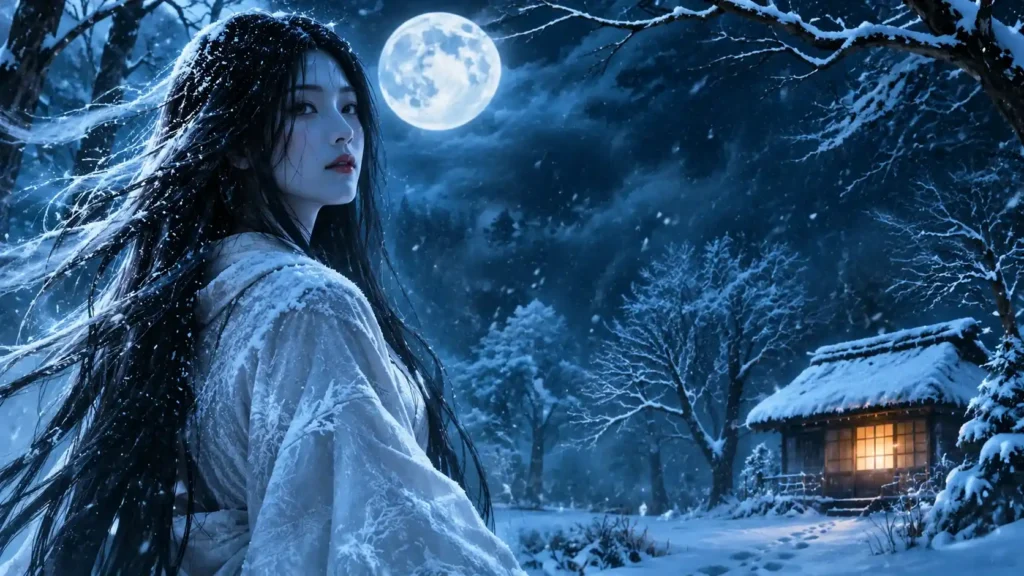

In Japan’s mountainous regions, winter storms can cover roads, isolate villages, and turn an everyday commute into a dangerous situation. Stories of presences appearing when night falls have emerged around these snowy landscapes. One of them is Yuki-Onna, known as the Snow Woman.
Its Japanese name, 雪女, is composed of two words: Yuki, which means snow, and Onna, which means woman. She is usually described as a female figure with very fair skin, dark hair and light clothing. In some accounts she has a breath capable of freezing her victims; in others, her appearance announces a danger that mountain dwellers have long known.
The legend does not have a single version. There are regional accounts in which Yuki-Onna is a mortal presence, while others present her as a spirit that causes no harm. One of the most well-known stories is that of Mosaku and Minokichi, two woodcutters who find a mysterious woman during a storm. Years later, one of them discovers that the apparition has remained much closer than he imagined.
Who is Yuki-Onna in Japanese folklore?
Yuki-Onna is a supernatural figure in Japanese folklore who is often included among the yōkai, a broad category of extraordinary beings and manifestations present in Japan’s traditional beliefs and stories.
She is not a character with a fixed history. Her appearance, behavior, and relationship with human beings change from region to region. In the most well-known narratives, she appears as a beautiful woman who walks through the snow and approaches travelers she encounters during storms.
In some stories, she causes death through her icy breath. In others, she appears accompanied by children or performs actions that do not pose a threat to people.
Therefore, describing it only as an evil spirit leaves out an important part of the tradition. Its name brings together different stories, united by its relationship with snow and winter landscapes.
Historical origin of the legend of Yuki-Onna
References to Yuki-Onna predate the literary compilations that made her known outside Japan. Her presence can be traced in texts from the Edo period, first as an expression related to poetry and later as a recognizable supernatural figure.
The first written references
One of the first datable appearances of the term Yuki-onna is located in Takatsukuba, a compilation of Haikai Poetry published in 1642. In this case, the expression appears within a poetic context. It is not yet a long story about a woman who attacks travelers during a storm.
The name appears again in other publications of the seventeenth century. This presence in literature allows us to follow the development of the expression before it acquired the characteristics with which it is usually identified today.
In 1685 it was published Sōgi Shokoku Monogatari, a work that contains a narrative set in Echigo, a territory that largely corresponds to the current prefecture of Niigata. It features a white woman of extraordinary stature, identified by one of the characters as a manifestation of the spirit of snow.
Although the work is attributed to Sōgi, it should be noted that it was published long after the life of that Japanese poet. Therefore, it is more accurate to speak of a seventeenth-century narrative that uses his figure, rather than a testimony written directly by him.
These documents show that the Snow Woman was already part of the literary and supernatural themes of Japan at that time.
Yuki-Onna in Japanese illustrations
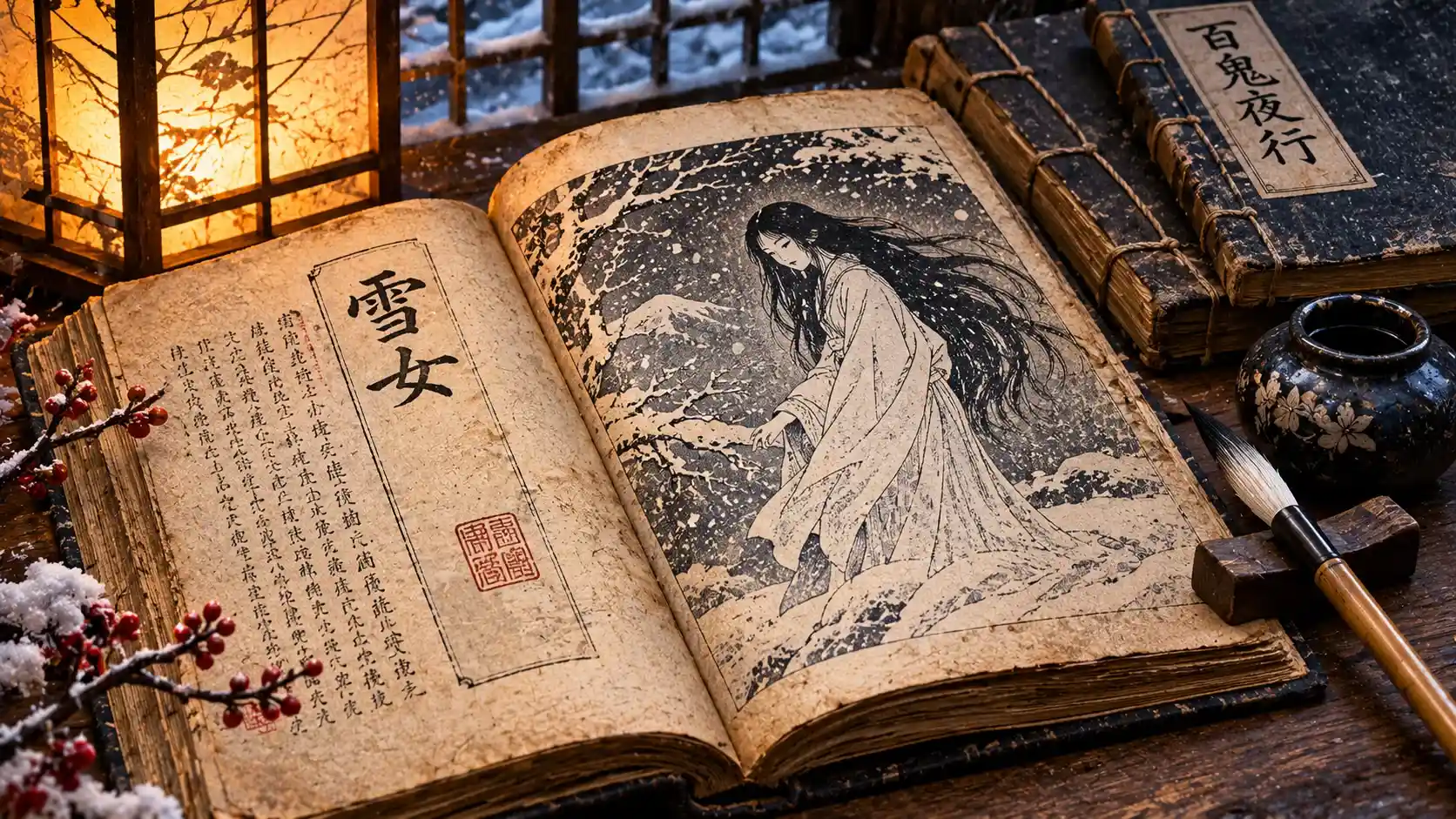
In 1737, Sawaki Suushi included Yuki-Onna in his illustrated work Hyakkai Zukan, dedicated to different supernatural creatures.
Another important record appeared in 1776, when Toriyama Sekien published Gazu Hyakki Yagyō. In this illustrated collection the snow woman also appears.
Sekien’s image presents her as a female figure related to the snowy landscape. Her importance lies in the fact that she incorporates her name into the visual repertoire of the yōkai of the period Edo.
The Enlightenment does not develop a biography or establish a list of powers. It is the later narratives that expanded its characteristics.
Lafcadio Hearn and the international spread of the legend
One of the stories that most influenced the modern image of Yuki-Onna was published by Lafcadio Hearn in 1904, within the book Kwaidan: Stories and Studies of Strange Things.
Hearn explained in the introduction that he had heard the story of a peasant from Chōfu, in Nishitama District, Musashi Province. According to him, the man told it to him as a legend of his place of origin. The writer also noted that he did not know if that narrative had previously been recorded in writing in Japanese.
This clarification is important for understanding the origin of the tale. Hearn did not claim to have created the legend or presented his version as the only extant account of the Snow Woman. He took a story that was passed down to him and turned it into a literary narrative.
Her work contributed to Yuki-Onna’s name reaching readers in other countries.
YOU MAY BE INTERESTED IN: Inunaki Village: The Truth About the Village Where There Is Supposedly No Law in Japan
Yuki-Onna’s Story: Mosaku, Minokichi, and the Snow Bride
The following narrative is based on Chapter XI, “Yuki-Onna, the Snow Lady”, by Myths and legends of Japan, published by Orion Editions, pages 200-204. It is presented with its own writing, respecting the characters and events of the version collected in that book.
The Snowstorm
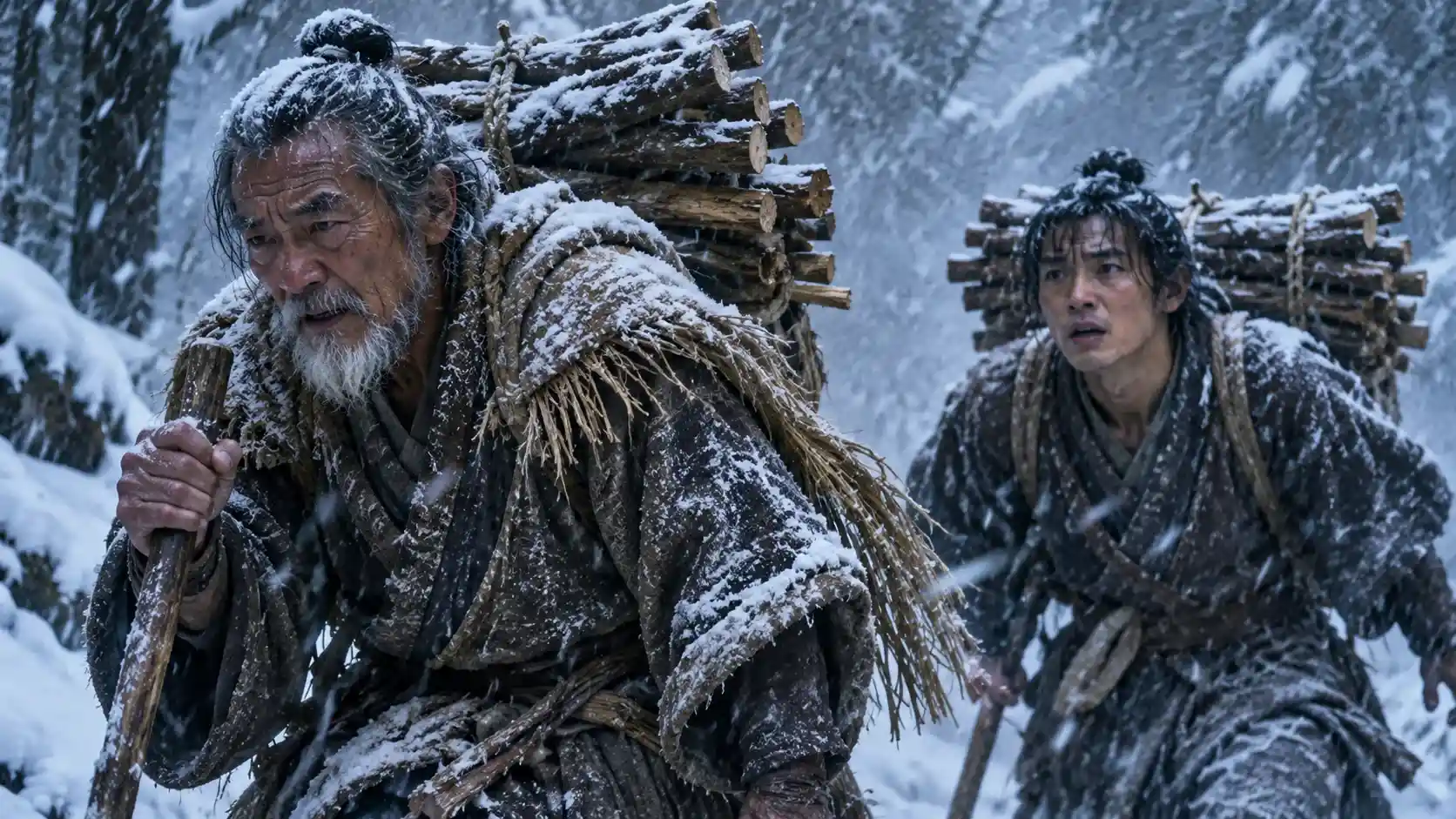
Mosaku he was an old woodcutter who worked accompanied by his apprentice, Minokichi. Both used to travel to a forest near their village.
One afternoon, while they were returning, they were surprised by a heavy snowstorm. When they reached the river they were to cross, they found that the boatman had left and left the boat on the other bank.
The storm was too intense to try to swim across the water. With no other alternative, they decided to seek refuge in the boatman’s small hut.
Mosaku lay down almost immediately and fell asleep. Minokichi, on the other hand, stayed awake for a long time. From inside he could hear the wind and the pounding of snow against the door.
The storm continued until the young man also ended up falling asleep.
The Woman Dressed in White
Minokichi woke up when she felt snow falling on her face. The door had opened, and inside the cabin was a woman dressed entirely in white.
The stranger was leaning over Mosaku. For a moment she lay motionless, then began to exhale a white, smoke-like breath.
After observing the old man for several minutes, he turned to Minokichi and approached him.
The young man tried to scream, but could not make a sound. The woman explained that she had thought of giving him the same fate as her partner. However, she decided to forgive him for his youth.
Before leaving, he imposed a condition on her: he must never tell anyone what he had seen. If he broke that promise, she would find him and end his life.
The woman disappeared shortly after, leaving Minokichi alone in the cabin.

The Death of Mosaku
When he managed to react, Minokichi called his teacher, but received no answer.
He came over and touched her body. It was completely frozen, like a block of ice.
Mosaku was dead.
The young man spent the rest of the night in the cold and fear. When the boatman returned, he found him next to the old man’s body. Minokichi survived, although it took him a long time to recover from that experience.
From then on he continued to work, but he never spoke of the woman he had seen. He remembered the threat and knew that revealing what had happened could cost him his life.
The meeting with Yuki
During the following winter, Minokichi was returning home when he encountered a young woman named Yuki.
She told him that she was heading to Edo, where she hoped to find work as a maid. Minokichi was impressed by her beauty and continued to converse with her along the way.
When he asked her if she was engaged and received a negative answer, he invited her to his house.
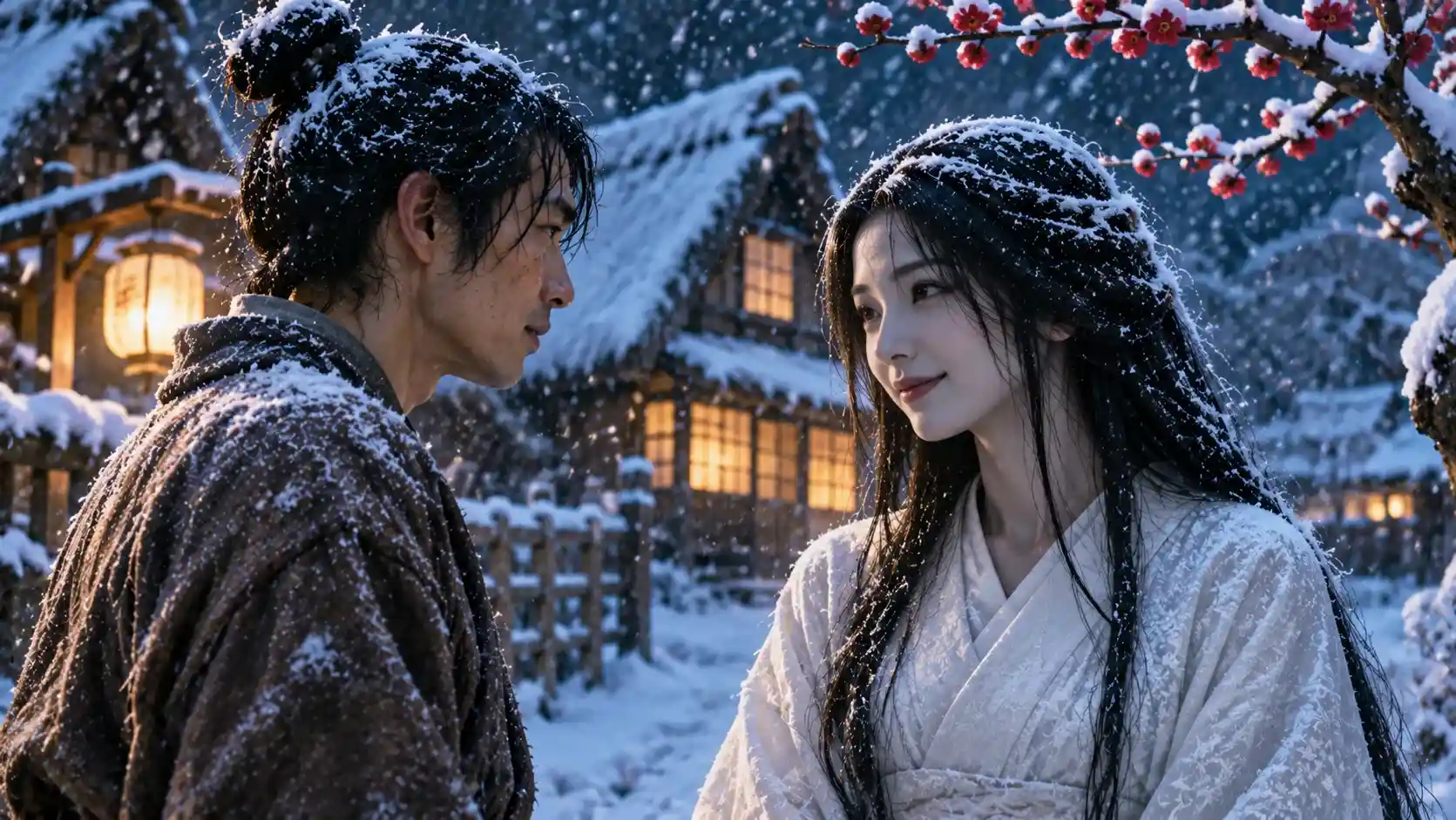
Yuki was welcomed by the family. Eventually, Minokichi married her, and the two began a life together.
The young lady turned out to be a good wife and a cherished daughter-in-law. When Minokichi’s mother died, her last words were of praise towards Yuki. The neighbors also spoke well of her.
The couple had ten children, described in the account as beautiful children with lighter skin than average.
Over the years, Yuki still retained the same youthful appearance she had when she arrived in the village.
The secret comes to light
One night, while Yuki was sewing by the light of a paper lamp, Minokichi watched her and remembered the encounter she had had in the boatman’s hut.
His wife seemed to him remarkably similar to the woman in white he had seen years ago.
Then he decided to tell him what happened.
He told him of the storm, the apparition, and the death of Mosaku. He also remembered the icy breath that had ended his master’s life.
Yuki stopped sewing. Her expression changed and she turned to him.
The woman revealed that she had been that apparition. She was the same one who had entered the hut and killed Mosaku.
Minokichi had broken his promise.
Yuki reproached him for having told what had happened and reminded him that he had warned of the consequences. In other circumstances, he would have killed him right then and there. However, the children who slept in the house changed their decision.
Before leaving, he warned her that she should take care of them. If the children ever had reason to complain about their father’s treatment, she would know. She also reminded him that he could return during a snowy night to carry out his old threat.
Afterwards, Yuki-Onna transformed into a white mist and disappeared through the hole intended for the smoke to escape.
Minokichi never saw her again.
A story that also appears in Kwaidan
The narrative of Mosaku, Minokichi, and Yuki corresponds closely to the short story “Yuki-Onna” by Lafcadio Hearn, published in Kwaidan in 1904.
Both versions share the main elements: the two woodcutters, the boatman’s hut, Mosaku’s death, the promise made to Minokichi, the marriage to a woman named Yuki, and the final revelation.
They also coincide in the number of children and in the transformation of women into a white mist.
The book in Spanish presents the story under the section “The Snow Bride”. Hearn, for his part, titled it simply “Yuki-Onna”. When consulting both works, the narrative relationship between their versions can be appreciated, although it is worth preserving the bibliographic reference of each one.
Other versions of Yuki-Onna in Japan
The story of Mosaku and Minokichi does not record all the traditions related to the snow woman. In different regions, there were stories in which her behavior changes considerably.
Tōno’s Yuki-Onna
In Tōno Monogatari, published in 1910 by folklorist Kunio Yanagita, another version of the Snow Woman appears.
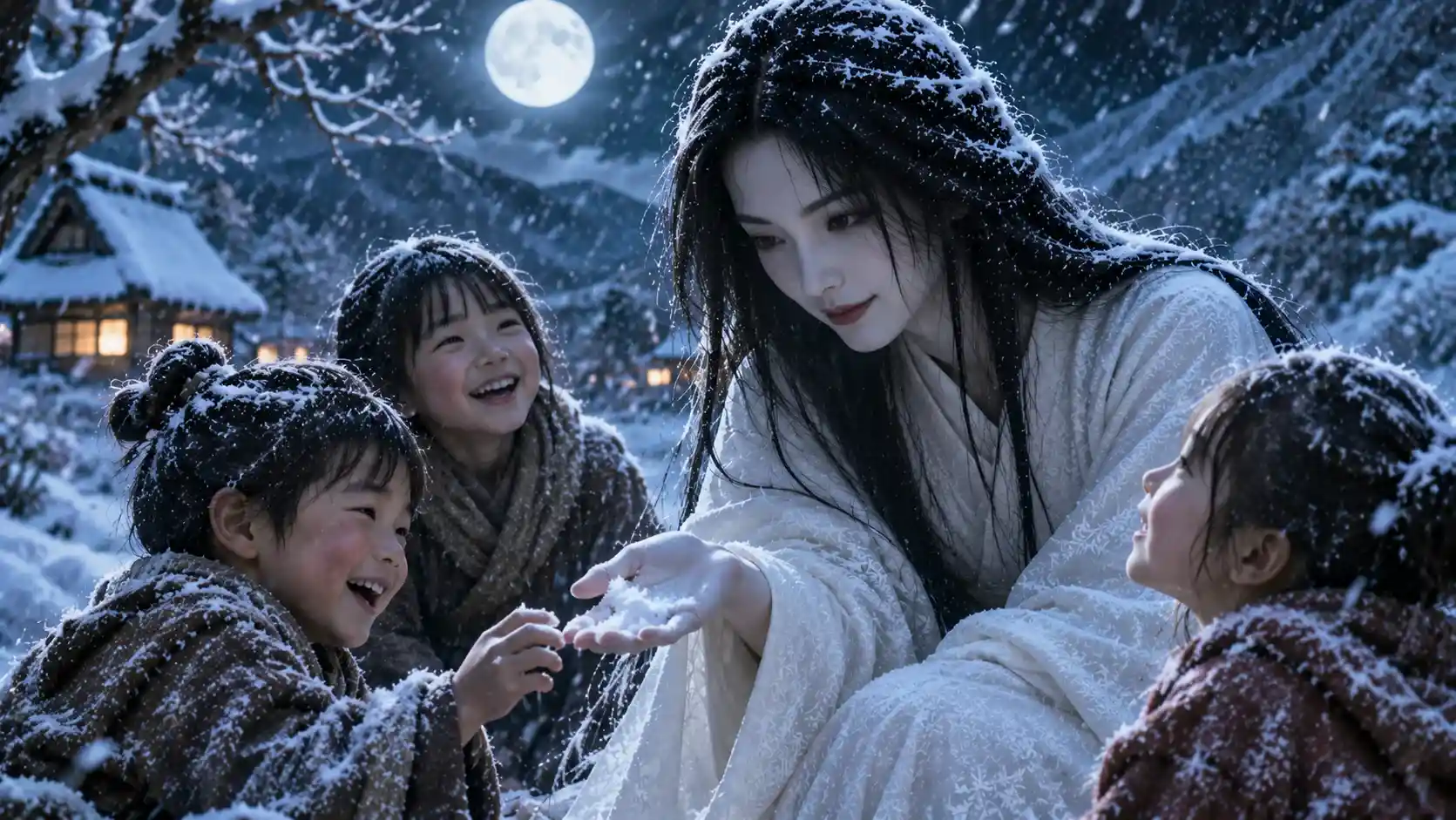
Story number 103 tells that Yuki-Onna goes out during the night of the Little New Year or on certain nights of the full moon in winter. She is described accompanied by numerous children who go out to play in the snowy hills.
Parents warned their children to return home early, for that night the woman of the snows might appear.
In this narrative, danger is not presented by a direct attack. The story functions as a warning related to the children who remained playing outside during winter nights.
A Snowwoman Helping Woodcutters
In Tateshina, Nagano Prefecture, a very different tradition was picked up.
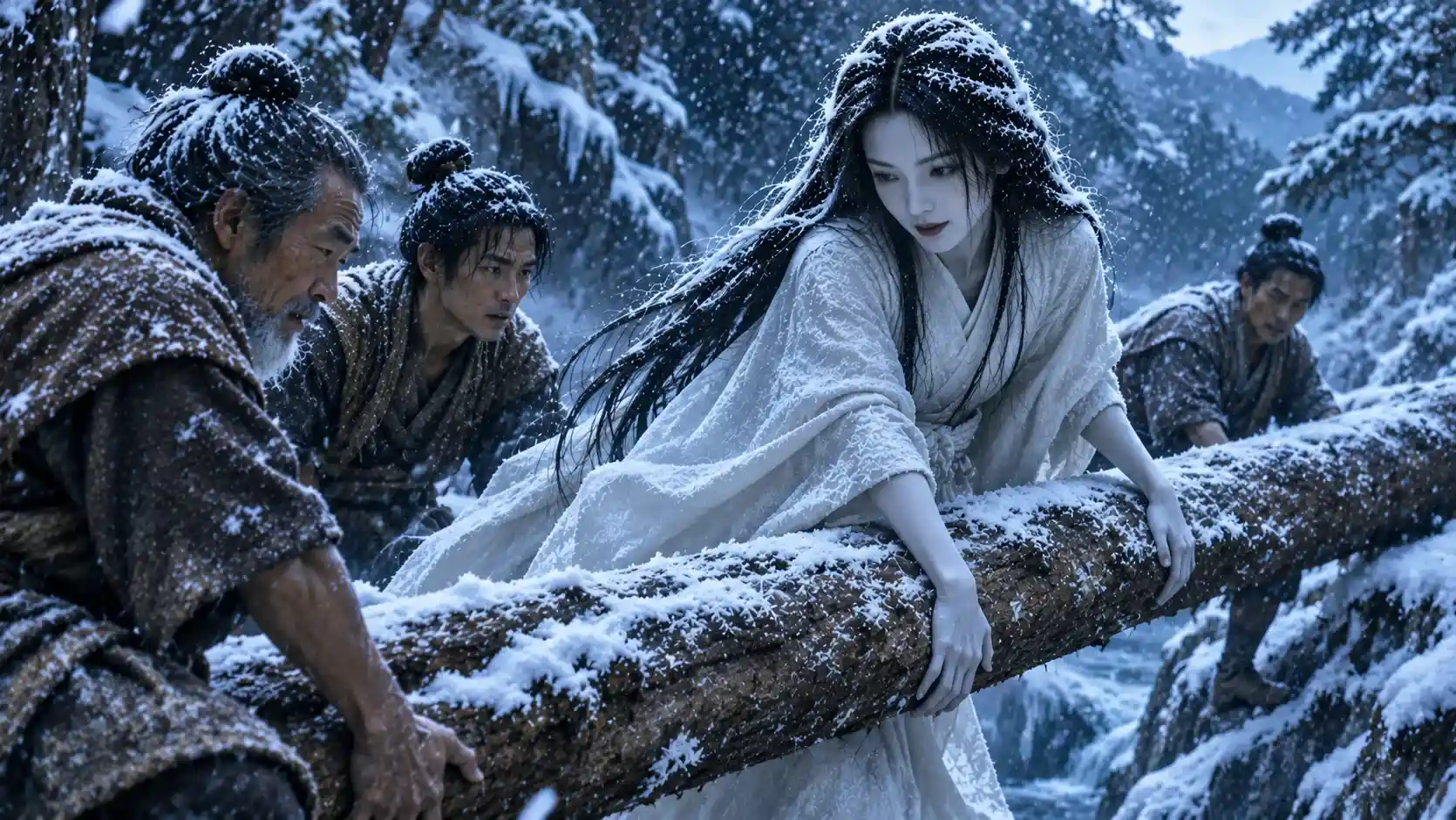
In a record published in 1931, the author Koichi Takahashi describes Yuki-Onna as a snow spirit who caused no harm. According to the account, when the woodcutters left a large tree after cutting it, the woman could place it overnight over a valley to form a bridge.
An old man who claimed to have seen her described her presence as a shadow that appeared and disappeared before his eyes.
This version contrasts with the woman who kills Mosaku and threatens Minokichi. In Tateshina, her presence was linked to an action that benefited the workers in the mountains.
Niigata’s Traces of Blood
In Niigata, a much more threatening version was recorded.
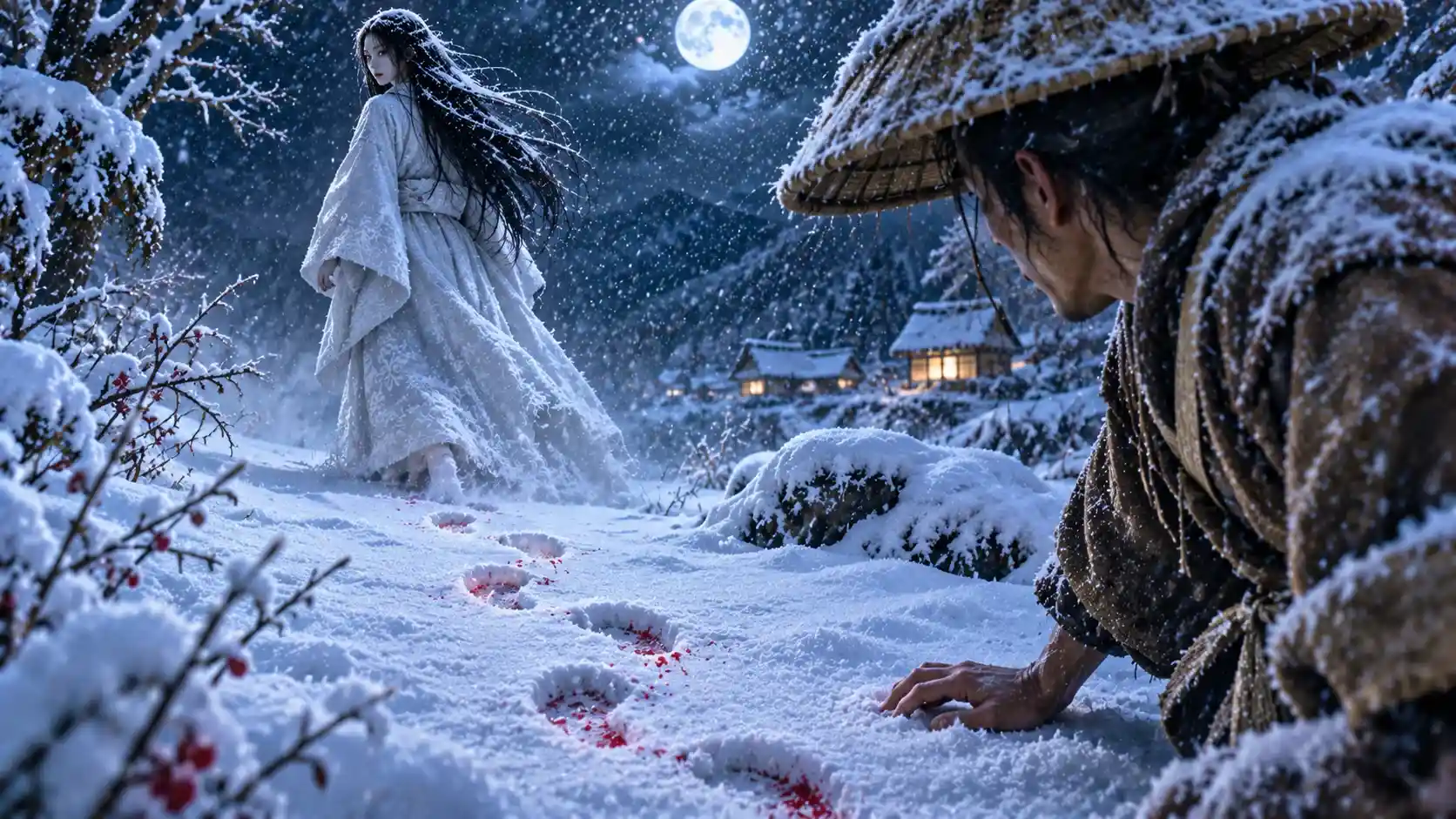
A text of local tradition published in 1939 recalls people who, during their childhood, heard warnings about a woman who appeared at midnight when it snowed.
It was said that her footprints were marked with small blood stains and that anyone who crossed paths with her ended up dying.
The record shows another way to depict Yuki-Onna. Rather than focusing on her beauty or her ability to adopt a human identity, the story focuses on the signs that heralded her arrival and the danger of finding her.
Appearance and characteristics of the snow woman
The most widespread image of Yuki-Onna is that of a woman with white skin, dark hair and light dress. However, the sources do not offer a single description.
In Mosaku and Minokichi’s account she appears as a beautiful woman, dressed in white, whose breath has the appearance of icy smoke. In the ancient narrative of Echigo, the female figure described is of extraordinary stature. Other regional versions mention featureless faces, silhouettes that blend in with snow, and apparitions that do not have a clearly defined human form.
Therefore, not all representations coincide in their appearance.
In Chapter XI of Myths and legends of Japan, the initial introduction also compares Yuki-Onna to a vampire. The text attributes to her icy lips capable of extracting the life blood of her victims.
This description corresponds to the approach taken by that exhibition. It should not be confused with a characteristic common to all Japanese tales. In the story of Mosaku and Minokichi, the deadly element is the woman’s icy breath.
What powers does Yuki-Onna have?
The abilities attributed to it depend on each narrative. Among the best known are:
- Icy Breath: in Mosaku and Minokichi’s account, his breathing causes the old man’s death.
- Appearance and disappearance: It can show up during storms and leave without a trace.
- Fog Transformation: At the end of the story of Snow’s bride, she disappears into a white cloud.
- Human appearance: In some versions he can live among people without revealing his identity.
- Relationship with snow: Its presence is linked to snowfall, mountain roads and winter nights.
There is no list of abilities that can be applied to all versions of Yuki-Onna. Some of these abilities belong to specific stories, while others come from later representations.
Yuki-Onna in Film and Popular Culture
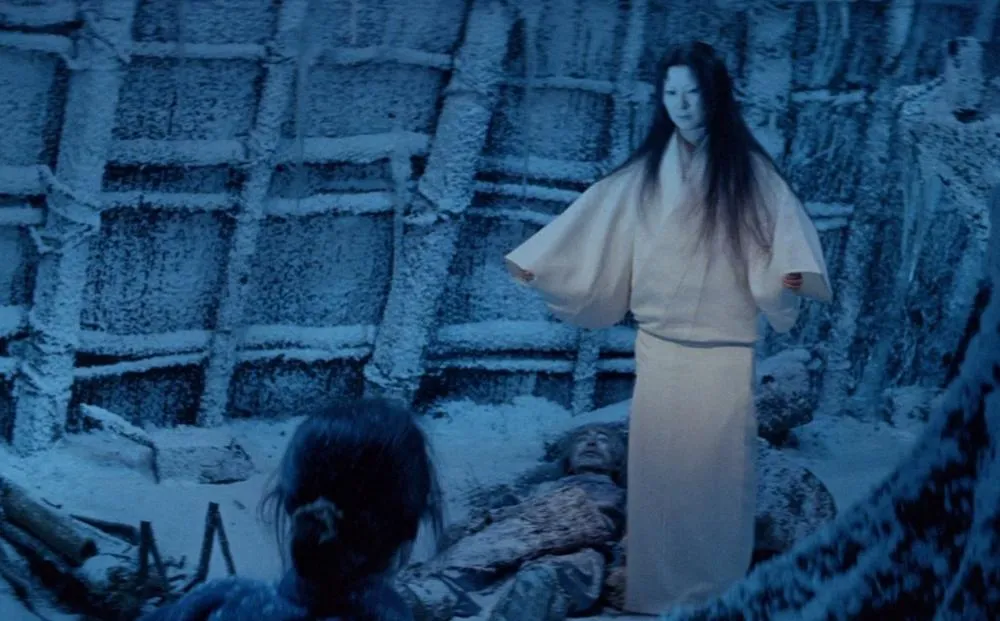
The Snow Woman has also made its way into Japanese cinema. One of the best-known adaptations appears in Kwaidan, film directed by Masaki Kobayashi, which brings together four supernatural stories based on stories by Lafcadio Hearn.
The production includes Yuki-Onna’s episode and retains the central elements of the story: the storm, the appearance of the woman dressed in white and the encounter with Minokichi.
The film helped to establish a recognizable image of the character for international audiences.
Subsequently, Yuki-Onna has also appeared in manga, anime, and video games. In these works, she is often depicted as a woman related to ice and supernatural powers. However, each adaptation can modify its story and characteristics, so not all of them should be taken as faithful representations of ancient traditions.
YOU MAY BE INTERESTED IN: Urban Legends: Japan (Spanish Edition)
Frequently Asked Questions about Yuki-Onna
What does Yuki-Onna mean in Japanese?
Yuki-Onna (雪女) means “snow woman” or “snow woman”. The name is used to identify a supernatural figure related to the snowy landscapes of Japan.
Is Yuki-Onna a ghost or a yōkai?
It is usually classified as yōkai, a broad category of supernatural beings in Japanese folklore. Some versions also describe it as a spirit related to snow.
What is the origin of the legend of Yuki-Onna?
The name appears in Japanese texts of the seventeenth century. One of the earliest datable references is found in Takatsukuba (1642), while Sōgi Shokoku Monogatari (1685) contains a narrative about a woman identified with the spirit of the snow.
How does Yuki-Onna kill her victims?
In Mosaku and Minokichi’s version, he uses his icy breath to kill the old man. Other traditions attribute different ways of causing harm to him.
Who were Mosaku and Minokichi?
They were two woodcutters seeking shelter in a boatman’s hut during a snowstorm. There they met Yuki-Onna. Mosaku died and Minokichi survived after promising to keep quiet.
How many children did Yuki and Minokichi have?
In the version of “The Snow Bride” they had ten children. The woman maintained her youthful appearance even after starting a family.
Does Yuki-Onna appear in other Japanese legends?
Yes. There are records from different regions, including Tōno, Tateshina, and Niigata. Some versions show her as a dangerous figure, while others do not attribute evil intentions to her.
Conclusion
Yuki-Onna occupies a particular place in Japanese folklore. Her name appears in texts from the Edo period, was represented by artists such as Toriyama Sekien and reached readers in other countries thanks to the compilations of Lafcadio Hearn.
The story of Mosaku, Minokichi, and Yuki It is one of the most well-known narratives, but it is not the only one. The stories of Tōno, Tateshina and Niigata show that the Snow Woman could take very different forms depending on where her story was told.
In some versions he was a presence that ended the lives of travelers. In others, he accompanied children or helped woodcutters.
Its legend continues to be linked to a landscape in which snow can hide paths, erase traces and completely change the appearance of things.
Did you know the story of Yuki-Onna? You can share your opinion in the comments and continue reading other Japanese legends in Terror and Legends.
Bibliography and documentary sources
Books and compilations
- Various authors. (2025). Myths and legends of Japan. Orion Editions. 548 pages. ISBN 978-607-14-4323-6. Chapter XI: “Yuki-Onna, the Lady of the Snows”, pp. 200-204. Consult the book.
- Hearn, Lafcadio. (1904). Kwaidan: Stories and Studies of Strange Things. Houghton, Mifflin and Company. Story “Yuki-Onna”. See the original text on Project Gutenberg.
- Yanagita, Kunio. (1910). Tōno Monogatari. Story number 103, dedicated to Yuki-Onna. A collection of traditional stories from the Tōno region.
- Sekien, Toriyama. (1776). Gazu Hyakki Yagyō. Illustrated work that includes a representation of Yuki-Onna.
- Suushi, Sawaki. (1737). Hyakkai Zukan. Illustrated scroll of Japanese supernatural creatures that includes the snow woman.
Folklore Studies and Records
- Kagawa, Masanobu. (2020). «鬼魅の名は―近世前期における妖怪の名づけ―». Nihon Minzokugaku, number 302, pp. 1-35. Study on the naming of supernatural beings in Japan at the beginning of the Modern Age. Consult in J-STAGE.
- Takahashi, Koichi. (1931). “Tateshina-yama Kikō”. Tabi to Densetsu, Volume 4, Number 7, pp. 73-74. Record of a regional tradition on the Yuki-Onna of Tateshina. Consult the database of the International Research Center for Japanese Studies.
- Nebukura Kichiyoshi. (1939). “Kyōdo no Densetsu (IV)”. Koshiji, volume 5, number 5, pp. 24-25. Record of a tradition about Yuki-Onna in Niigata. Consult the database of the International Research Center for Japanese Studies.
- YOKAI. JP. “Yuki-Onna: The Woman of the Snow, from the Haikai of Edo to Lafcadio Hearn”. Encyclopedia of Yōkai. Compilation and contrast of historical references, representations and regional variants. Consult research.
Film adaptation
- Kobayashi, Masaki. (1965). Kwaidan. Japanese film based on stories by Lafcadio Hearn. See film profile of The Criterion Collection.
Documentary note: the story of Mosaku, Minokichi, and Yuki is told according to the version on pages 200-204 of Myths and legends of Japan. Its correspondence with Lafcadio Hearn’s story is indicated as a literary relationship, without attributing to the anthology an editorial provenance that has not been proven. The regional references are presented separately, respecting the place and date of each record.