


What is the Gospel of Judas?
What if one of the most controversial figures in Christianity hadn’t been the traitor we all know?
That is the question posed by the Gospel of Jude, an ancient Christian text that offers a completely different interpretation of Judas Iscariot. While the New Testament gospels present him as the disciple who handed Jesus over for thirty pieces of silver, this writing claims that his actions were part of a much deeper plan.
Since the manuscript came to light in 2006, it has sparked enormous interest among historians, archaeologists, theologians, and curious readers. However, it has also generated numerous misunderstandings. Some people believe it completely changes the story of Jesus, while others consider it proof that Judas was never a traitor.
The reality is much more complex.
The Gospel of Jude it does not rewrite the history of Christianity nor replace the canonical gospels. It is an apocryphal gospel linked to Gnostic thought that reflects the beliefs of a Christian community of the 2nd century. Its value lies in showing the diversity of ideas that existed during the early centuries of Christianity and in helping us better understand the religious context of that era.
In this guide, you will discover what the Gospel of Jude is, who wrote it, what it really says about Judas Iscariot, why it is not part of the Bible, and its historical importance.
History of the Gospel of Judas
For centuries it was believed that this gospel had been lost forever.
Its existence was only known thanks to references from some ancient Christian writers, who mentioned a text used by certain Gnostic groups. However, no one knew where it was or if a copy still existed.
Everything changed at the end of the 20th century.
When was it written?
Although the preserved manuscript is later, most specialists consider that the original text was written approximately between the years 150 and 180 AD. C.
This means it was composed several decades after the four canonical gospels.
The document that has survived to this day is written in Sahidic Coptic, a variant of the Coptic language used in Egypt. Researchers believe it is a translation of a work originally written in Greek.
This dating is important because it places the Gospel of Jude in a time when numerous Christian currents coexisted with very different interpretations of the figure of Jesus.
The discovery of the Codex Tchacos
The manuscript was found in Egypt during the 1970s, probably near the town of El Minya.
After its discovery, it began a long journey through the antiques market. For years it remained stored in poor conditions and changed owners several times.
This situation caused severe deterioration of the papyrus.
Many pages were fragmented, others broken, and some were almost lost forever.
Finally, the codex was acquired by the Maecenas Foundation for Ancient Art, which promoted an ambitious restoration and translation project with the collaboration of international experts.
The manuscript was named Code of Tchacos, in honor of the antique dealer Frieda Nussberger-Tchacos.

The restoration of the manuscript
The recovery of the Gospel of Judas was a true precision work.
Specialists had to reconstruct hundreds of papyrus fragments, stabilize the material, and decipher a very deteriorated text.
In addition to restorers, linguists, historians, experts in papyrology, and specialists in ancient Christianity participated.
Tests carried out by carbon-14 dating and ink analysis confirmed that the manuscript was authentic and had been produced between the 3rd and 4th centuries.
After several years of work, the Gospel of Judas was officially presented to the world in April 2006.
The news made headlines in numerous international media and sparked enormous interest in learning about the content of this ancient gospel.
Who wrote the Gospel of Judas?
One of the most frequent questions is whether Judas Iscariot was really the author of the text.
The answer is no.
The title “Gospel of Judas” it does not indicate that Judas wrote the manuscript. As with many apocryphal gospels, the name was used to give authority to the account.
Historical studies agree that it was written by a Christian community linked to the Gnosticism, a religious movement that gained wide diffusion during the 2nd and 3rd centuries.
These groups maintained that Jesus had transmitted secret teachings reserved for a few disciples capable of understanding the true nature of the universe and of God.
From that perspective, Judas held a privileged place.
He was not the disciple who betrayed Jesus out of economic ambition, but the only one capable of understanding his spiritual mission.
This interpretation explains why the Gospel of Judas differs so much from the accounts included in the New Testament.
What does the Gospel of Jude really say?
The content of the Gospel of Jude is surprising because it completely reverses the traditional image of Judas Iscariot.
In the Gospels of Matthew, Mark, Luke, and John, Judas hands Jesus over to the religious authorities, an act that leads to his crucifixion.
However, the Gospel of Jude offers a different interpretation.
According to this text, Judas acts following a special revelation received from Jesus. It is important to point out that this is the unique view of the Gnostic writing and it does not represent the historical consensus nor the doctrine of the main Christian churches.
In the story, Jesus converses privately with Judas and shares teachings that remain hidden from the rest of the disciples.
While others interpret Jesus’ words literally, Judas understands the spiritual meaning of his mission.
As a consequence, Jesus’ surrender ceases to be understood as a betrayal and becomes a necessary action to fulfill the divine purpose described by the text itself.
This is the central idea that has made the Gospel of Jude one of the most debated documents of ancient Christianity.
But why is this interpretation so different from the one conveyed by the canonical gospels?
The answer lies in the religious current to which its author belonged: the Gnosticism, a movement that developed a completely different vision of Jesus, the material world, and salvation.

The Gospel of Judas and Gnosticism
To understand the Gospel of Jude It is essential to know the Gnosticism, a religious movement that had a great influence during the early centuries of Christianity.
The word “gnosis” means knowledge. However, it does not refer to intellectual knowledge, but to a spiritual revelation that, according to the Gnostics, allowed the human being to attain salvation.
Unlike traditional Christian doctrine, Gnosticism held that the material world was imperfect and that the true destiny of the human being was to return to the spiritual world.
In this context, Jesus did not come only to teach or to die for humanity. His mission was to transmit secret knowledge that only a few could understand.
That idea explains why the Gospel of Jude presents such a different relationship between Jesus and Judas.

Jesus and Judas in the Gnostic vision
In this gospel, Jesus appears speaking alone with Judas on several occasions.
While the other disciples do not understand the true meaning of his teachings, Judas receives revelations reserved exclusively for him.
According to the account, Jesus explains aspects related to:
- The origin of the universe.
- The nature of the soul.
- The different levels of the spiritual world.
- The final destiny of the human being.
For this reason, Judas is presented as the disciple who best understands Jesus’ mission.
This representation contrasts sharply with the tradition found in the canonical gospels.
The main teachings of the Gospel of Judas
Although the text is incomplete due to the deterioration of the manuscript, specialists have identified several fundamental ideas.
Knowledge leads to salvation
The Gospel of Jude holds that salvation does not depend solely on faith or works, but on access to spiritual knowledge reserved for a few.
This idea constitutes one of the pillars of Gnostic thought.
The material world is imperfect
The text describes the physical universe as an inferior reality compared to the spiritual world.
For Gnosticism, the human goal is to free oneself from bodily limitations and return to true divine reality.
Judas fulfills a special mission
The best-known aspect of the Gospel of Jude is the reinterpretation of the figure of Judas Iscariot.
According to the text, Judas hands Jesus over because he asks him as part of a higher plan.
It is important to remember that this interpretation belongs exclusively to the Gnostic account and does not represent the historical position accepted by most scholars nor the doctrine of the Christian churches.
The other disciples do not understand Jesus
Another characteristic element of the gospel is the criticism directed at the rest of the disciples.
In several scenes, they appear unable to understand the true meaning of Jesus’ teachings.
Only Judas receives the full explanation.
This idea reinforces the Gnostic belief that only a select few possess the knowledge necessary to attain salvation.

YOU MAY BE INTERESTED
Book of Enoch: The Forbidden Story of the Fallen Angels
Can you imagine discovering an ancient book that talks about rebellious angels, giants who walked the Earth, and celestial secrets hidden for centuries?
That is precisely what makes the Book of Enoch in one of the most fascinating and controversial texts in religious history.
Why isn’t the Gospel of Jude part of the Bible?
One of the most searched questions on the Internet is why this gospel was not included in the New Testament.
The answer lies in several historical and theological factors.
It was written too late
The four canonical gospels were written between the middle and late 1st century.
In contrast, most specialists place the composition of the Gospel of Jude around the year 150 AD. Several decades after the death of the apostles.
This fact already represented an important difference compared to the texts considered apostolic.
Its content reflects a distinct tradition
The Gospel of Jude does not intend to expand the New Testament accounts.
It presents a completely different interpretation of essential aspects such as:
- The nature of Jesus.
- The role of Judas.
- The meaning of salvation.
- The creation of the world.
- The authority of the apostles.
These differences caused the majority Christian communities not to accept him as an authorized source.
The first Christians already knew this gospel
At the end of the 2nd century, the bishop Irenaeus of Lyon mentioned a text known as Gospel of Jude in his work Against heresies.
In it, he criticized certain Gnostic groups for using writings that, according to him, did not come from the apostles and contained teachings incompatible with the Christian faith.
This reference shows that the Gospel of Jude was already circulating among some communities, although it was never recognized as part of the biblical canon.
The canon formation process
The Bible was not formed overnight.
During the early centuries, Christian communities used numerous writings.
Over time, the Church began to distinguish those texts it considered directly linked to the apostles and consistent with the teaching received.
The Gospel of Jude did not meet those criteria and, therefore, was excluded from the New Testament canon.
Differences between the Gospel of Jude and the canonical gospels
Although both speak of Jesus and Judas Iscariot, they belong to very different traditions.
| Canonical Gospels | Gospel of Jude |
| Judas hands Jesus over for treason. | Judas fulfills a mission revealed by Jesus. |
| Salvation is offered to all humanity through Christ. | Salvation depends on reserved spiritual knowledge. |
| Jesus publicly teaches his disciples. | Jesus communicates secrets only to Judas. |
| Creation is the work of a single God. | It presents a complex cosmology typical of Gnosticism. |
| The twelve apostles play a fundamental role. | The other disciples appear confused and spiritually limited. |
These differences show that both texts respond to different religious contexts and pursue different objectives.

Is the Gospel of Jude authentic?
A very common question is whether the discovered manuscript is authentic.
The answer is yes, but an important distinction should be made.
The manuscript is indeed authentic
Scientific evidence on papyrus, ink, and writing confirms that the codex dates back to Antiquity.
Laboratory analyses place its production between the 3rd and 4th centuries.
Therefore, the preserved document is not a modern forgery.
Its content does not prove that the events occurred in this way
That the manuscript is authentic does not mean that the version of events described in it is historically accurate.
The Gospel of Jude reflects the beliefs of a specific Gnostic community.
Historians consider it a very valuable source for understanding the diversity of ancient Christianity, but not definitive evidence about the life of Jesus or the behavior of Judas Iscariot.
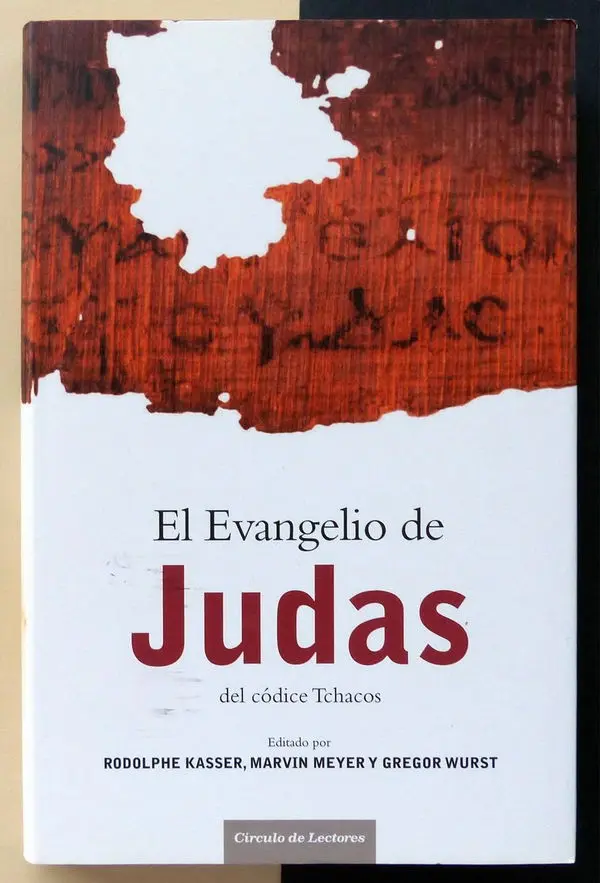
The Gospel of Judas from the Tchacos Codex
The Gospel of Judas, preserved in the Code of Tchacos, offers a striking insight into one of the most controversial figures in Christianity. Far from presenting Judas Iscariot solely as the disciple who betrayed Jesus, this ancient text proposes a different interpretation of his role within the divine plan.
Was he really the traitor of Christ or a faithful disciple who accepted to bear the contempt of history to fulfill Jesus’ redemptive mission?
Rescued from the sands of the Egyptian desert and restored after decades of deterioration, this manuscript was edited and translated from Coptic by an international team of specialists. Its publication made it possible to discover an apocryphal gospel that, beyond the controversy, constitutes a valuable source for understanding the diversity of beliefs of early Christianity.
This edition brings the reader an exceptional historical document, inviting them to discover a different perspective on Judas Iscariot and the religious context in which this fascinating ancient text emerged.
What do historians think?
Currently, there is broad academic consensus on the Gospel of Judas.
The researchers agree on several points:
- It is an authentic text from Antiquity.
- It was written by a Gnostic community.
- It was not written by Judas Iscariot.
- It reflects a minority Christian tradition.
- It constitutes a historically valuable source for studying early Christianity.
At the same time, specialists emphasize that the discovery of the Gospel of Jude it does not require rewriting the history of Jesus nor does it modify the content of the canonical gospels.
Its main importance lies in showing that, during the 2nd and 3rd centuries, different interpretations coexisted regarding the figure of Jesus and the role of his disciples.
It is precisely this diversity that makes the Gospel of Jude one of the most studied manuscripts of recent decades.

Historical importance of the Gospel of Jude
Although the Gospel of Jude it is not part of the New Testament; its discovery was one of the most significant events for the study of early Christianity.
Its main value does not lie in altering the story of Jesus or Judas Iscariot, but in offering a window into the diversity of beliefs that coexisted during the first centuries of our era.
Far from a single interpretation of Jesus’ message, historians know that numerous Christian communities coexisted with very different ideas about salvation, the nature of Christ, and the role of his disciples.
In this context, the Gospel of Jude constitutes an exceptional testimony of Gnostic thought.
Moreover, his discovery allowed a better understanding of how Christianity evolved before the biblical canon was definitively established.
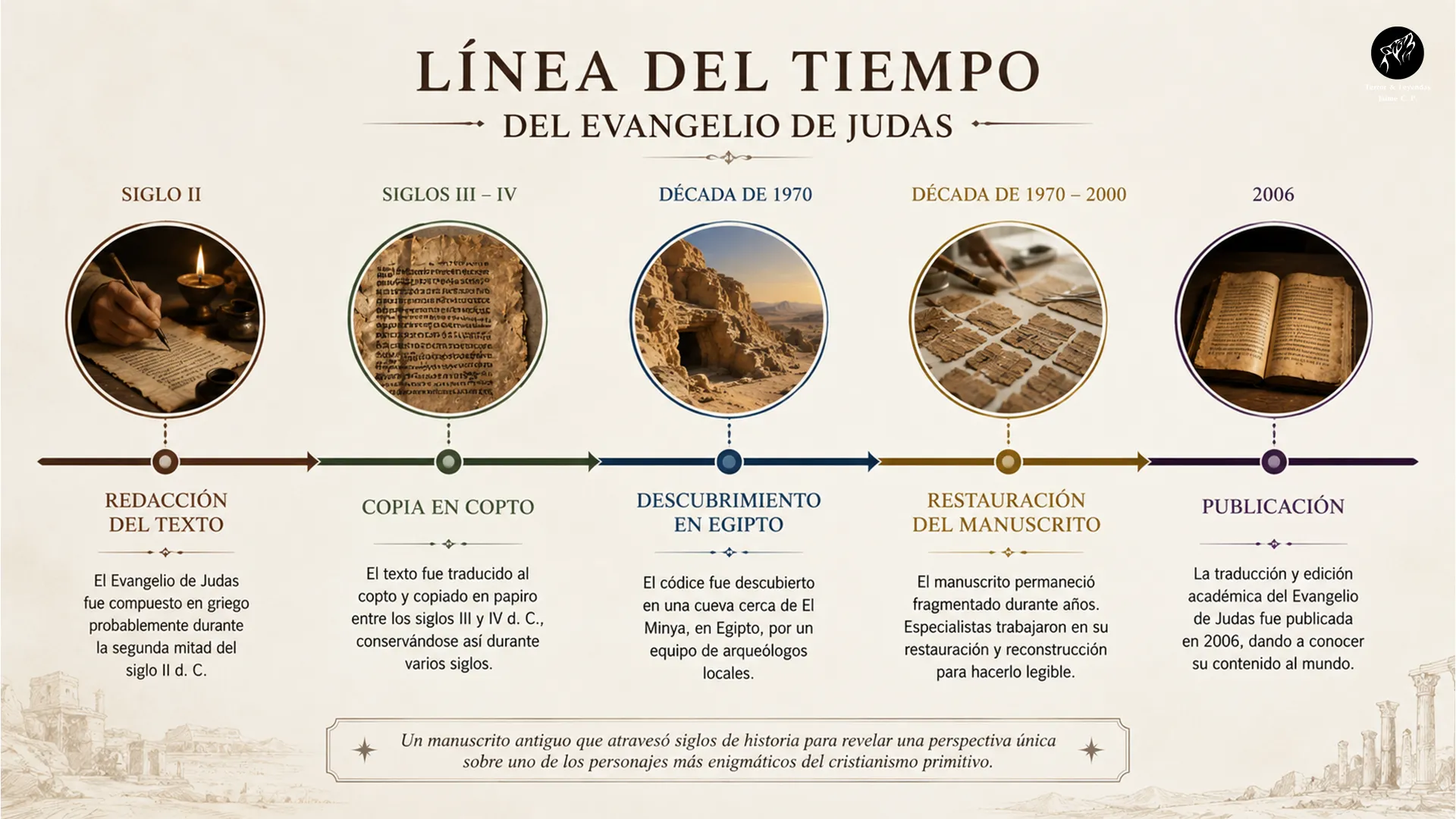
Chronology of the Gospel of Jude
Understanding the history of the manuscript becomes much easier if we look at the most important events in chronological order.
| Date | Event |
| 150-180 AD. C. | The original text is drafted in Greek. |
| 3rd-4th centuries | The preserved manuscript is copied and translated into Coptic. |
| 2nd Century | Irenaeus of Lyon mentions a “Gospel of Judas” in Against Heresies. |
| 1970s | Discovery of the codex in Egypt. |
| 1980-2000 | The manuscript remains hidden and suffers significant deterioration. |
| 2001-2006 | Restoration and translation by an international team of specialists. |
| April 2006 | Official publication of the Gospel of Judas. |
Myths and realities about the Gospel of Jude
Since its publication, numerous statements have circulated that should be clarified.
Myth 1: it proves that Judas was a hero
Reality: the Gospel of Jude presents this interpretation from a Gnostic perspective. However, there is no historical consensus confirming that view.
Myth 2: completely changes the history of Christianity
Reality: the discovery expanded knowledge about the different currents of early Christianity, but did not alter the main historical sources about the life of Jesus.
Myth 3: the Church hid this gospel
Reality: the text was known by some Christian authors since the 2nd century and was rejected because it represented a tradition different from the one that eventually formed the biblical canon.
Myth 4: Judas personally wrote the gospel
Reality: specialists agree that it was written by a Gnostic community about a century after Judas’s death.
Myth 5: the Gospel of Judas contradicts the entire Bible
Reality: offers a different interpretation of some events, but its purpose was to transmit the theology of a specific community, not to replace the canonical gospels.
What can we learn from the Gospel of Judas?
Beyond the controversies, this text offers interesting lessons from a historical point of view.
It allows understanding:
- How different interpretations about Jesus emerged.
- The influence of Gnosticism on some Christian groups.
- The process by which the New Testament was formed.
- The importance of preserving ancient manuscripts.
- The cultural richness of early Christianity.
For this reason, it continues to be studied in universities, research centers, and specialized seminars.
Frequently asked questions about the Gospel of Jude
Is the Gospel of Jude part of the Bible?
No. It is considered an apocryphal gospel and was never included in the New Testament canon.
Who wrote the Gospel of Judas?
Its author is unknown. Specialists believe it was written by a Gnostic community around the middle of the 2nd century.
Where did the manuscript appear?
It was discovered in Egypt during the 1970s.
What language do you use?
The preserved manuscript is written in Sahidic Coptic and probably translates an earlier Greek text.
What is the Codex Tchacos?
It is the name given to the codex containing the Gospel of Jude and other ancient writings.
Does the Gospel of Judas claim that Judas obeyed Jesus?
Yes. That is the interpretation presented by the Gnostic text itself. However, this view does not represent the historical consensus nor the doctrine of the main Christian churches.
Why is this manuscript so important?
Because it allows a better understanding of the diversity of beliefs existing during the early centuries of Christianity.
Is it authentic?
Yes. Scientific analyses confirm the authenticity of the ancient manuscript.
Where can it be read?
There are translations into Spanish and other languages published by specialized publishers and research centers.
Is it worth reading the Gospel of Jude?
Yes, especially if approached as a historical document that helps to understand the development of ancient Christianity and the different religious currents of the time.

Conclusion
The Gospel of Jude It is one of the most fascinating manuscripts discovered in recent decades. Although it does not alter the history of Christianity nor replace the canonical gospels, it offers a unique perspective on the diversity of ideas that existed during the early centuries of this religion.
Its true value lies in showing how different groups interpreted the figure of Jesus, the role of Judas Iscariot, and the path to salvation. Thanks to his discovery, today we better understand the complex religious landscape of early Christianity and understand more clearly the process that led to the formation of the biblical canon.
If you are interested in the history of Christianity, the apocryphal gospels, or the great archaeological finds, the Gospel of Jude is an essential read to understand one of the most fascinating periods in the history of religions.