
The Ridgeway Ghost
What would you do if a figure appeared on the road at night and, when you looked at it again, it had completely changed its appearance?
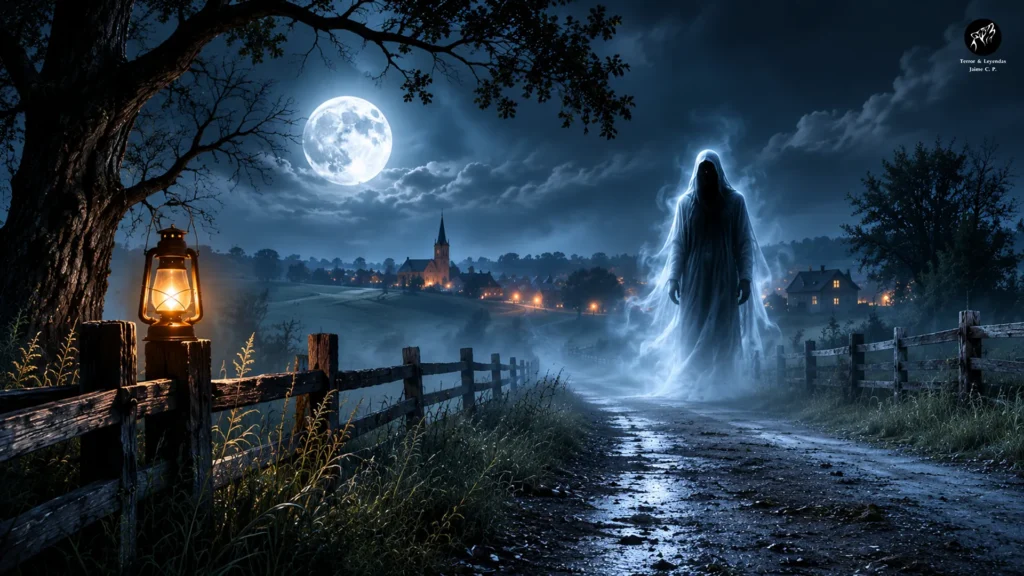
That is precisely one of the most unsettling characteristics of the Ridgeway Ghost, an ancient supernatural legend from Wisconsin. During the 19th century, locals and travelers in the area claimed to have seen a mysterious presence on the roads near Ridgeway.
But there was something that set this supposed specter apart: it did not seem to have a fixed form.
According to stories passed down through generations, it could appear as a man, a woman, an animal, or even a headless figure. Some accounts spoke of a presence that walked alongside travelers. Others claimed it pursued them.
The story is part of Ridgeway’s folklore and continues to spark interest due to its combination of mystery, violence, ancient paths, and accounts that are difficult to explain. The town of Ridgeway itself acknowledges its ghostly tradition and has historically promoted itself as the “Home of the Famous Ghost.”
But where did this legend come from?
What is the Ridgeway Ghost?
The Ridgeway Ghost is a figure from Wisconsin folklore associated primarily with Ridgeway and the region’s old roads.
Legend dates its first appearances to the 19th century. The town of Ridgeway reports that the alleged specter was said to have been seen between 1840 and 1885, especially along the old Military Road. However, local history itself notes that there is no complete record of those accounts and that many were passed down from generation to generation.
This lack of systematic records is significant. We are dealing with an oral tradition that grew over time, not a scientifically proven paranormal phenomenon.
That is precisely why the ghost is so interesting from a folklore perspective.
There is no single description of the Ridgeway Ghost. According to the accounts collected, it could take on different appearances.
These include:
- A man carrying a whip.
- A young or elderly woman.
- A headless horseman.
- Dogs and other animals.
- Other human figures that were difficult to identify.
- A shadowy presence that walked alongside or pursued the travelers.
Wikipedia summarizes this characteristic by describing it as a ghost capable of changing its appearance at will.
The Origin of the Ridgeway Legend
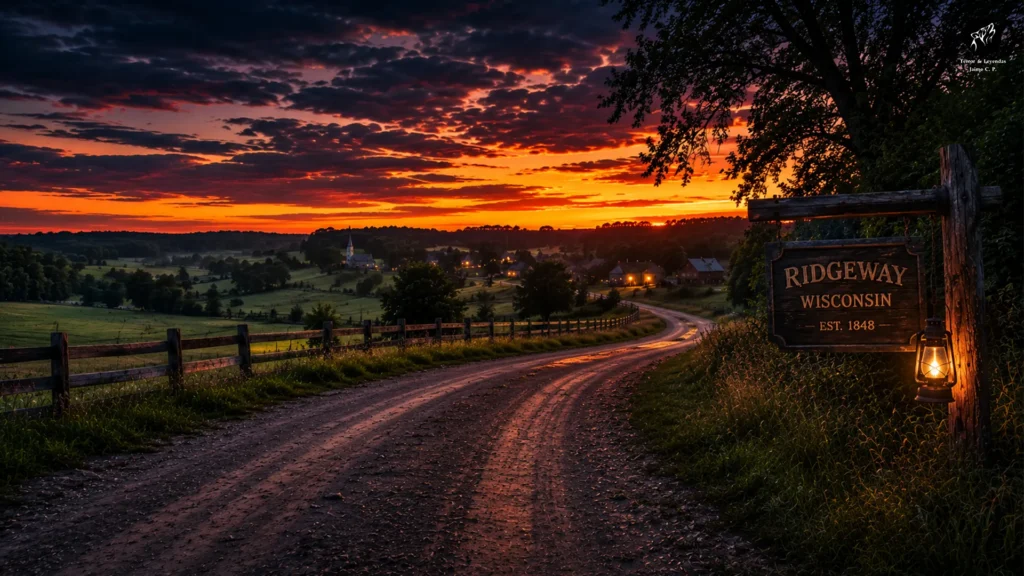
To understand the Ridgeway ghost, we must go back to 19th-century Wisconsin.
Between 1832 and 1845, the southwestern part of the state experienced rapid growth linked to lead mining. The region welcomed numerous immigrants, including people of Cornish, Welsh, Irish, and German descent.
Travel back then was very different from what it is today.
Travelers used rural roads and ox-drawn carts. Journeys could last several days, and along the routes, inns, post offices, stores, and saloons sprang up where travelers could rest.
Life in that region was also marked by violence. The official history of Ridgeway mentions fights, robberies, confrontations, and other violent incidents related to the mining communities and saloons of the time.
That context provided the perfect setting for the birth of a legend.
Nighttime, isolated roads, weary travelers, alcohol, violence, and a scattered population. All of this could fuel stories of apparitions and unexplained events.
The two brothers behind the ghost
One of the best-known versions links the Ridgeway ghost to two brothers who are said to have died during a bar fight in the early 1840s.
According to this legend, the spirits of both brothers became bound to the region, and over time, their apparitions gave rise to the figure known as the Ridgeway Ghost.
This explanation should not be confused with a proven historical fact. It is an interpretation rooted in regional folklore.
However, it is essential for understanding how the legend evolved.
In many ghost stories, a violent death serves as the starting point for explaining why a supposed presence lingers in a place. In the case of Ridgeway, that idea became intertwined with accounts from travelers who claimed to have encountered a mysterious figure on the old roads.
The result was a supernatural character whose identity could change depending on who was telling the story.
The Strange Apparitions of the Ridgeway Ghost
This is where the most peculiar part of the legend begins.
Most ghosts have a recognizable appearance. The Ridgeway Ghost, on the other hand, seems to have been practically anything.
Some accounts spoke of a man who appeared wielding a whip. In other stories, the specter could take the form of a domestic animal.
There are also references to a headless horseman, a classic image in the supernatural imagination.
On other occasions, the figure could appear as a young or elderly woman.
This variety explains why the Ridgeway ghost is so unique. It does not seem to be a character with a single appearance, but rather a presence capable of transforming itself depending on the story.
According to sources compiled by Wikipedia, the sightings spanned an area of approximately 25 miles, from Blue Mounds to Dodgeville, following old roads associated with mining activity.
Dr. Cutler’s Account
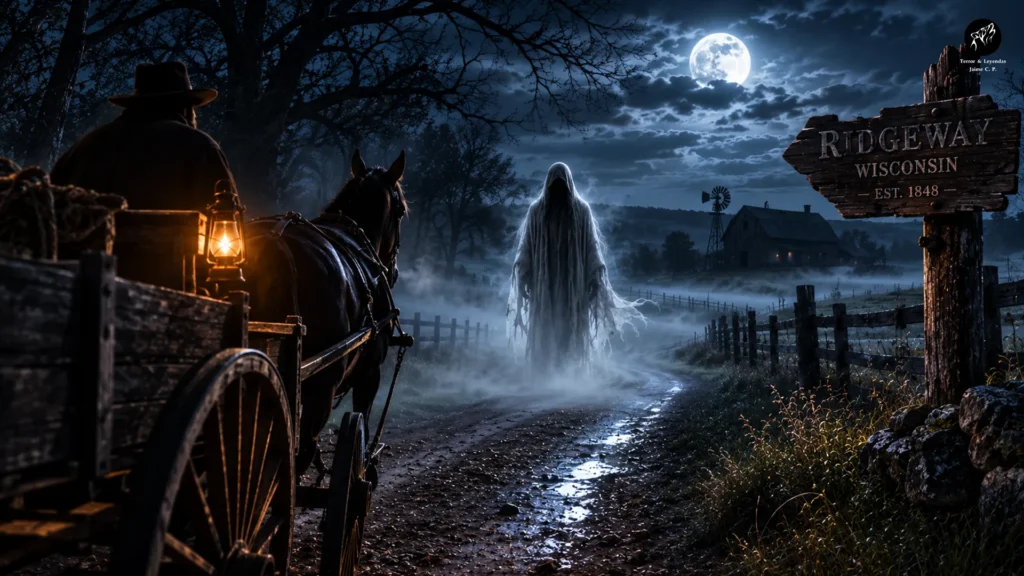
One of the episodes associated with the Ridgeway Ghost involves Dr. Cutler of Dodgeville.
According to tradition, he was one of the first to publicly claim that he had seen the ghost.
The story goes that the apparition appeared on the pole of his wagon as he was returning home at night. The incident is said to have occurred near the home of a deceased person connected to the legend.
This type of account is particularly interesting because it shows how the stories gradually took on specific details.
A nocturnal apparition could, as it was passed down from one person to another, become a story with a specific location, an identified witness, and specific circumstances.
Over time, these elements helped solidify the ghost’s reputation.
The Mysterious Case of Sampsons Saloon
Another important account appears in the official history of Ridgeway.
During the 1840s, a traveling salesman reportedly arrived at Sampsons Saloon. After entering the establishment, he was never seen again.
The strange thing, according to local lore, was that his horse remained outside, saddled and ready to go. The animal reportedly tried to enter the saloon and could not be driven away.
The story does not prove that a supernatural phenomenon occurred. In fact, Ridgeway’s own historical account acknowledges that some stories may have been pranks, exaggerations, or figments of the imagination.
But it also notes that there were people who claimed to have seen things they could not explain.
That combination of mystery and ambiguity is precisely what has allowed the legend to endure.
Did the Ridgeway Ghost kill its victims?
Some versions of the legend go far beyond a simple apparition.
The account on Wikipedia mentions a man named John Lewis, who reportedly attributed his health problems to a “supernatural force” linked to the ghost. The story claims that he died after his alleged encounter with the Ridgeway Ghost. There are also accounts of other people who are said to have died after encountering the apparition.
However, these claims belong to the realm of legend.
There is no scientific evidence to support the claim that the ghost caused those deaths.
Therefore, it is important to distinguish between two different questions:
Is it part of the legend that the ghost could cause death? Yes.
Has it been proven that a supernatural entity caused those deaths? No.
This distinction allows us to enjoy the story without presenting folklore as a proven fact.
Why did it appear from time to time?
Another curious detail of the tradition is the supposed regularity of the sightings.
Some sources note that stories of the ghost seemed to resurface in cycles of approximately 40 years. The 1850s, 1890s, 1930s, and 1970s are mentioned in particular.
Does this mean that the ghost actually returned?
Not necessarily.
These cycles can be explained in other ways. Folk tales tend to resurface when a new generation discovers them. An anniversary, a newspaper article, or a local celebration can also spark renewed interest.
In other words, the supposed cycle might reflect the way communities keep their legends alive.
YOU MIGHT BE INTERESTED IN
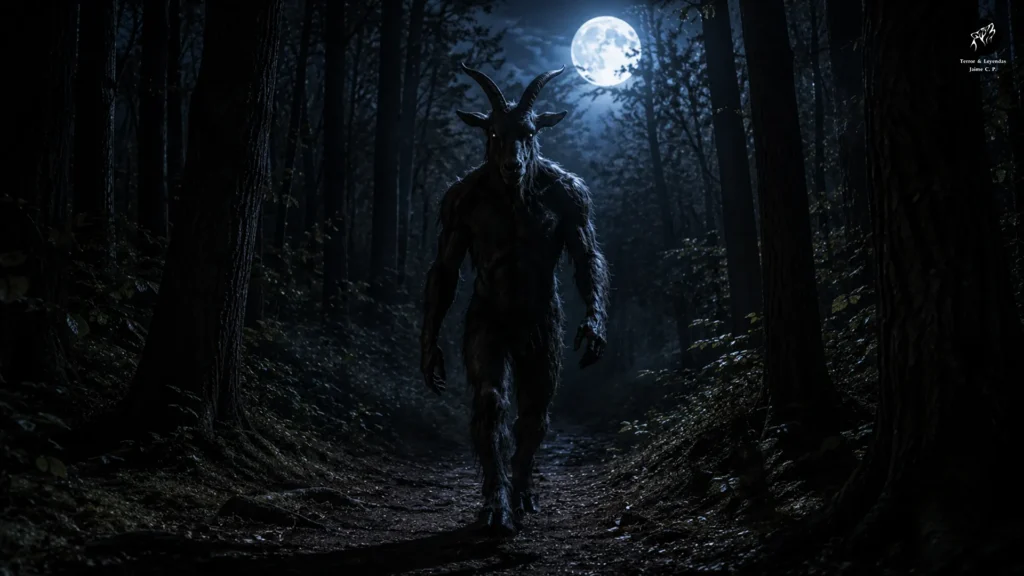
Goatman: The Half-Man, Half-Goat Creature
It’s 2:00 a.m. You’re driving down a road surrounded by woods. There’s barely any light. The silence is absolute.
Suddenly, something appears among the trees.
The figure looks human. However, its enormous horns and strange appearance make something seem off. It stares at you for a few seconds and then vanishes into the darkness.
This scene is part of hundreds of stories related to Goatman, one of the most unsettling and popular urban legends in the United States.
Is there a rational explanation for the Ridgeway ghost?
It is impossible to prove exactly what the people who claimed to have seen the ghost experienced.
However, there are several possible explanations.
Conditions of the Old Roads
Nineteenth-century travelers traveled at night on poorly lit roads. A human figure, an animal, or even an object located some distance away could be difficult to identify.
Fatigue and Perception
Journeys could last for hours or days. Fatigue can alter perception and lead to misinterpretations of visual stimuli.
Stories That Change
Oral tradition also plays an important role.
A story can change every time someone tells it. An animal can become a human figure. A shadow can become a ghost. A rumor can end up being associated with a specific place.
Jokes and Pranks
Ridgeway’s own official account acknowledges that some of the stories were possibly pranks.
Therefore, not all alleged sightings require a paranormal explanation.
The Ridgeway Ghost in Wisconsin Folklore
What’s truly interesting is that the Ridgeway Ghost did not disappear over time.
The story continues to be part of Ridgeway’s cultural identity. The town keeps the legend alive and has incorporated its ghostly tradition into activities and celebrations.
The Wisconsin Historical Society has also addressed Wisconsin’s ghost stories as part of the state’s folklore. In materials related to its Halloween activities, the Society explains that 19th-century rural communities used these stories to entertain themselves, share experiences, and keep their traditions alive.
Even Old World Wisconsin has included the tale of the Ridgeway Ghost in its Halloween activities, presenting it as a story linked to two murders that occurred in the 1840s.
This demonstrates something important: regardless of whether or not one believes in ghosts, the Ridgeway Ghost holds a real place within Wisconsin’s cultural tradition.
Frequently Asked Questions About the Ridgeway Ghost
Where did the Ridgeway Ghost appear?
Stories place his appearances mainly in Ridgeway and along old roads in the area. Some accounts extend the area to include the region between Blue Mounds and Dodgeville.
When did the stories begin?
Local tradition places the earliest accounts around the 1840s. The town of Ridgeway specifically cites the period between 1840 and 1885.
What was the Ridgeway Ghost like?
It did not have a single, distinct appearance. The accounts mention men, women, animals, a man with a whip, and a headless horseman, among other forms.
Is the Ridgeway Ghost real?
The Ridgeway Ghost is real as a legend and a piece of folklore, but there is no scientific evidence to prove that it is a supernatural entity.
Who were the original ghosts?
One version of the legend claims that the ghost is linked to two brothers who were murdered during a bar fight in the early 1840s.
Conclusion
The Ridgeway ghost combines many of the elements that make for a timeless horror story: violent deaths, lonely roads, nocturnal apparitions, bewildered witnesses, and a figure that seems capable of shape-shifting.
We don’t know how much truth lies behind the old tales. Nor can we verify that the apparitions were supernatural.
What we do know is that the legend is part of Ridgeway’s cultural history and has survived for generations. The town itself recognizes its tales as one of Wisconsin’s most unique historical legends.
And perhaps that is the most unsettling part.
Because when a story survives for nearly two centuries, one question always remains: What really happened that night on the old roads of Ridgeway?