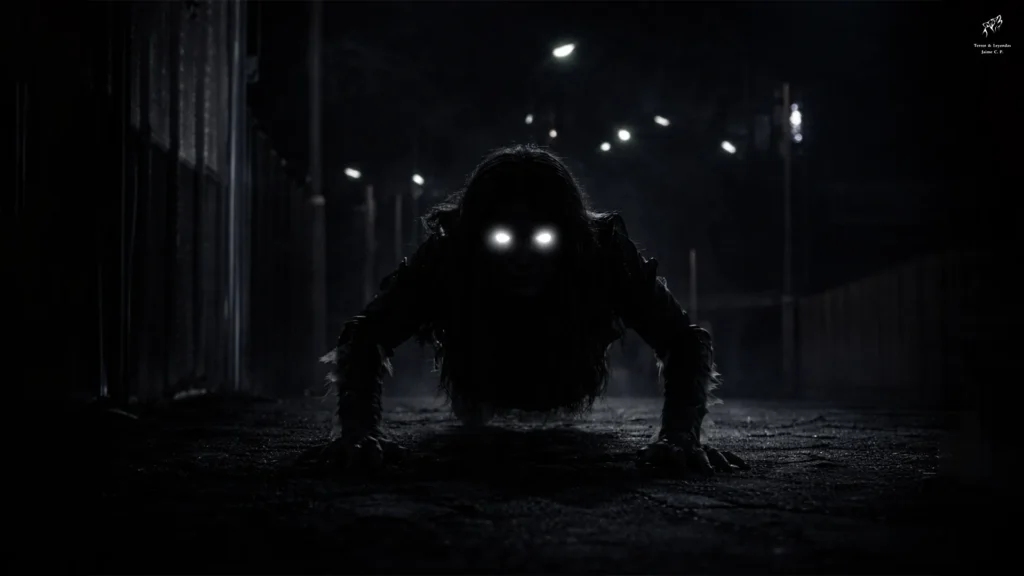
La Leyenda de Teke Teke

Teke Teke is one of the most haunting urban legends of contemporary Japan. It tells the story of a young girl who was tragically killed when she was run over by a train and, unable to find rest, returned as a vengeful spirit.

Her name comes from the sound she makes as she moves:
“teke… teke… teke… teke…”, the thud of her hands or elbows against the ground as she crawls.

Although widely circulated on the Internet today, the Japanese Teke Teke legend has been widespread since the mid-20th century, especially among students.

What is Teke Teke?

Teke Teke is a ghost of Japanese urban folklore that represents a woman split in two by a train. As she has no lower body, she moves using only her arms, moving with unnatural speed.

Within Japanese tradition, she fits the figure of the vengeful spirit: souls who die with resentment and return driven by trauma.

Origin of the legend of Teke Teke

The legend began to spread strongly in Japan during the second half of the 20th century. There is no documented historical case to confirm the original incident, but the narrative gained traction in school settings.

The best known version relates that:

  • A young girl fell or was pushed onto the train tracks.
  • The train broke her in half.
  • She remained conscious for a few moments.
  • She bled to death or died from the cold.
  • Her rancor transformed her into a vengeful spirit.

Some variants place the origin in Hokkaidō, although the exact place changes according to the region.
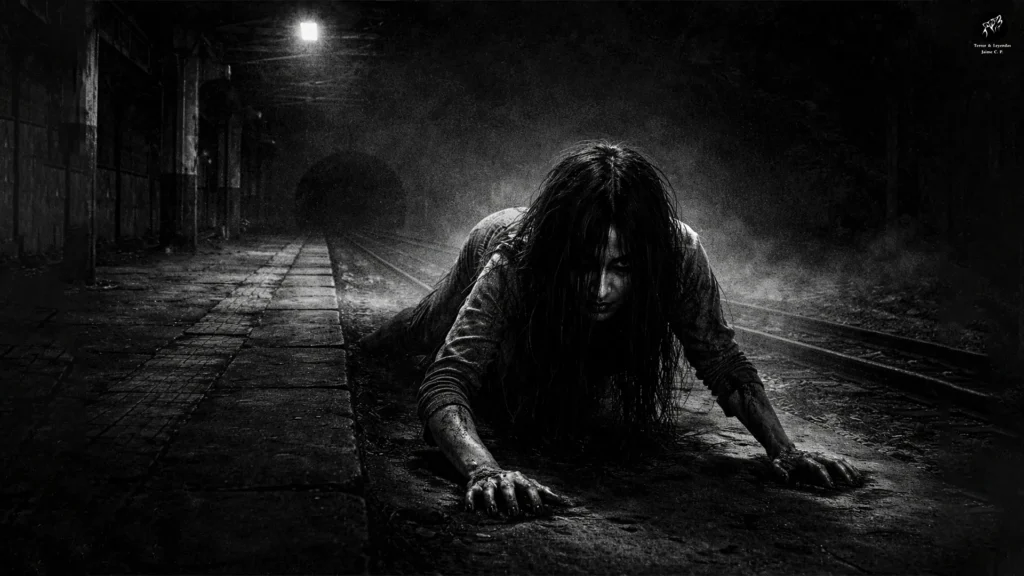
Teke Teke Leyenda Urbana

Who is Teke Teke according to Japanese legend?

In most accounts, Teke Teke is described as:

  • A young student.
  • Long dark hair.
  • Pale or expressionless face.
  • Legless.
  • Able to move extremely fast despite crawling.

In certain versions it carries a scythe or blade with which it attacks its victims.

The image is simple but powerful: an incomplete body that moves with impossible speed.
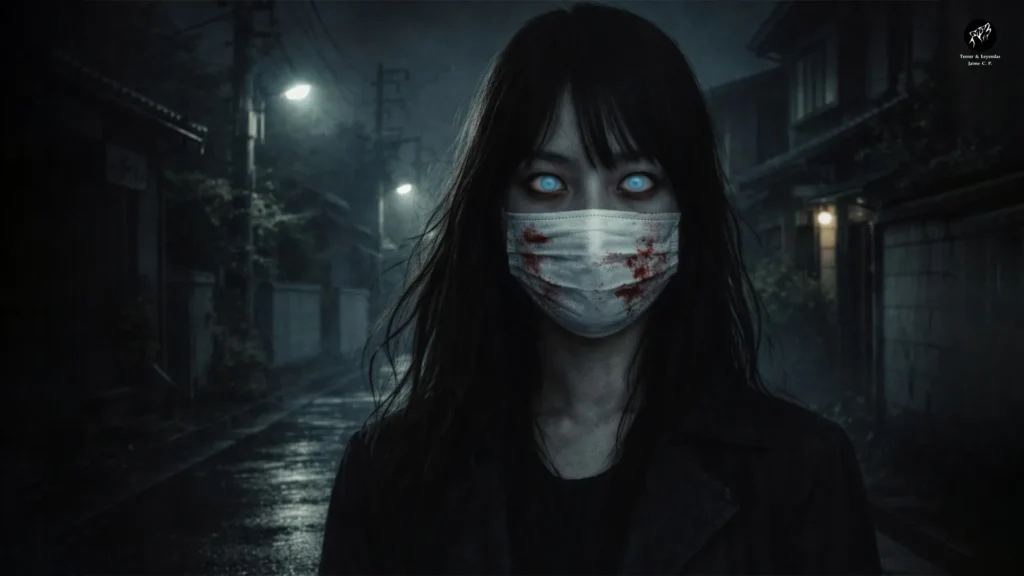
Kuchisake Onna

YOU MAY BE INTERESTED IN

Kuchisake Onna: the Japanese legend of the woman with the severed mouth

Kuchisake Onna is one of the most disturbing and persistent Japanese urban legends in modern folklore. Its story, passed down for generations, unfolds in everyday settings – quiet streets, school roads, residential neighborhoods – where a simple question can become a sentence.

How does Teke Teke attack?

According to Japanese legend, he appears mainly in:

  • Train stations.
  • Lonely streets.
  • School roads.
  • Deserted urban areas at night.

If someone sees it, the chase is on.
No matter how fast you run, it can catch up with you.

When it does, it cuts its victim in half, replicating the way she died.

How to defeat Teke Teke?

This is one of the most sought-after questions: can Teke Teke be defeated?

The answer depends on the version of the legend.

The classic version: you can’t beat

In the more traditional form of the tale, Teke Teke is unstoppable.

  • He asks no questions.
  • She offers no warnings.
  • She cannot be defeated.

Once you see it, you are its target.
The chase ends when it catches up with you.

The essence of terror lies precisely in that inevitability.

The modern variant associated with Kashima Reiko

Over time, the legend of Teke Teke began to merge with another Japanese urban figure known as Kashima Reiko.

In these more recent versions, the encounter changes.

The question

The entity may ask:

“Where are my legs?”

Some versions indicate that answering correctly could save you. Answers vary according to the account:

  • “On the railroad track.”
  • “On Meishin Road.”
  • “At the place where you died.”

There is no universally accepted answer, as this part belongs to the modern evolution of the legend.

The name trap

In certain variants it is warned that if she asks who she is and “Kashima Reiko” is answered, it may be a trap that triggers the immediate attack.

This dynamic belongs mainly to the Kashima Reiko tradition, although today the two stories are often confused.

So, can it be defeated?

In the original version, no.

In the modern variants, there are supposed answers that could save you… but they change depending on who is telling the story.

And that ambiguity is part of what keeps the legend alive.

Difference between Teke Teke and Kashima Reiko

Although they are often conflated today, they were originally separate stories:

  • Teke Teke: spirit split by a train that chases and cuts its victims.
  • Kashima Reiko: an entity that asks questions about its mutilation.

The Internet ended up merging both figures, generating the hybrid version that many know today.

Cultural significance of the Japanese Teke Teke legend

Beyond the superficial fear, the story reflects deep collective fears:

Fear of the train

Japan has one of the most extensive railway systems in the world. Turning it into a horror scenario connects to a real vulnerability.

Body horror

Mutilation generates an immediate visceral reaction.

The vengeful spirit

In Japanese tradition, dying with resentment prevents the soul from resting.

School anxiety

Many Japanese urban legends arise and are passed on in student environments.

Teke Teke is not just a ghost: it is a representation of trauma turned myth.

Is the legend of Teke Teke real?

There are no verifiable historical records to confirm the original case. It is considered a modern urban legend.

However, its permanence demonstrates the narrative power of contemporary myths.

YOU MAY BE INTERESTED: Urban Legends: Japan
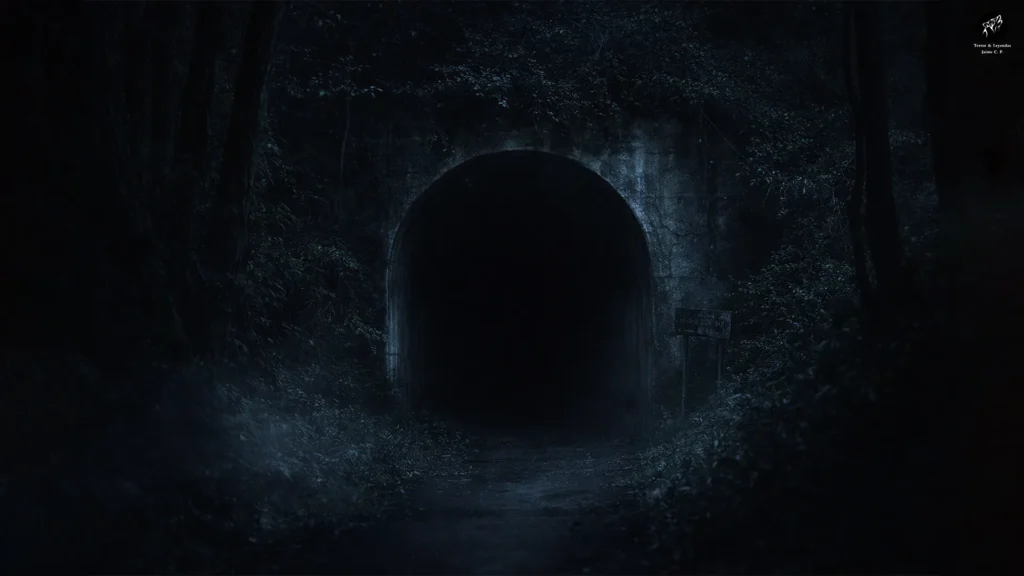
Aldea Inunaki

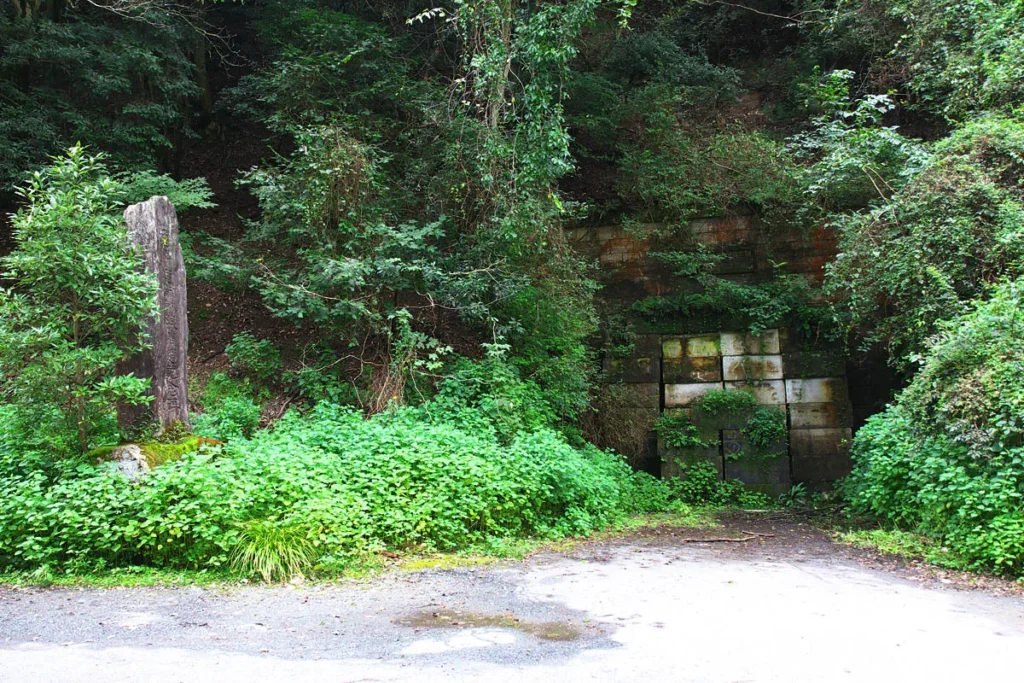
Deep in the mountains of Fukuoka is an ancient tunnel that many prefer to avoid. The structure is worn, dark, almost forgotten. But what is really disturbing is not its appearance… but the history that surrounds it.

It is said that when you cross it you enter the Inunaki Village, a village where the Japanese Constitution has no effect. A place outside the system. Lawless. Without protection.

But does it really exist?
Can it be found on Google Maps?
Is it dangerous?

Let’s separate myth and reality.

Where is Inunaki Village?

Legend places this supposed village in a mountainous area near the city of Fukuoka, on the island of Kyūshū.

In that region there does exist a place called Inunaki (犬鳴), whose meaning is “the howling of the dog”. There you can find:

  • The ancient Old Inunaki Tunnel
  • The Inunaki Dam
  • Remains of an ancient settlement now virtually abandoned.

Many people search for “Inunaki village Google Maps”, expecting to find an exact spot marked as a forbidden village. However, there is no official record under that name as an active community.

What does appear on maps is the ancient tunnel and the mountainous area that fueled the legend.

Inunaki old tunnel

Was there ever a village at Inunaki?

Yes, but not as the viral story goes.

In the past there were small rural settlements in that area. As with many Japanese communities in the 20th century, urban development and the construction of infrastructure – such as the dam – led to the gradual abandonment of the site.

It was not a mysterious disappearance. It was migration and modernization.

That physical emptiness, combined with the sense of isolation, was perfect ground for the myth to be born.

How was the legend of the Inunaki Village born?

The best-known version of the story began circulating on anonymous Japanese forums in the early 2000s. In those digital spaces, accounts appeared from urban explorers who claimed to have found a tunnel with an eerie sign:

“The Constitution of Japan has no effect beyond this point.”

From there, the narrative grew: a hidden town, isolated inhabitants, violence against intruders and a territory where the law does not exist.

There is no documentary evidence that such a cartel ever officially existed. However, the idea was so powerful that it ended up establishing itself as one of the most famous Japanese urban legends.

Kuchisake Onna

YOU MAY BE INTERESTED IN

Kuchisake Onna: the Japanese legend of the woman with the cut mouth

Kuchisake Onna is one of the most disturbing and persistent Japanese urban legends in modern folklore. Its story, passed down for generations, unfolds in everyday settings – quiet streets, school roads, residential neighborhoods – where a simple question can become a sentence.

The real crime that reinforced fear

In 1988 a brutal murder occurred in the mountainous area near Inunaki. The case was real and documented.

The fact that a violent crime had happened in an already isolated area reinforced the perception of danger. When reality and rumor mix, legends become more credible.

There was no lawless town.
But there was an event that left a mark on local memory.

Does the Inunaki Village really exist?

Clear answer: there is no official evidence of an autonomous village outside the Japanese legal system.

What is real:

✔ The area called Inunaki.
✔ The abandoned ancient tunnel.
✔ The dam and remains of ancient settlements.
✔ A crime that occurred in the region.

What is not proven:

✖ An official sign nullifying the Constitution.
✖ A community living outside the law.
✖ A territory without government control.

Inunaki Village, as a “forbidden village”, is a modern urban legend.

Is it possible to visit Inunaki Village?

The ancient tunnel can be located in Fukuoka Prefecture. However, access may be restricted or not recommended for safety reasons.

The danger is not supernatural.
It is physical: deteriorated structures, uneven terrain and isolation.

Many searches such as “is Inunaki Village dangerous?” or “is it possible to enter?” arise out of curiosity. The answer is simple: it is not a horror theme park, it is a real rural area that should be treated with respect and caution.

The movie that made the legend famous

Howling Village, directed by Takashi Shimizu, known for his work in Japanese horror films, was released in 2020.

The film brought the myth to the cinema, mixing ghosts, family curses and tragedies of the past. Since then, searches for “Inunaki Village real or fake” have increased considerably.

The film did not create the legend, but it cemented it internationally.

Why is this story so disturbing?

Unlike traditional yōkai or classic ghosts, Inunaki Village touches on a more human fear.

The fear of being left out of the system.
The fear of a territory where no one can protect you.
The fear that there is a place where the law simply doesn’t work.

It’s not a demon that’s scary.
It’s the idea that you might cross an invisible boundary and lose all collateral.

And that, psychologically, is much more disturbing.

Comparison with other similar Japanese legends

Inunaki Village is not the only story of an isolated village in Japan. Other legends, such as the alleged Sugisawa Village, follow a similar pattern: hidden communities, violence and isolation.

These narratives share a central element: fear of the unknown within one’s own country.

In a nation known for its order and social structure, the idea of an out-of-control territory is especially disturbing.

What are the exact coordinates of the Inunaki Village tunnel?

The exact coordinates of the ancient tunnel associated with the Inunaki Village legend are:

33.6589, 130.5174

Entering this point into Google Maps locates the Old Inunaki Tunnel(旧犬鳴トンネル), in a mountainous area of Fukuoka Prefecture, Japan.

Actual location of the Inunaki tunnel

The tunnel is located:

  • Southwest of the Inunaki Dam.
  • Inside a wooded area
  • Off the main modern road
  • In an old section currently in disuse

It is important not to confuse it with the new tunnel on Highway 21, which is a modern structure and not related to the urban legend.

Does Inunaki Village exist on Google Maps?

No. There is no official point marked as “Inunaki Village”.
What people usually find when searching for “Inunaki village coordinates” is this ancient tunnel, which was the origin of the myth spread on the internet.

Modern myth with real roots

Inunaki Village does not exist as a forbidden village where Japanese law does not apply.

But the area does exist.
The tunnel does exist.
The isolation is real.
And so is the crime that happened there.

The legend was born from a powerful mix: rural abandonment, a violent event and amplification on the internet.

Sometimes it doesn’t take a ghost to create a haunting story.
All it takes is a forgotten place… and a phrase that suggests the law doesn’t reach there.

Qué es el tonal

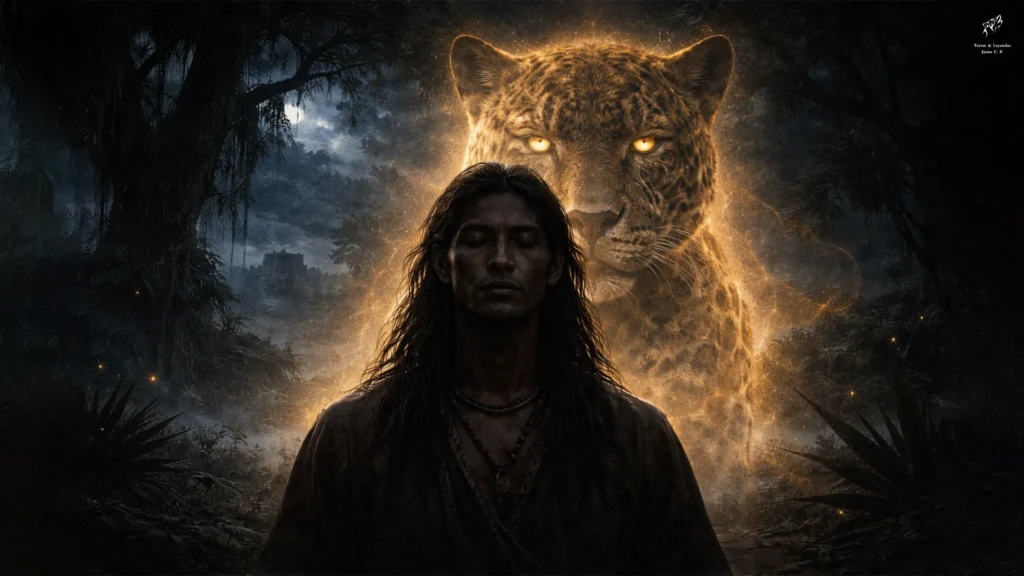
In the spiritual tradition of Mesoamerica, each person is born accompanied.

Not by an angel.
Not by a demon.
Not by an animal.

That sacred connection is known as tonal.

More than a superstition, it is a profound concept that was part of the spiritual structure of pre-Hispanic cultures.

What does tonal mean?

The word comes from the Nahuatl word tonalli, which can be translated as “vital energy”, “heat of the soul” or “destiny linked to the day”.

In the Mexica cosmovision, tonalli was a spiritual force that resided in the head and was related to:

  • Character
  • Fortune
  • Health
  • Destiny

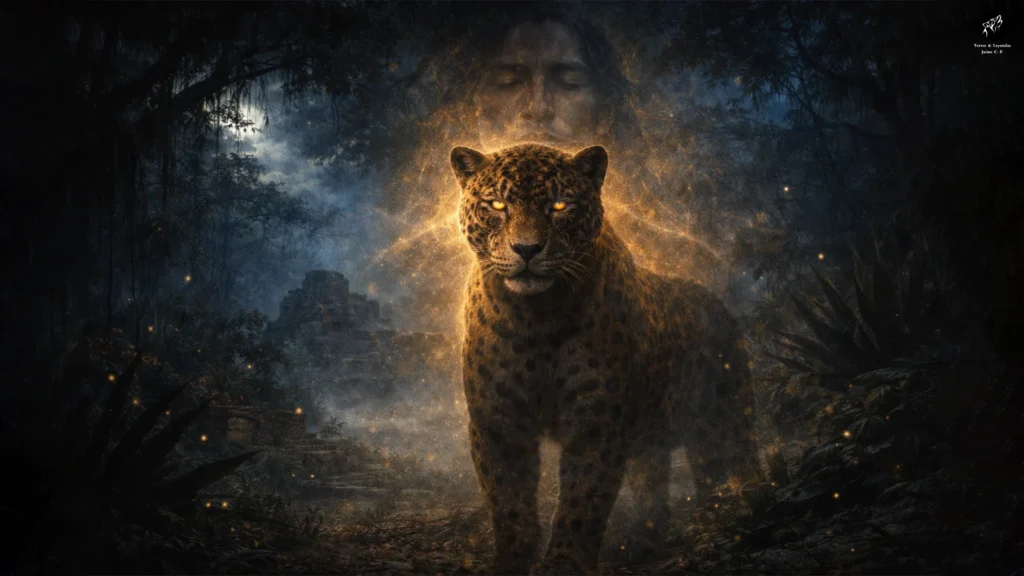
The tonal was not simply a symbolic animal. It was a spiritual extension of the individual.

Qué es el tonal

Difference between tonal and nahual

Although they are often confused, they are not the same.

  • The tonal is the animal spirit with which a person is born.
  • The nahual is the one who can manipulate or transform through that connection.

Every person had tonal.
Not every person was a transformer.

This difference is key to understanding Mesoamerican mythology without colonial distortions.

How was the spirit animal determined?

In the Mexica and Maya tradition, the protector animal was determined by:

  • The exact day of birth
  • The ritual calendar (Tonalpohualli in the Mexica world)
  • The energy of the cosmic moment

The sacred calendar had 260 days, each associated with symbols, forces and creatures.

In this way, destiny and character were linked to a being of the natural world.

Qué es el nahual

YOU MAY BE INTERESTED IN

What is a nahual? Origin, Mexican legend and real meaning in pre-Hispanic culture

In the villages of Mexico, when a dog howls at dawn or a shadow crosses the mountain under the moon, there are still those who whisper an ancient word.

But what really is a nahual? A sorcerer who turns into an animal? A protective spirit? A rural superstition?

Animals most associated with the tonal

Depending on the region and the calendar, some frequent animals were:

  • Jaguar (strength and leadership)
  • Eagle (vision and power)
  • Coyote (cunning and adaptation)
  • Snake (transformation and wisdom)
  • Dog (spiritual guidance)

These were not simply decorative totems. They represented living energy.

The tonal as a reflection of destiny

If the animal fell ill, the person fell ill.
If the protective spirit died, the individual was in danger.

This belief reinforced the idea that the human being was not separate from nature, but intertwined with it.

The spiritual and physical worlds were not distinct dimensions, but parts of the same reality.

Does tonal exist today?

In indigenous communities in Oaxaca, Chiapas and Guatemala, the belief still persists.

Some traditional healers still consult the ritual calendar to interpret a person’s vital energy.

However, many modern versions simplify the concept as “spirit animal” without understanding its cosmological depth.

Is it the same as the power animal?

Not exactly.

The contemporary concept of “power animal” comes from modern spiritual currents and neo-shamanism.

The tonal belongs to a specific religious structure, with its own calendar, ritual and cosmovision.

To reduce it to a spiritual fashion erases its historical roots.

The link between human and nature

Mesoamerican cultures did not see humans as superior to nature, but as part of it.

The animal was not a symbol.
It was destiny.
It was a mirror.
It was double.

And losing that link meant losing balance.

Conclusion

It is neither a creature nor a legend of terror.
It is a fundamental piece of pre-Hispanic spirituality.

Understanding it allows us to understand why transformation, the animal bond and vital energy occupied such a central place in the Mesoamerican imaginary.

Not every protective spirit manifests itself with wings.
Some walk on all fours.

YOU MAY BE INTERESTED IN: Legends of Mexico

Qué es el nahual

In the villages of Mexico, when a dog howls at dawn or a shadow crosses the mountain under the moon, there are still those who whisper an ancient word.

But what really is a nahual? A sorcerer who becomes an animal? A protective spirit? A rural superstition?
The answer is deeper – and more disturbing – than it seems.

What does nahual mean?

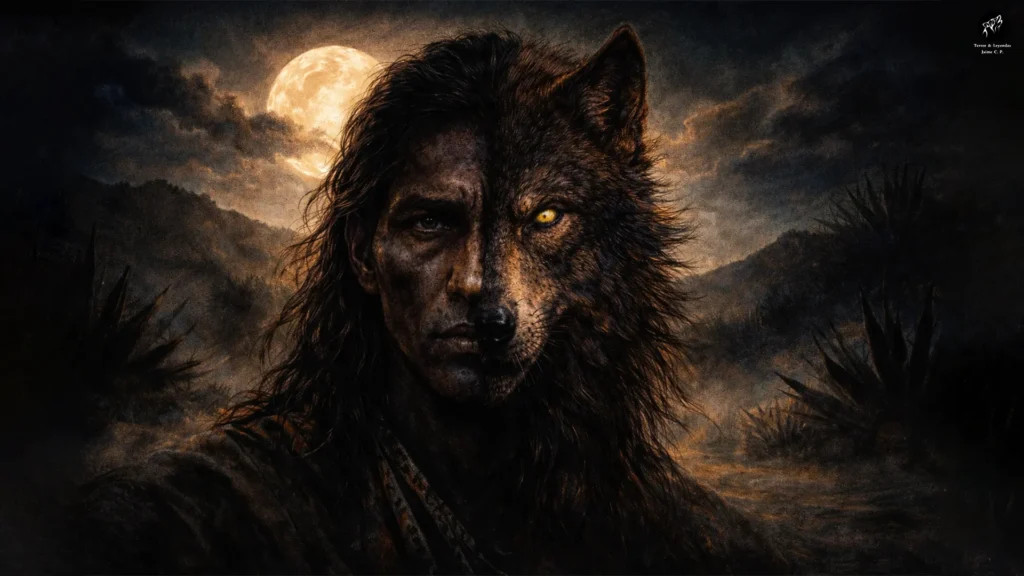
It is a figure from Mesoamerican mythology that represents a human being capable of transforming into an animal. In various indigenous cultures, it is also considered a protective spirit linked to the birth of a person.

The word comes from the Nahuatl nāhualli, which can be translated as “the hidden”, “that which is disguised” or “spiritual double”.

Since pre-Hispanic times, the concept has been linked to the idea that every human being possesses a supernatural bond with an animal.

Origin of the nahual in pre-Hispanic culture

It was not born as an evil figure. Its origin is deeply spiritual.

Etymology and root

In the Mexica tradition, the nāhualli was someone with the ability to transform himself or project his essence into an animal. He was not always a dark sorcerer; he could be a sage or shaman.

The nahual and the tonal

In many Mesoamerican communities there was a belief that each person was born under the protection of a spirit animal called a tonal.
While the tonal was the protective spirit, the nahual was the one who could manipulate that connection.

Presence in Oaxaca, Chiapas and Veracruz

In Zapotec and Mayan communities, this creature is still part of the collective imagination. In some regions it is believed that certain sorcerers can transform themselves into:

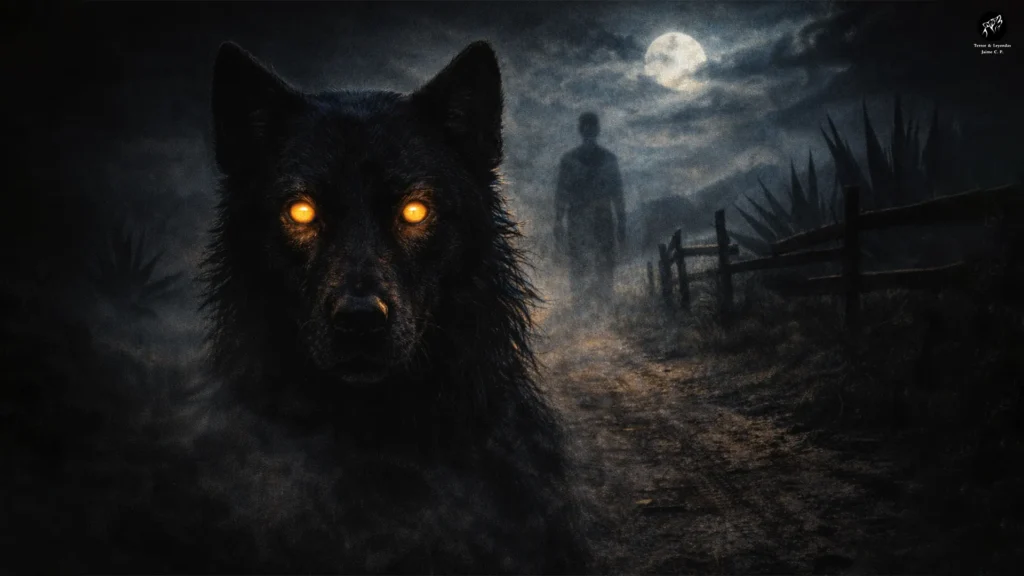
  • Black dogs
  • Coyotes
  • Guajolotes
  • Jaguars

The animal form is not random: it reflects the strength or intention of the practitioner.

La leyenda de La Llorona

YOU MAY BE INTERESTED IN

La Llorona: real origin and history of the Mexican legend

Few figures in Mexican folklore are as disturbing as La Llorona, that presence that seems to manifest itself when the night becomes too silent and the water reflects more shadow than light.

The legend of the nahual in Mexico

With the passage of time, the spiritual figure transformed into something darker.

During colonial times, stories began to describe the nahual as a sorcerer who sold his soul to obtain the power to become a beast. He was said to attack cattle, steal energy or prowl houses at night.

This warning is still heard in many villages:

If an animal stares at you in the wee hours of the morning and doesn’t blink…it might not be an animal.

The mixture of indigenous tradition and colonial fear gave rise to the most terrifying version of the myth.

How do you know which one is your nahual?

From the indigenous cosmovision, the spiritual animal of a person depended on:

  • Their date of birth
  • The Mesoamerican calendar
  • Their lineage
  • Initiation rituals

However, in the authentic tradition, one does not “choose” one’s nahual. It is a spiritual connection determined from birth.

Today, many modern versions mix this belief with astrology or contemporary esoteric interpretations.

What are nahuals afraid of?

According to popular rural tradition, there are elements that can weaken or drive away a nahual:

  • Direct fire
  • Salt scattered at entrances
  • Iron objects
  • Prayers or prayers
  • Discover your human identity

It was believed that if someone managed to wound the animal, the next day the supposed sorcerer would appear with the same wound in his human form.

These stories are part of Mexican oral folklore, passed down through generations.

Qué es el nahual

How to defeat a nahual according to Mexican legends?

It is important to clarify: in the original pre-Hispanic tradition, the nahual was not always evil.
The idea of “defeating” him comes from later stories.

In towns in central and southern Mexico, it was said that it was necessary to defend oneself from a nahual:

  1. Show no fear
  2. Light a fire immediately
  3. Throw salt or holy water
  4. Name it out loud if you knew its identity.

Some stories claim that discovering who the nahual was in his human form broke his power.

Beyond the myth, these practices reflect the ancestral fear of the unknown in the rural darkness.

Do nahuals really exist?

From an anthropological perspective, it is a cultural construct linked to the Mesoamerican cosmovision.

From the oral tradition… there are those who claim to have seen them.

In rural communities, stories are still told of animals that walk on two legs, of shadows that cross cornfields and of sorcerers that do not age like others.

Conclusion

It is not just a legend of terror.
It is a living vestige of pre-Hispanic spirituality, transformed by centuries of fear, religion and superstition.

To understand its origin is to understand a profound part of the Mexican imaginary.

And when you hear a howl in the early morning?
you may remember that some stories don’t disappear. They just change form.

YOU MAY BE INTERESTED: Legends of Mexico

La Leyenda de Akai Ito

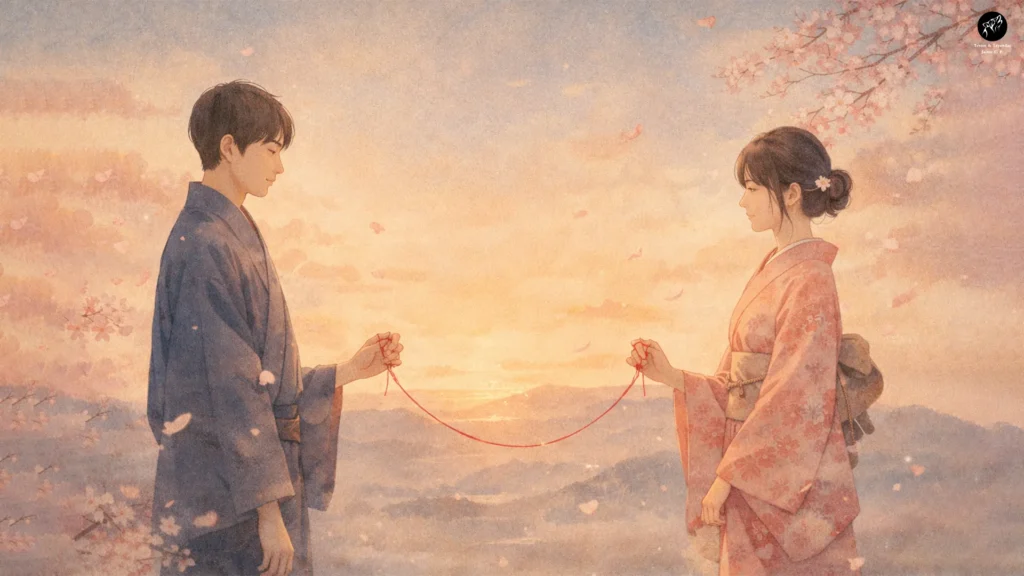
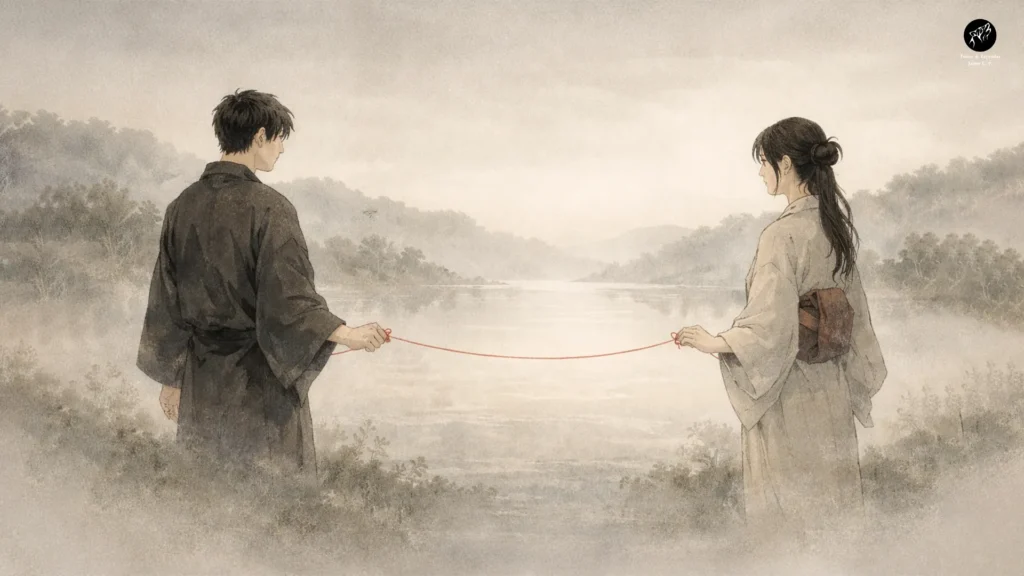
Akai Ito (赤い糸), which translates as red thread, is one of the most well-known legends of Japanese folklore. This belief holds that people destined to meet are linked by an invisible red thread, regardless of the time, distance or circumstances that separate them.

Although today it is deeply associated with Japanese culture, Akai Ito is the result of an Eastern reinterpretation of the ancient myth of destiny, transformed in Japan into a poetic metaphor about love, inevitable encounters and the bonds that mark a life.

In this article you will discover what Akai Ito is, what its origin is, its cultural significance and why it is still so relevant today.

What is Akai Ito?

Akai Ito is a Japanese legend that states that two people destined to meet are linked from birth by an invisible red thread. This thread:

  • Cannot be seen
  • Cannot be broken
  • Can be stretched or tangled
  • It always leads to a meeting

The legend does not assure happy endings, but inevitable encounters. Destiny is fulfilled, even if the road is long or painful.

Origin of Akai Ito

The belief in the red thread has its origins in Chinese folklore, where destiny was guided by supernatural forces. Over time, this idea reached Japan, where it was adopted and reinterpreted in a more symbolic and spiritual way.

In the Japanese tradition, the myth loses its moralizing or tragic character and becomes an intimate representation of destiny, focused on human and emotional relationships.

Thus Akai Ito was born as a Japanese version of its own, detached from punishments or imperial figures, and focused on the connection between ordinary people.

Where is the red thread tied in the Japanese tradition?

One of the clearest differences between the Japanese version and other Eastern traditions is where the thread is tied.

In Japan, the red thread is tied to the little finger of the left hand. This belief is based on the idea that this finger is symbolically connected to the heart, reinforcing the emotional and affective meaning of the myth.

La leyenda del emperador y la bruja

YOU MAY BE INTERESTED IN

The legend of the emperor and the witch

A long time ago, an emperor heard a rumor that aroused his curiosity and his pride.
In one of the provinces of his kingdom lived a witch with an extraordinary gift: she could see the Red Thread of Destiny, the invisible bond that unites people destined to meet.

Meaning of the Akai Ito in Japanese culture

The Akai Ito represents:

  • Inevitable destiny
  • The spiritual connection between people
  • Predestined love
  • Bonds that transcend time

Although it is often associated with romantic love, in Japan it can also be interpreted as a deep bond between people who are destined to influence each other, even if they don’t stay together forever.

The color red symbolizes life, protection and energy, values deeply rooted in Japanese culture.

Akai Ito in Japanese popular culture

The legend of Akai Ito has inspired numerous artistic and cultural expressions, including:

  • Japanese films and dramas
  • Novels and romantic poetry
  • Manga and anime
  • Popular songs
  • Tattoos, jewelry, and amulets.

The red thread symbol appears frequently in modern stories to represent destined encounters, inevitable separations, and impossible-to-ignore connections.

Difference between Akai Ito and other versions of Red String

Although they share a common origin, Akai Ito is clearly distinct in its approach:

  • It does not feature punishments or authoritarian figures
  • It does not impose a harsh moral
  • It does not explain fate as a punishment, but as an encounter

In Japan, the red thread is a poetic metaphor, not a warning.

Current relevance of Akai Ito

Today, Akai Ito is still a very present symbol in Japan and other Asian cultures. It is used in:

  • Symbolic ceremonies
  • Weddings
  • Accessories and jewelry
  • Contemporary art

Beyond its mythical origin, Akai Ito continues to resonate because it connects with a universal idea: some people come into our lives because they were always meant to.

Conclusion

The Japanese legend of Akai Ito is a delicate and profound representation of human destiny. It does not promise eternal happiness, but it does promise encounters that leave a mark. In a world dominated by uncertainty, this story offers a comforting idea: some bonds exist before we can understand them.

La leyenda de Yue Lao

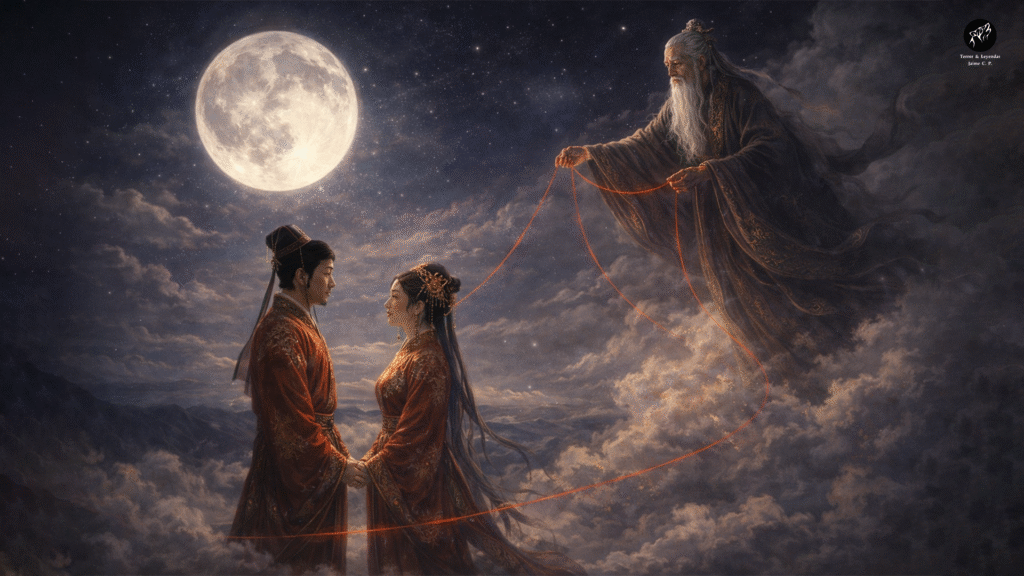
In Chinese mythology there is a figure who silently observes the affairs of the human heart. From the moon, with infinite patience, he is in charge of uniting people destined to meet, even if their paths seem impossible to cross.

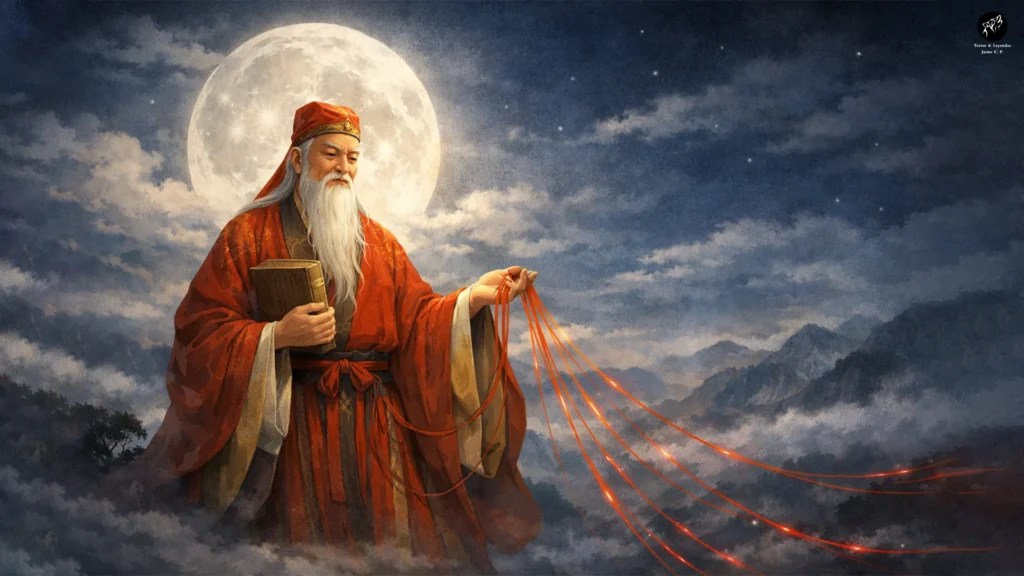
His name is Yue Lao (月老), also known as Yue Xia Lao Ren, “the old man under the moon”. Considered the Chinese god of love and marriage, he is the central figure behind the legendary Red Thread of Fate, the invisible tie that binds fated souls.

In this article you will discover who Yue Lao is, his historical origin, his most famous legend, his iconography, and why his cult is still alive today.

Who is Yue Lao?

Yue Lao is a Chinese folklore deity associated with love, marriage and romantic destiny. He is often compared to the “Chinese Cupid,” although his role is much more profound and solemn.

He does not provoke sudden flirtations or fleeting passions.
His mission is to ensure that people destined to unite meet, regardless of time, distance or obstacles.

Destiny can be delayed, but not avoided.

La leyenda del anciano de la luna y el Hilo Rojo del Destino

YOU MAY BE INTERESTED IN

The Legend of the Moon Elder and the Red Thread of Destiny

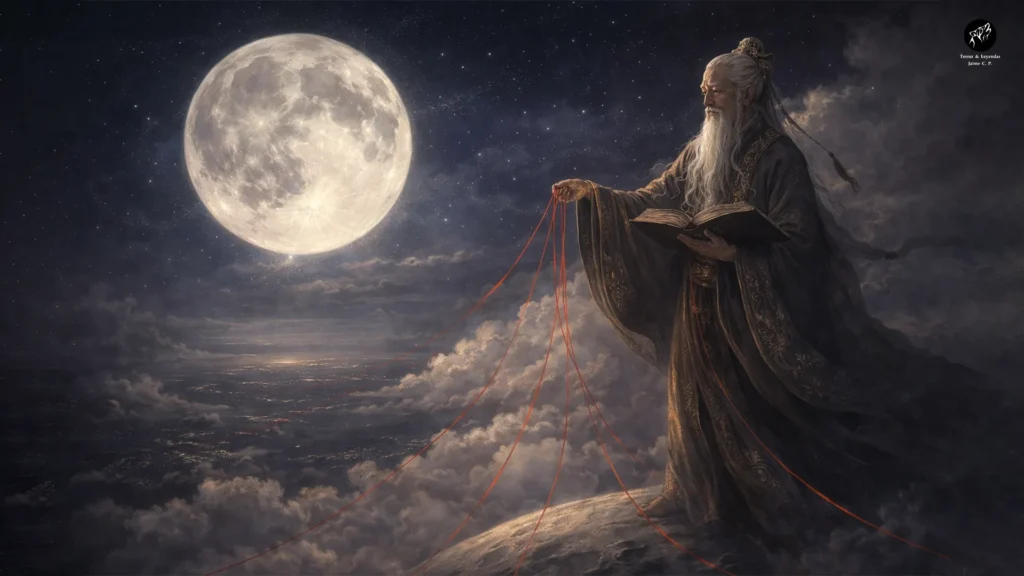
According to an ancient Chinese legend, there is an old man who lives on the moon and silently observes the fate of human beings. His name is Yue Lao, the god of marriage and fated bonds.

Facts about Yue Lao

  • Domain: Love and marriage
  • Distinguishing symbol: Red thread of destiny (紅線)
  • Epoch of origin: Tang Dynasty (618-907 AD)
  • Attributes:
    • Marriage book (姻緣簿)
    • Red threads
    • Staff
    • White beard
  • Associated festivities:
    • Qixi Festival (七夕)
    • Mid-Autumn Festival

The book of destiny and the red thread.

According to legend, Yue Lao possesses a sacred book of marriage, where the names of all fated couples are written. Next to it he keeps invisible red threads, with which he binds those people together from birth.

The red thread:

  • Can be stretched
  • Can become entangled
  • It can be stretched until it hurts

But it never breaks.

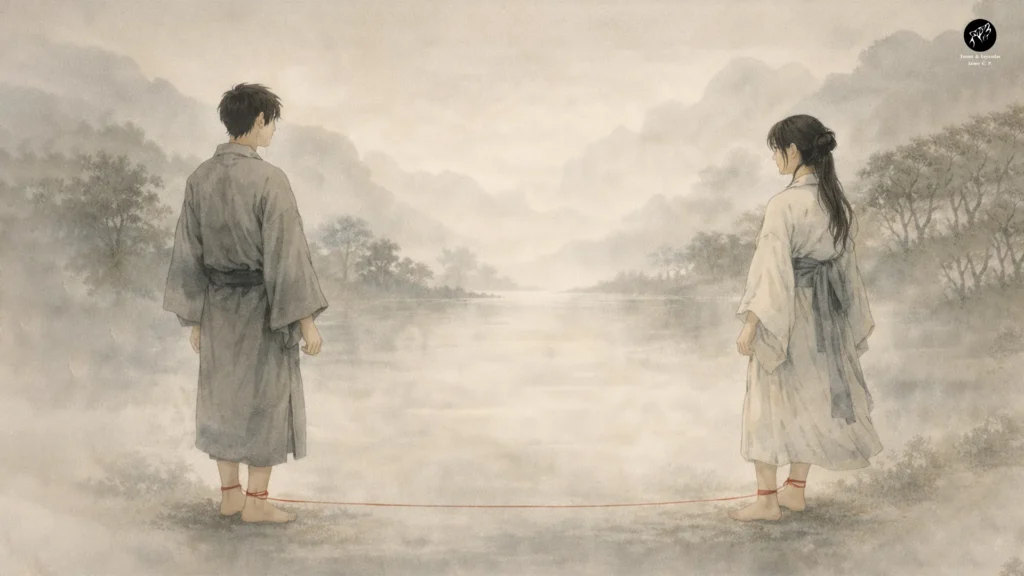
In Chinese tradition, this thread is tied to the ankles of people destined to meet, a key difference from the later Japanese version.

Origin and legend of Yue Lao

The best-known account of Yue Lao appears in the work Xu Xuan Guai Lu, written during the Tang dynasty.

The story narrates that a young scholar named Wei Gu met one night an old man reading a book under the moonlight. The old man was Yue Lao. When asked what he was reading, Yue Lao explained that it was the record of predestined marriages.

Yue Lao also showed him a bag full of red threads, which he used to bind destined couples together.

The old man revealed to Wei Gu who would be his future wife. The young man, incredulous and upset by the prediction, attacked a girl who had been pointed out to him as his destiny.

Years later, Wei Gu married a noblewoman. When he lifted the veil during the wedding, he discovered a scar on her forehead: the same wound he had caused in his youth.

Destiny had been fulfilled.

Iconography and attributes of Yue Lao

Yue Lao is usually depicted as:

  • An old man with a white beard.
  • With a kind and serene expression
  • Dressed in red or yellow robes
  • Carrying a book with the names of the partners
  • Holding red threads of destiny

Often appears under the moon, symbol of his constant vigilance over the affairs of the human heart.

Cultural significance and cult of Yue Lao

The cult of Yue Lao is still very popular in China, Taiwan and other regions of East Asia. Many people flock to Taoist temples to ask for his blessing in love.

Among the best-known temples are:

  • Xia-Hai Temple in Taipei.
  • Wong Tai Sin Temple in Hong Kong.

During the festivities, devotees tie red threads, wear symbolic bracelets or perform rituals to find a mate or strengthen their marriage.

Yue Lao and the Red Thread of Destiny

The legend of Yue Lao is considered the oldest origin of the Red Thread of Destiny. From this myth later versions emerged, such as the Japanese reinterpretation known as Akai Ito.

While Japan transformed the story into a poetic metaphor for fated love, the Chinese tradition retains a more solemn approach:
fate is not defied without consequences.

Contemporary relevance

Today, Yue Lao continues to inspire:

  • Asian films and dramas
  • Romantic novels
  • Modern rituals
  • Cultural practices related to love

Her figure represents a persistent belief in Chinese culture: some encounters are not casual, they are written from before birth.

Conclusion

The legend of Yue Lao, the Elder of the Moon, is one of the deepest roots of the myth of the Red Thread of Destiny. It is not only a love story, but a reflection on time, fate and the bonds that define a life.

Perhaps the thread can’t be seen….
but many claim to have felt it tighten at one time or another.

La Leyenda de San Valentín

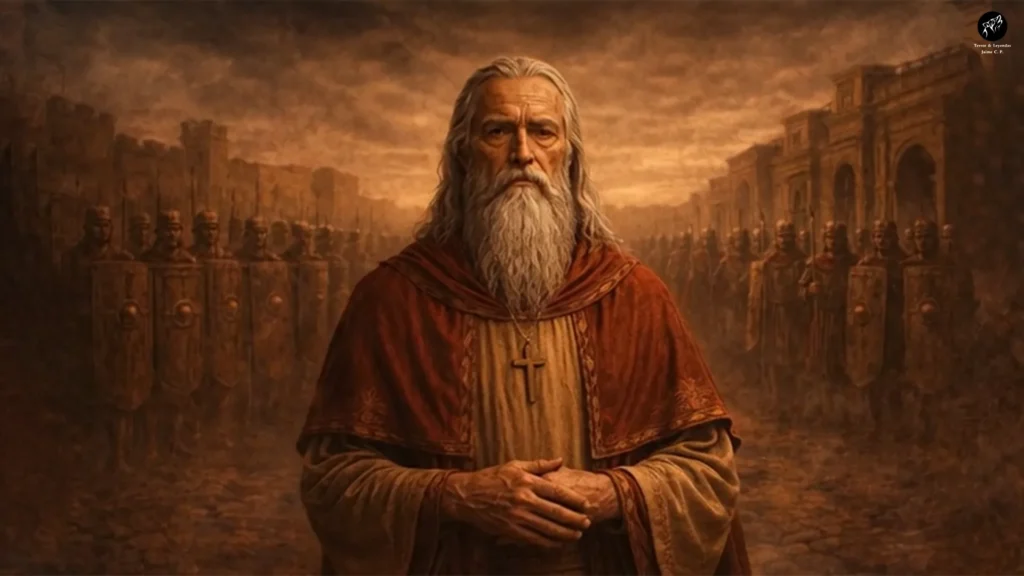
Every February 14 the world is filled with flowers, promises and sweet words. However, the original story of St. Valentine is far from modern romanticism. He was born in a time of persecution, punishment and death; in a Rome where loving, believing and disobeying could cost one’s life.

The legend of St. Valentine is no light fable. It is the tale of a man who defied the Empire, of a young girl named Julia who illuminated his last days and of a letter written from the shadows, when the end was inevitable.

Who was really St. Valentine?

Christian tradition speaks of St. Valentine as a priest – or, in some versions, a bishop – who lived in Rome during the third century. In that period, Emperor Claudius II promoted measures that favored single soldiers, convinced that having no ties made them more effective in war.

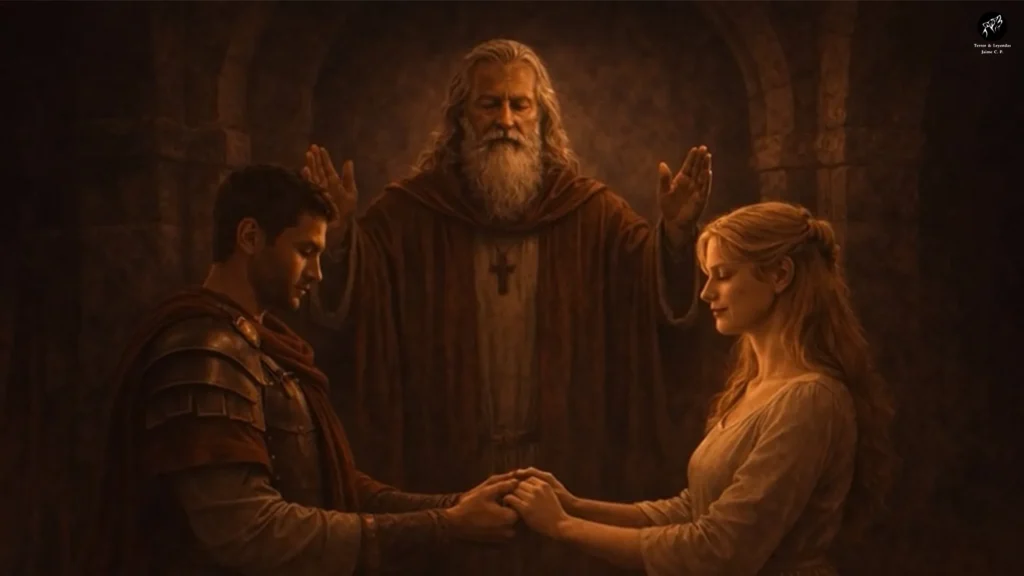
Valentinian, guided by his faith, continued to celebrate marriages in secret. For him, love and commitment could not be subject to political decrees. This gesture, apparently intimate, was read by those in power as a direct challenge.

La Leyenda de San Valentín

The crime that condemned him

The clandestine ceremonies came to light. Valentinus was arrested and charged with disobedience, rebellion and treason against the Roman laws. He was not punished for loving, but for refusing to obey.

In prison he was interrogated and pressured to renounce his faith. He refused. He knew the price would be high.
Finally, he was condemned to death and executed on February 14, around 269 A.D., by beheading, a punishment reserved for those who defied the authority of the state.

Julia: the light inside the cell

Here begins the most human – and most disturbing – part of the legend.

During his imprisonment, Valentine was placed in the custody of a Roman official identified by tradition as Asterius. He had a daughter named Julia, described as blind (or seriously ill, depending on the version). Asterius allowed Valentinus to speak with her.

In the silence of the prison, Valentinus and Julia talked. Not about romance, but about faith, hope and the world she could not see. Legend has it that Valentin prayed for Julia and she regained her sight, an event that deeply marked both of them and, according to some accounts, brought her father closer to Christianity.

How long did they talk?

Until the end.
The conversations take place during the days of imprisonment, shortly before the execution. Julia was, according to tradition, the last luminous presence in Valentin’s life, the last human link before martyrdom.

La leyenda del Hilo Rojo del Destino

YOU MAY BE INTERESTED IN

The legend of the Red Thread of Destiny

Not everyone who comes into your life does so by chance.
According to an ancient Japanese legend, there are encounters that are written long before we are born. An invisible bond, impossible to break, unites certain people regardless of time, distance or mistakes made along the way.

The final letter: “From your Valentine”.

Before he died, Valentin wrote a note addressed to Julia. It was neither a festive gesture nor a commercial symbol. It was a farewell, written by someone who knew he would never see the light of day again.

The signature attributed to that letter became the origin of everything:

“From your Valentine.”

Read with distance, the phrase does not sound like light romance, but like last words. A message that outlived the body that wrote it.

When was Saint Valentine declared a saint?

After his death, Valentine was venerated as a Christian martyr by the early communities. His cult spread over time, until in 496 A.D., Pope Gelasius I officially declared him a saint and set February 14 as a liturgical commemoration day.

At that time, the date was not associated with romantic love, but with the memory of sacrifice and faith.

Why did February 14 become a celebration?

The Church also sought to replace ancient pagan festivities celebrated in mid-February, associated with fertility and excess. By consecrating that day to St. Valentine, the calendar was Christianized and the meaning of the ritual was transformed.

Centuries later, during the Middle Ages, poets and writers began to associate February 14 with idealized love. Thus the metamorphosis occurred:

  • The martyr became a symbol
  • The cell became a metaphor
  • The farewell became tradition

The result is the modern celebration we know.

The version that almost nobody remembers

Some popular traditions hold that St. Valentine’s Day:

  • Protects forbidden loves
  • Blesses unions that defy norms
  • Demands sacrifice from those who vow eternal love in his name

Perhaps that is why its story continues to resonate. Because it does not speak of a comfortable love, but of one that defends itself even when the price is death.

Conclusion

The true legend of St. Valentine was born not among flowers and gifts, but in a Roman prison. It began with a condemned man, a young woman named Julia and a letter written before he died.

The next time you hear “Happy Valentine’s Day,” remember this:
the love celebrated on that day was born as a farewell.

La leyenda del anciano de la luna y el Hilo Rojo del Destino

According to an ancient Chinese legend, there is an old man who lives on the moon and silently observes the fate of human beings. His name is Yue Lao, the god of marriage and fated bonds.

It is said that Yue Lao possesses a sacred book in which the names of all people destined to meet are written. Along with that book, he keeps long red threads invisible to human eyes.

Every night, when the moon rises over the earth, the old man descends to search for the souls who are destined to be united. When he finds two people whose destiny is linked, he ties a red thread between them. From that moment on, they are united forever.

The red thread can lengthen, tighten or tangle with the passage of time. People bound by it can drift apart, live in different places, make mistakes or even hate each other without knowing why. However, the thread never breaks.

In some versions of the legend, the thread is tied to people’s ankles; in others, it is said to be attached to invisible parts of the body or spirit. What is important is not where it is tied, but what it represents: an unavoidable bond.

La leyenda del anciano de la luna y el Hilo Rojo del Destino

Yue Lao does not intervene in how or when encounters occur. He does not force love or impose decisions. His task is only to ensure that paths cross. The rest is left to humans.

Thus, the legend teaches that not all encounters are meant to be happy, but they are meant to be meaningful. Some unions last a lifetime; others only long enough to leave an indelible mark.

It is said that when two people finally meet, the thread is no longer taut. And though it remains invisible, its purpose has already been fulfilled.

Thus, the old man of the moon continues his work night after night, weaving destinies that humans call chance, but which in reality were already written.

La leyenda del Hilo Rojo del Destino

YOU MAY BE INTERESTED IN

The legend of the Red Thread of Destiny

Not everyone who comes into your life does so by chance.
According to an ancient Japanese legend, there are encounters that are written long before we are born. An invisible bond, impossible to break, unites certain people regardless of time, distance or mistakes made along the way.

You may be interested in: Stay With Me: Stories of Love and Sadness

La leyenda del emperador y la bruja

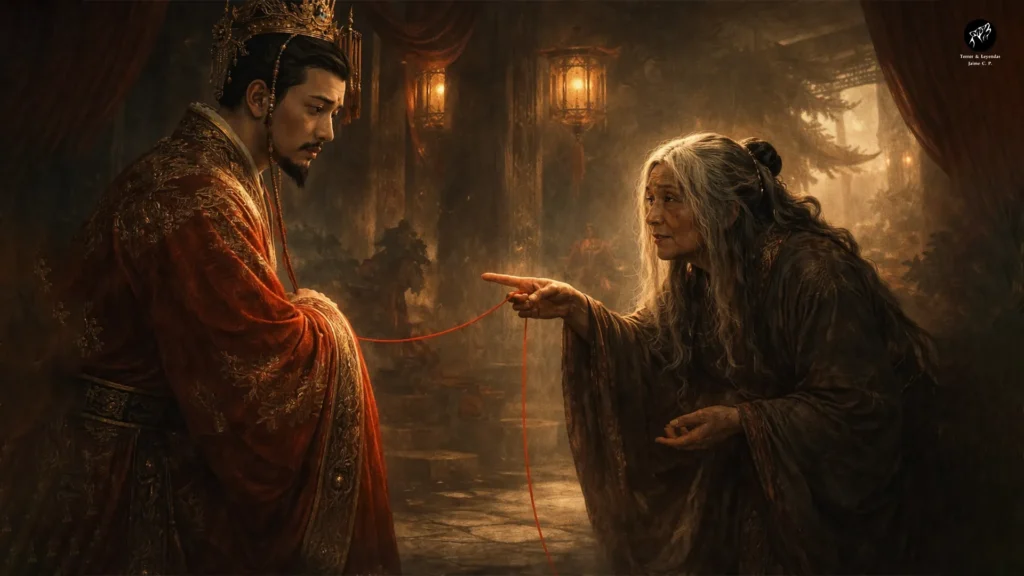
A long time ago, an emperor heard a rumor that aroused his curiosity and his pride.
In one of the provinces of his kingdom lived a witch with an extraordinary gift: she could see the Red Thread of Destiny, the invisible bond that unites people destined to meet.

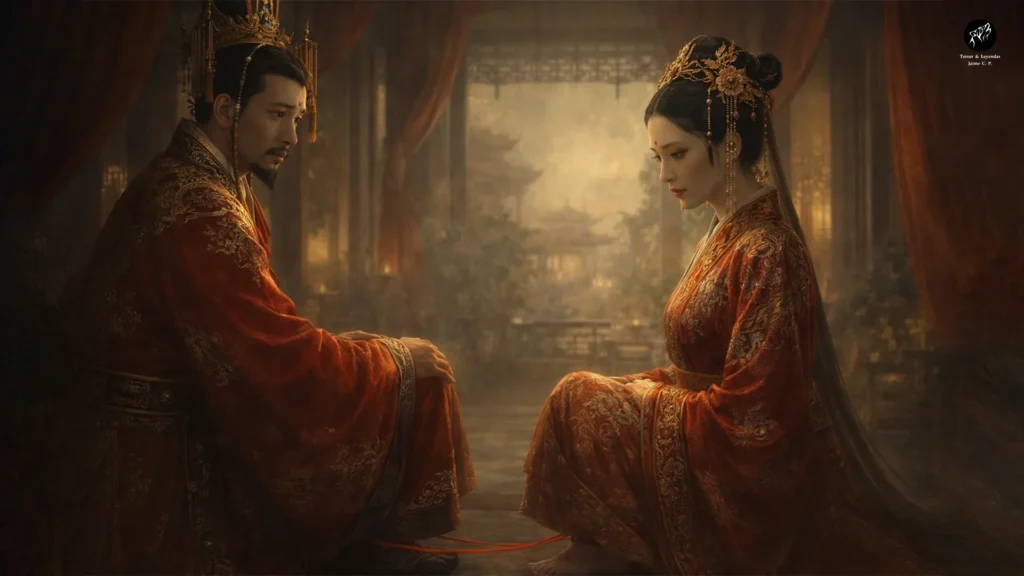
Intrigued by this power, the emperor ordered the woman to be brought before him. When the witch arrived, he demanded that she find the other end of the red thread tied to her little finger and lead him to the woman who was destined to be his wife.

The witch accepted the order and began to follow the invisible thread. The journey led them to a humble market, where a peasant woman, with her baby in her arms, was offering her products. The witch stopped in front of her and asked her to stand up.

Then she made the emperor approach her and said in a firm voice:

-Here ends your thread.

The emperor, hearing those words, burst out in anger. He thought the witch was mocking him. In his fury, he pushed the peasant woman, who fell to the ground without letting go of her daughter. The baby violently hit her forehead and was seriously injured.

Out of his mind, the emperor ordered the witch to be arrested and beheaded for having deceived him.

La leyenda del emperador y la bruja

Time passed.

Many years later, the emperor decided to marry. His court recommended him to marry the daughter of a powerful general. He accepted without objection and, finally, the wedding day arrived.

When the bride lifted her veil, the emperor was paralyzed.
On his wife’s forehead there was a very particular scar.

At that moment he understood the truth.

That baby wounded in the market?
was the woman with whom he was now destined to share his life.

The emperor understood, too late, that the Red Thread of Destiny cannot be broken, and that the punishment for defying it does not always come immediately, but it is always fulfilled.

La leyenda del Hilo Rojo del Destino

YOU MAY BE INTERESTED IN

The legend of the Red Thread of Destiny

Not everyone who comes into your life does so by chance.
According to an ancient Japanese legend, there are encounters that are written long before we are born. An invisible bond, impossible to break, unites certain people regardless of time, distance or mistakes made along the way.

You may be interested in: Stay With Me: Stories of Love and Sadness

La leyenda del Hilo Rojo del Destino

Not everyone who comes into your life does so by chance.
According to an ancient Japanese legend, there are encounters that are written long before we are born. An invisible bond, impossible to break, unites certain people regardless of time, distance or mistakes made along the way.

That bond is known as the Red Thread of Destiny, one of the most famous and symbolic legends of Eastern tradition. In this article you will discover what it is, what its origin is, what it really means and why it continues to fascinate the whole world.

What is the Red Thread of Destiny?

The Red Thread of Destiny is an ancient belief that states that people destined to meet are united from birth by an invisible red thread.

This thread has very clear characteristics according to the legend:

  • It cannot be seen
  • It cannot be broken
  • It can be stretched or tangled
  • It always fulfills its purpose

Sooner or later, people united by it will end up meeting, especially in the realm of love, although not exclusively.

La leyenda del emperador y la bruja

YOU MAY BE INTERESTED IN

The legend of the emperor and the witch

A long time ago, an emperor heard a rumor that aroused his curiosity and his pride.
In one of the provinces of his kingdom lived a witch with an extraordinary gift: she could see the Red Thread of Destiny, the invisible bond that unites people destined to meet.

Origin of the legend of the Red Thread of Destiny

Although today it is mainly associated with Japan, this legend has its origins in China, where it emerged as part of its traditional mythology.

In the Chinese version, the one in charge of bringing people together is Yue Lao, the moon elder and god of marriage. It is said that Yue Lao observes humans from the sky and ties a red thread between those who are destined to share an important bond.

La leyenda del Hilo Rojo del Destino

Over time, the story made its way to Japan, where it was adapted and reinterpreted under the name Akai Ito (赤い糸), which literally means red thread.

Where is the Red Thread of Fate tied?

The location of the thread changes according to culture:

  • In the Chinese tradition, the thread is tied to the ankles.
  • In the Japanese tradition, the thread is tied to the little finger of the left hand.

This belief gave rise to the popular idea that the little finger is directly connected to the heart, which reinforces the romantic and emotional symbolism of the legend.

La leyenda del Hilo Rojo del Destino

Meaning of the color red in the legend

The color red has deep significance in Eastern cultures. In the context of the Red Thread of Destiny, it represents:

  • Love and passion
  • Life and vital energy
  • Spiritual protection
  • Good fortune
  • Inevitable destiny

Therefore, the thread could not be any other color. Red symbolizes that which is marked, protected and destined to be fulfilled.

You may be interested in: Stay with Me: Stories of Love and Sadness

The true message of the Red Thread of Destiny

Beyond a romantic story, this legend conveys a profound message about destiny and human bonds.

The Red Thread of Fate teaches that:

  • True love is not always immediate
  • Fated people can be separated for years
  • The path can be painful or confusing
  • The final encounter is not always happy

The legend does not promise perfect endings, but inevitable encounters.

La leyenda del anciano de la luna y el Hilo Rojo del Destino

YOU MAY BE INTERESTED IN

The Legend of the Old Man of the Moon and the Red Thread of Destiny

According to an ancient Chinese legend, there is an old man who lives on the moon and silently observes the fate of human beings. His name is Yue Lao, the god of marriage and fated bonds.

The Red Thread of Fate in today’s culture

Today, this legend is still very present in popular and contemporary culture. It appears frequently in:

  • Japanese anime and manga
  • Romantic movies and series
  • Literature and poetry
  • Tattoos, bracelets and amulets
  • Modern spiritual philosophies

It has become a universal metaphor for talking about deep connections that defy logic and chance.

Does the Red Thread of Fate only unite couples?

Traditionally, the Red Thread of Destiny is associated with romantic love. However, more modern interpretations point out that it can also unite:

  • Spiritual soul mates.
  • People destined to change each other’s lives
  • Family or karmic ties

Not all threads lead to eternal love, but all lead to meaningful encounters.

Conclusion

The legend of the Red Thread of Destiny has endured for centuries because it answers a universal question:
Are we destined to meet certain people?

Perhaps the thread cannot be seen, but many claim to have felt it tighten at some point in their lives. And if you’ve ever met someone who changed your path with no apparent explanation, maybe it wasn’t a coincidence.

Perhaps, without knowing it, the red thread was already there.

Origen prehispánico de La Llorona

Long before the legend of La Llorona took the form of a woman dressed in white who wanders the rivers at night, there were already stories in Mesoamerica about a female figure linked to weeping, motherhood and death.
Far from being a myth that emerged during the Colonial period, the oldest origin of La Llorona is found in pre-Hispanic beliefs, where the crying of a supernatural woman was interpreted as an omen of misfortune and destruction.

Understanding this origin is fundamental to understanding why the legend has survived for centuries and why her lament continues to be one of the most haunting in Mexican folklore.

Early references to female weeping in Mesoamerica

In pre-Hispanic cultures, weeping was not only an expression of human pain. It was also a divine sign, a warning sent by higher forces.
The weeping of certain female entities was related to loss, war, death and the end of a cycle.

Among the Mexica peoples there were stories about a supernatural woman who wandered at night crying for her children, announcing calamities for her people. These stories were collected after the Conquest by chroniclers who documented indigenous beliefs, preserving fragments of a much older tradition.

Cihuacóatl: the weeping mother

One of the most important figures linked to the pre-Hispanic origin of La Llorona is Cihuacóatl, whose name can be translated as “snake woman”.
She was a deity associated with motherhood, childbirth, war and death, as well as the protection of children.

Paradoxically, she was also deeply linked to grief for the loss of children.

Cihuacóatl was considered the symbolic mother of the Mexica people, but at the same time she was a feared figure, for her weeping heralded misfortune. She did not cry out of weakness, but as a warning: her voice presaged the end of something important.

La leyenda de La Llorona

YOU MAY BE INTERESTED IN

La Llorona: real origin and history of the Mexican legend

Few figures in Mexican folklore are as disturbing as La Llorona, that presence that seems to manifest itself when the night becomes too silent and the water reflects more shadow than light.

Weeping as a harbinger of the fall of the Mexican world.

According to 16th century chronicles, including those compiled by Bernardino de Sahagún, before the arrival of the Spaniards, the cry of a woman crying for her children was heard at night.

The stories describe that this figure appeared at night, wept inconsolably, walked near the water and announced the end of an era.
This cry was later interpreted as one of the omens of the fall of Tenochtitlan and the collapse of the Mexica world.

The woman was not weeping for individual children, but for an entire people destined to disappear.

Relationship with water and the underworld

In the pre-Hispanic cosmovision, water was both a sacred and dangerous element.
Rivers, lakes and canals not only gave life, but also functioned as thresholds to the underworld.

That this female figure always appeared near water was no coincidence.
Water represented the transit between worlds, ritual death and rebirth.

This symbolism explains why, even in later versions of the legend, La Llorona always appears next to rivers, lagoons or canals, keeping intact one of the oldest keys to the myth.

Motherhood as sacred pain

In Mexica thought, motherhood was not only seen as a biological act, but also as a sacrifice.
Women who died during childbirth were considered warriors and their spirit possessed a special power.

Cihuacóatl embodies this vision: a powerful mother, but also a tragic one.
Her weeping does not represent weakness, but sacred pain, the lament of one who loses that which she was meant to protect.

This concept survived the passage of time and was transformed during colonial times, when the divine mother was reinterpreted as a woman punished for losing her children. However, the symbolic background never disappeared.

From deity to specter: the transformation of the myth

After the Conquest, pre-Hispanic deities were reinterpreted from a Christian viewpoint.
Figures such as Cihuacóatl ceased to be understood as divine entities and began to be transformed into souls in pain, punished spirits and nocturnal apparitions.

Thus, sacred weeping became condemnation, and the divine mother became a spectral woman.
This process marked the transition between the pre-Hispanic myth and the colonial legend of La Llorona, as it is known today.

The pre-Hispanic origin of La Llorona and its permanence

The fact that La Llorona has such an ancient origin explains why she appears almost everywhere in Mexico, adopts different regional forms and maintains constant elements such as crying, water and night.

It is not an isolated story, but a myth deeply rooted in the Mesoamerican cosmovision, adapted over time to new times and beliefs.

Conclusion

The pre-Hispanic origin of La Llorona shows that this figure existed long before the Colonial period and that her lament was not born of an individual tragedy, but of a collective pain.
Before being a punished woman, she was a divine mother who wept for the destruction of her people.

That is why, when her lament is heard today in rivers and lonely roads, it is not only a legend of terror, but the echo of a civilization that disappeared, but that still cries in the memory of Mexico.

YOU MAY BE INTERESTED IN: Legends of Mexico

La leyenda de La Llorona

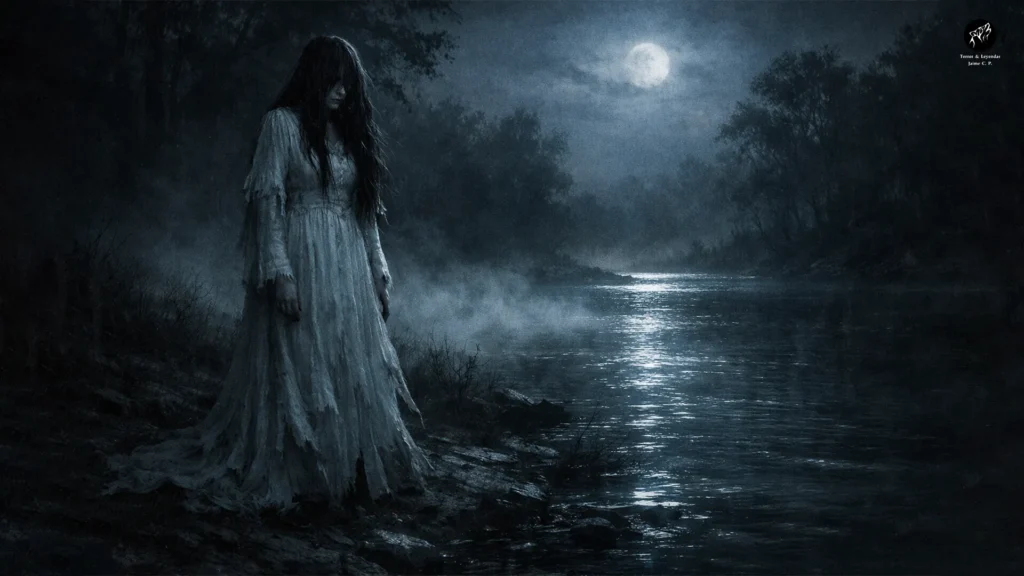
Few figures in Mexican folklore are as disturbing as La Llorona, that presence that seems to manifest itself when the night becomes too silent and the water reflects more shadow than light. Her story has endured for centuries because it does not belong to a single time or place: it is born of ancient myth, transformed into colonial tragedy and survives thanks to oral tradition.

Throughout Mexico there are different versions of this legend, but they all coincide in the same disturbing element: its lament does not belong to this world.

Who really was La Llorona?

La Llorona does not come from a single story or a single woman. Her figure was built over time, mixing pre-Hispanic, colonial and modern roots, until she became one of the most deeply rooted myths in the Mexican imagination.

To understand its origin, it is necessary to go through these three fundamental stages.

Pre-Hispanic origin of La Llorona

Before the arrival of the Spaniards, there were already stories about a female figure linked to weeping, motherhood and death.
Chronicles from the 16th century, especially those compiled by Fray Bernardino de Sahagún, mention Cihuacóatl, an entity associated with childbirth and fatal omens.

In these ancient accounts, this figure:

  • cried for her lost children,
  • manifested near the water,
  • and announced impending tragedies.

These records are considered the oldest antecedent of what, centuries later, would be identified as La Llorona.

Origen prehispánico de La Llorona

YOU MAY BE INTERESTED IN

Pre-Hispanic origin of La Llorona before the Conquest

Long before the legend of La Llorona took the form of a woman dressed in white who roams the rivers at night, there were already stories in Mesoamerica about a female figure linked to weeping, motherhood and death.

La Llorona in colonial times

During New Spain, the legend took on a more human and tragic face.
Stories began to circulate of indigenous women who were seduced, abandoned and condemned to social rejection.

Colonial accounts tell of:

  • forbidden love affairs,
  • unrecognized mestizo children,
  • public shame,
  • and family tragedies that ended in the rivers.

Documents from the 17th century already mention a woman dressed in white crying for her children during the night, an image very close to today’s version.

The modern version of the legend

Over time, pre-Hispanic beliefs and colonial tragedies merged in the oral tradition, giving rise to the most widespread version of La Llorona:
a beautiful woman, betrayed by the man she loved, who in an act of grief drowns her children and is condemned to mourn them for eternity.

This is the version that has been passed down from generation to generation to the present day.

La Leyenda de La Llorona

The traditional story of La Llorona

The story goes that many years ago, in a village near a river, there lived a woman whose beauty caught everyone’s attention. She had dark hair, bright eyes and a presence that was effortlessly bewitching.

A wealthy gentleman fell in love with her and, with sweet words and promises of the future, managed to win her trust.
From this relationship three children were born.

For a time, the woman believed that happiness was real. However, the man never kept his promise to formalize the relationship.
One day, she saw him riding through town on his horse, dressed in full dress and accompanied by a rich lady.
She was his legitimate wife.

Her heart broke at that instant.

That night, under a moonless sky, she took her children to the river. He embraced them in despair, wept silently and asked for forgiveness.
And in an instant of madness and pain, she let them fall into the dark waters.

The river carried them away, and when she understood what she had done, her cry echoed throughout the valley:

-Oh, my children!

At dawn, the inhabitants of the village found her lifeless….
but her soul never rested.

What does La Llorona do?

According to oral tradition, La Llorona continues to wander between this world and the next, searching for the children she lost.

The stories agree that:

  • she appears near rivers, lagoons and lonely roads,
  • confuses living children with her own,
  • announces misfortunes or deaths,
  • it causes a sudden chill in the air,
  • and its cry changes according to the distance:
    if heard near, it is far away; if heard far away, it is very near.

Regional variants of La Llorona in Mexico

The legend of La Llorona is not told in the same way everywhere. Each region adapted it to its environment, always keeping the crying as a central element.

In Xochimilco, it is said that she floats through the mist of the canals at dawn.
In Guanajuato, it travels through colonial streets and is associated with a legendary tomb.
In Oaxaca, it crosses bridges at dawn leaving a trail of water.
In the north of the country, it takes a more spectral form, sometimes described as a foggy figure.
In the southeast, it mixes with local beliefs and appears near cenotes and jungle paths.

The meaning of La Llorona

Beyond terror, La Llorona symbolizes:

  • the irreparable pain of a mother,
  • eternal guilt,
  • abandonment,
  • historical inequalities,
  • and the deep fears that have accompanied Mexican society since colonial times.

It is not just a story of fear:
It is an emotional reflection of centuries of history.

Is the legend of La Llorona real?

There is no historical evidence that identifies a single woman as the authentic Llorona.
However, there are chronicles, records and testimonies that confirm the antiquity and cultural strength of the myth.

In that sense, La Llorona is as real as the fears, guilt and pain that have accompanied mankind throughout time.

Conclusion

La Llorona is more than a legend: she is a voice that runs through the history of Mexico from ancient times to the present.
Her lament is still alive because it represents human emotions that never end.

And as long as there are rivers, lonely roads and too silent nights, there will always be those who claim to have seen her passing by, murmuring in the darkness:

-Oh, my children!

YOU MAY BE INTERESTED IN: Legends of Mexico

La leyenda de Artabán

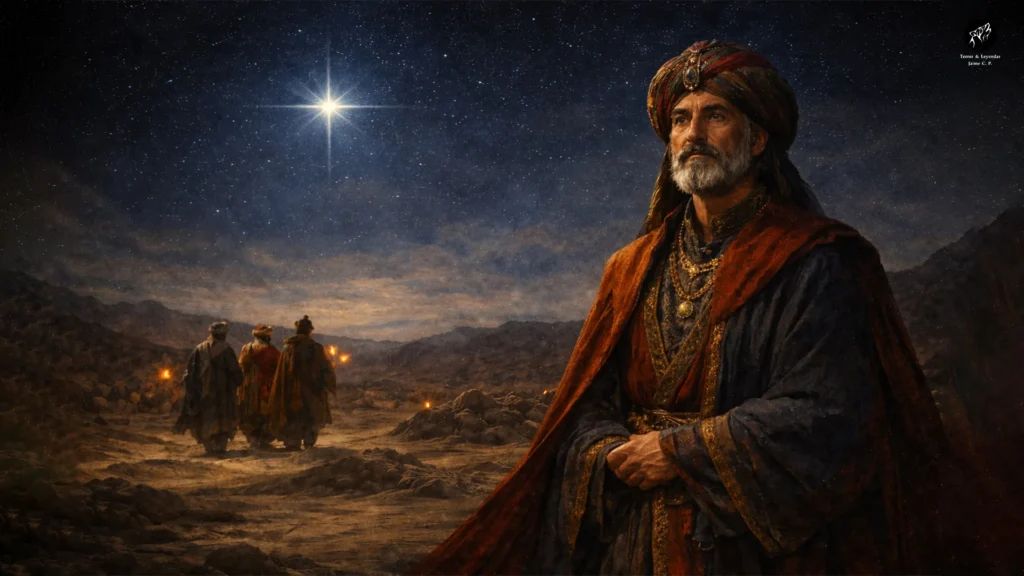
It is said that, in addition to Melchior, Gaspar and Balthasar, there was a fourth wise man from the East named Artaban.

Artaban was a Persian wise man who, like the other Wise Men, observed in the sky the star that announced the birth of the Messiah. Understanding its meaning, he decided to set out on a journey to Bethlehem to pay homage to it.

Before leaving, he gathered three jewels of great value:
A diamond, a ruby and a jasper.
These treasures were to be his offering to the baby Jesus.

However, when he began his journey, his path was different.

During the journey, Artaban found a badly wounded man by the side of the road. No one stopped to help him. Although he knew that stopping meant being delayed, Artaban could not ignore his suffering. To save his life, he gave the diamond he had set aside for Christ and stayed with him until he was safe.

When he resumed his march, it was too late. Artaban arrived in Bethlehem after the child had been taken to safety.

Some time later, he witnessed the horror provoked by the order of King Herod, who had the little children killed. In the midst of the tragedy, Artaban found a desperate mother trying to save her son. Without hesitation, she gave up her ruby to allow the child to escape.

Years passed and Artaban continued on his way helping those he met. Finally, as an old man, he arrived in Jerusalem. There he saw a young slave girl condemned to a life of suffering. Moved by compassion, he gave his last jewel, the jasper, to buy her freedom.

Then Artaban was left without riches, without gifts and without ever having seen the child Jesus.

He thought he had failed.

He never reached the manger.
He never saw the Messiah.
He never delivered his offerings as he had planned.

But according to legend, at that moment he understood a deeper truth. Christ would have revealed to him:

“What you did for your brothers, you did for me.”

And so Artaban understood that true greatness is not in coming first,
but in serving without expecting anything in return.

Note

This legend is based on the book The Other Wise Man, written in 1896 by Henry van Dyke, a work of spiritual character that gave rise to the story of the so-called Fourth Wise Man.

Kuchisake Onna

Kuchisake Onna is one of the most disturbing and persistent Japanese urban legends in modern folklore. Her story, passed down for generations, unfolds in everyday settings – quiet streets, school roads, residential neighborhoods – where a simple question can become a sentence. Also known as the woman with the cut mouth, this figure embodies the fear of the unexpected that lurks in everyday life.

Below, we explore the legend of Kuchisake Onna, its origin, its best-known versions and the reasons why it continues to provoke panic even today.

Kuchisake Onna(口裂け女): quick facts.

  • Name: Kuchisake Onna
  • Meaning: “The woman with the cut mouth.”
  • Origin: Japan
  • Type: urban legend / yūrei (vengeful spirit).
  • Appearances: Streets, alleys, areas near schools.
  • Time of greatest diffusion: 1970s

Who is Kuchisake Onna?

Kuchisake Onna is often described as a tall, elegant woman, dressed in a long coat with a surgical mask covering her face. This detail, common in Japan, allows her to blend in easily among people without arousing suspicion.

She appears mainly at night and approaches people walking alone. His tone is calm, almost friendly. He then asks the question that defines the legend:

– “Am I beautiful?”

What is disturbing is not only her appearance, but the calm with which she begins an encounter that, in most accounts, ends in tragedy.

The Legend of Kuchisake Onna: Origin and History

The origin of the legend of Kuchisake Onna dates back to Edo-period Japan, although there are no official historical records confirming a real case. The most widespread version tells that she was the wife of an extremely jealous samurai. Convinced of her infidelity, he brutally punished her by cutting her mouth from side to side while asking her who could consider her beautiful after that.

After her death, her spirit returned as a vengeful apparition, doomed to repeat the question that marked her fate.

It was in the 1970s, however, that the legend resurfaced with a vengeance. Rumors of sightings spread throughout Japan, especially near schools. The panic was such that some schools organized patrols to escort children home, and the media amplified the collective fear.

The encounter with the woman with the cut mouth

The core of Kuchisake Onna ‘s terror lies in its psychological play. According to most versions:

  • If you answer “yes,” she will remove her mask and reveal her grotesquely cut mouth, repeating the question.
  • If you answer “no,” she will immediately attack you.
  • If you hesitate, remain silent or try to flee, the outcome is rarely favorable.

How to escape from Kuchisake Onna?

Some variants of the legend suggest possible ways to escape, although none are completely certain:

  • Answering something ambiguous like “like this, like this.”
  • Throw candy or money at her to distract her.
  • Break off the conversation with an unexpected question.

These outlets reinforce the unpredictability of the story and increase its tension.

Modern variants of the legend of Kuchisake Onna

Over time, the legend has evolved:

  • In some versions, he carries huge, blood-stained scissors.
  • In others, he can move at impossible speeds.
  • There are stories where she is not a spirit, but a living woman marked by extreme violence.

These adaptations have allowed the woman with the cut mouth to remain in force, adjusting to the fears of each era.

Is Kuchisake Onna real?

There is no historical or police evidence to confirm the real existence of Kuchisake Onna. Its strength comes from rumor, word of mouth and collective suggestion. However, the fear it generated in the 1970s was real: schools were temporarily closed, children were escorted and entire communities were on alert.

Like many urban legends, its impact does not depend on its veracity, but on the emotion it arouses.

Kuchisake Onna in Japanese popular culture

The figure of Kuchisake Onna has inspired films, manga, novels and video games. His constant presence in Japanese popular culture demonstrates how an urban legend can transcend generations and formats, keeping its disturbing power intact.

Beyond entertainment, the story reflects deep fears: domestic violence, the obsession with beauty and the terror of discovering that the familiar can become monstrous.

Why does the legend of Kuchisake Onna continue to cause fear?

Unlike other supernatural stories, Kuchisake Onna does not inhabit faraway places or abandoned castles. He appears in common spaces, on paths that anyone could walk at night. His question is simple, human, and that is precisely why it is so disturbing.

The legend of Kuchisake Onna transforms an everyday conversation into a threat, and turns a human face into a warning.

Conclusion

Kuchisake Onna is not just a horror story: it is a dark reflection of Japanese society and its deepest fears. The legend of the woman with the cut mouth lives on because it adapts, reinvents itself, and is passed on like a haunting whisper in the night.

And maybe that’s why, if ever a woman in a mask stops in front of you and asks if she is beautiful, it may already be too late to think of the answer.

La leyenda de Krampus

The old stories of the alpine mountains tell that, many centuries ago, during one of the coldest nights of the winter, a group of children decided to disobey their parents. Despite the warnings and the strong wind that lashed the village, they left their homes to play in the snow, laughing and making fun of the rules that had been imposed on them.

The night was advancing and the storm was becoming more and more intense. Suddenly, amidst the whistling wind, the children heard a strange sound: the distant echo of bells. At first it seemed faint, almost mistaken for the sound of falling snow, but gradually it became clearer and closer. Along with the bells, the metallic dragging of chains began to be heard.

Fear gripped them as they realized they were not alone.

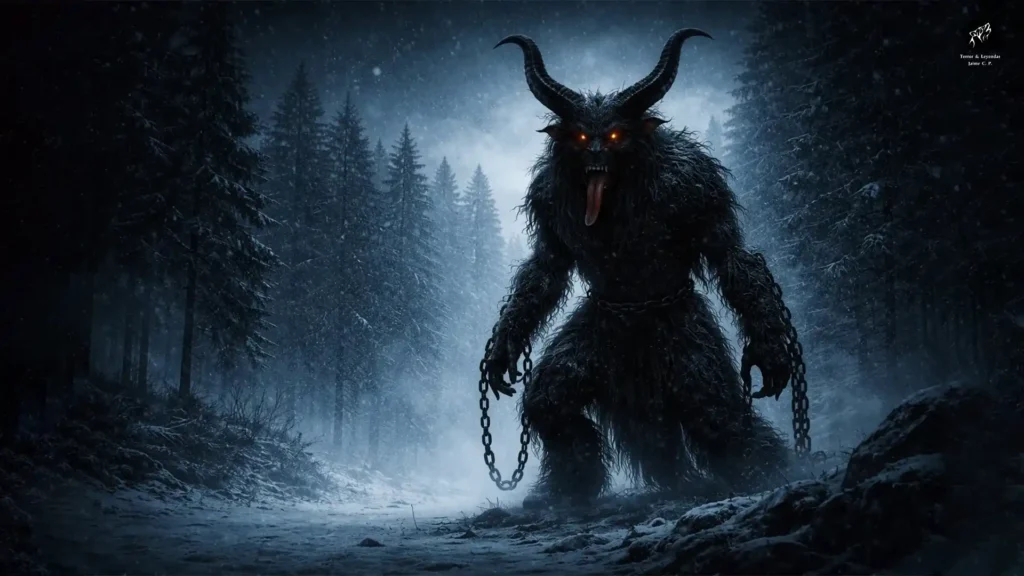
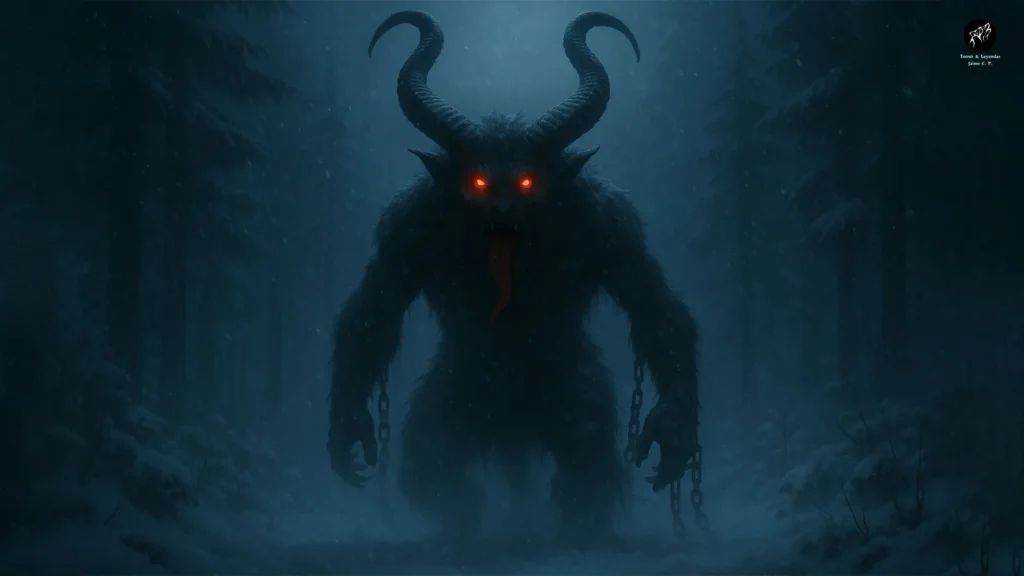
Through the trees of the forest, shrouded in mist and darkness, a huge figure emerged. It had twisted horns, a body covered with thick dark fur and eyes that glowed like burning embers. From its mouth protruded a long red tongue, and from its arms hung heavy chains that clanked with every step. It was Krampus.


Quién es Krampus

YOU MAY BE INTERESTED IN

Krampus: who he is, his origin and the darkest Christmas legend

In the snowy mountains of Central Europe, where winters are as harsh as the stories that were born there, there is a figure that completely breaks with the warm and cheerful image of Christmas. His name is Krampus, a creature feared for centuries in the Alpine regions.


At the sight of the creature, some children fled in terror, losing themselves in the snow. Others, paralyzed with fear, were unable to move. Krampus advanced slowly towards them, lifting an old sack slung over his shoulder. One by one, the children who had misbehaved were caught and stuffed inside, while their screams were lost in the storm.

When dawn came, the village awoke covered by a blanket of fresh snow. That morning, St. Nicholas descended from the mountains to fulfill his annual visit. He handed out sweets and gifts to the obedient children, but soon noticed that some were not there.

When he asked for them, no one could give a clear answer. They only found, marked in the snow that surrounded the forest, deep hoofprints that were lost among the trees.

The children Krampus took away… were never heard from again.

Since then, it is said that every winter, when the wind blows hard and the bells ring in the distance, Krampus goes through the mountains reminding everyone that it is not only goodness that visits the villages at Christmas, but also punishment.

Quién es Krampus

In the snowy mountains of Central Europe, where winters are as harsh as the stories that were born there, there is a figure that completely breaks with the warm and cheerful image of Christmas. His name is Krampus, a creature feared for centuries in the Alpine regions. While St. Nicholas rewards well-behaved children, Krampus represents punishment, warning and the dark side of winter.

Far from being a simple Christmas monster, Krampus is a figure deeply rooted in European folklore and in the cultural history of communities that learned to live with cold, scarcity and darkness.

Who is Krampus

Krampus is described as a half-goat, half-demon creature with huge twisted horns, a body covered in thick dark fur, eyes that glow like embers and a long red tongue protruding from his mouth. It usually carries chains, bells and a sack or wicker basket on its back, where, according to tradition, disobedient children were carried.

His appearance is not casual. Every element of his appearance was designed to make an impact, instill respect and reinforce discipline at a time when social order was essential to survive the winter.

The origin of Krampus: pagan roots

Although today many consider him to be a figure associated with Christian Christmas, the origin of Krampus is much older. Its roots lie in pre-Christian pagan rituals, celebrated during the winter solstice in the Alpine regions.

In these ceremonies, masked men with skins, horns and grotesque faces went through the villages in order to drive away the evil spirits of winter. The clanging of bells, chains and screams were part of the ritual, as it was believed that the din drove away evil forces and protected the community.

When Christianity spread through Central Europe, these traditions were not eliminated. Instead, the Church integrated them into the Christian calendar, giving rise to a clear symbolic duality: St. Nicholas would represent reward and goodness, while Krampus would embody punishment and correction.


La leyenda de Krampus

YOU MAY BE INTERESTED IN

The Legend of Krampus

The old stories of the Alpine mountains tell that, many centuries ago, during one of the coldest nights of the winter, a group of children decided to disobey their parents.


The Night of Krampus and the Krampuslauf

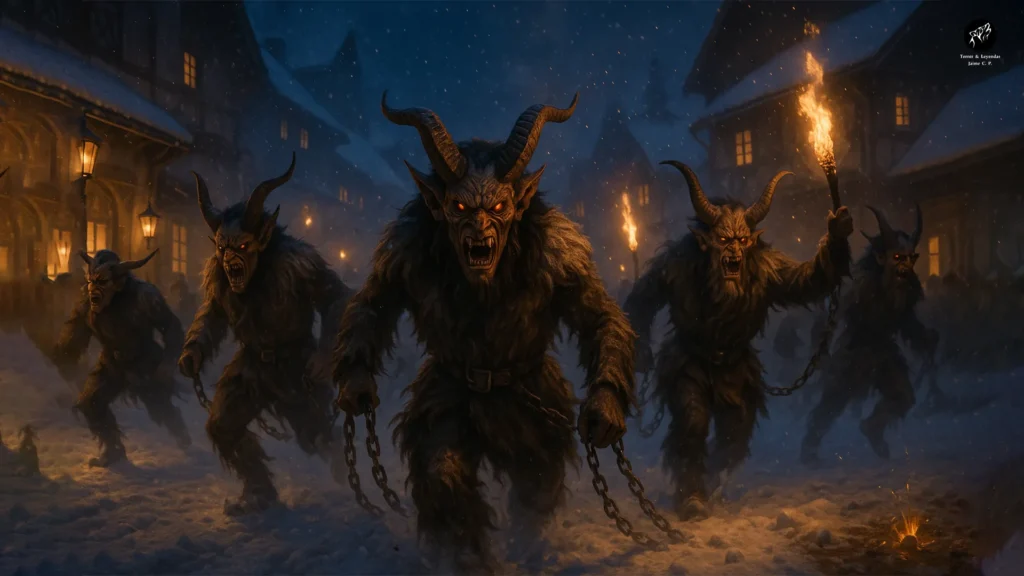
Every December 5, on the eve of St. Nicholas Day, Krampusnacht, known as Krampus Night, is celebrated. In countries such as Austria, Germany, Switzerland and other Alpine regions, this tradition is still alive to this day.

During the night, young villagers don hand-carved demonic masks, thick skins, huge horns and bells. They parade through the streets at nightfall, rattling chains, shouting and symbolically chasing those who cross their path. This parade is called Krampuslauf, the so-called ” Krampusrace”.

Although for many modern spectators it may seem like a chaotic party or a tourist spectacle, for local communities it is an ancestral tradition that connects the present with a past marked by the fear of winter and the need to maintain social order.

Krampusnacht

The punishment in the legend

In the oldest versions of the tale, Krampus was not only frightening. His function was clearly disciplinary. While St. Nicholas handed out sweets, fruit or small gifts, Krampus carried birch rods to punish naughty children or a sack in which he could carry them off into the mountains.

Some darker variants of the legend tell of throwing children into icy rivers, locking them in caves or even devouring them. These stories reflect the mentality of a time when winter represented a real threat and discipline was seen as a means of survival.


Similar figures in Europe

There are other figures with similar functions, such as Knecht Ruprecht in Germany, Pelznickel in the Rhine region, Schmutzli in Switzerland or the Perchten in Austria. They all share a common origin: the need to balance light and darkness during the winter.

However, none of these creatures achieved the fame and visual impact of Krampus, whose demonic image made him one of the most recognizable symbols of Alpine folklore.

Krampus today

Today, Krampus has transcended the local level and has become a global icon. He appears in films, series, festivals and alternative Christmas celebrations. Still, in the Alpine regions his original meaning remains intact: he is not a modern monster, but a cultural figure inherited from past generations.

The Krampuslauf continues to be celebrated every year, proving that the tradition is still alive and that the ancient fear of winter is still part of the European cultural identity.

The shadow that accompanies Christmas

The legend of Krampus did not survive just because it was terrifying. It persisted because it offered a symbolic explanation to a profound human reality: the need for balance between reward and punishment, light and darkness, order and chaos.

It should not be understood as a villain in the modern sense, but as an echo of a primitive winter that Europe never forgot. While Christmas is celebrated with lights and gifts, his figure is a reminder that somewhere, amidst the snow and silence, the bells of a much older tradition still ring.