

The Legend of the Cempasúchil Flower is one of the most poignant and symbolic stories of Mexican tradition. Directly related to the Day of the Dead, this bright yellow flower has become a spiritual bridge between the world of the living and the world of the dead.
But behind its beauty lies an ancient narrative of love, death and reunion that has survived for generations. In this article you will discover the origin of the cempasúchil flower, what it means, what is its relationship with the Mexica culture and why it is still so important in Mexico.
What is the marigold flower?
The marigold flower is an ornamental plant known for its bright yellow and orange tones. Its name comes from the Nahuatl cempohualxochitl, which can be translated as “flower of twenty petals” or “many flowers”.
Currently, it is one of the most relevant symbols of the Day of the Dead in Mexico, as it is used to decorate altars, roads, tombs and offerings dedicated to deceased loved ones.
According to popular tradition, its aroma and color help guide the souls to find their way back home during the celebrations of November 1 and 2.
The Legend of the Cempasúchil Flower
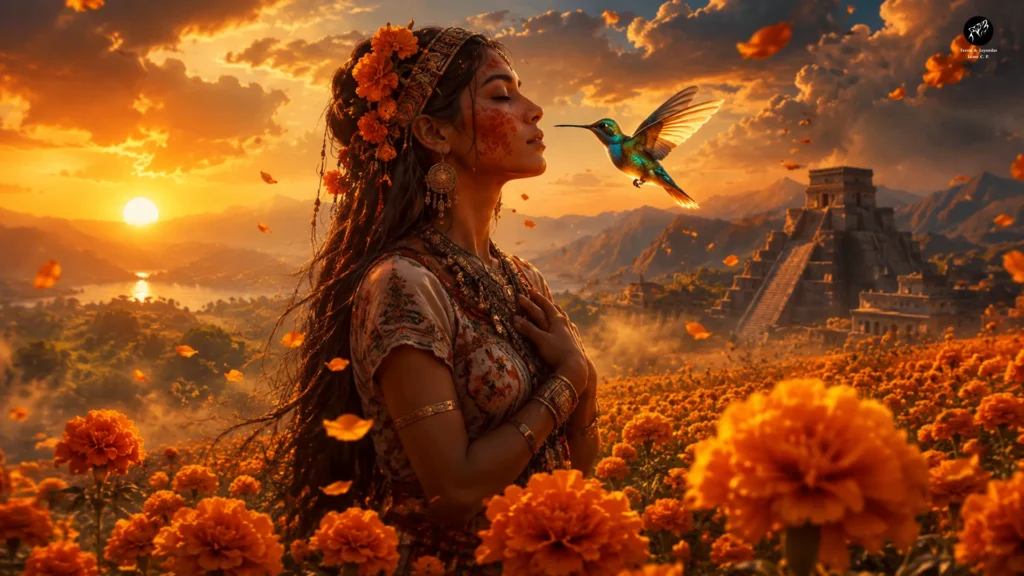
Many centuries ago, when the Mexica Empire dominated a large part of Mesoamerican territory, there lived two young men named Xochitl and Huitzilin.
Since they were young, they shared an inseparable friendship that eventually turned into a deep love. Both used to climb together to the top of a mountain to offer flowers and prayers to Tonatiuh, the god of the Sun.
It is said that the god observed with pleasure the pure love of the young people.
As the years passed, Huitzilin decided to become a warrior. However, during a battle he died defending his people.
The news destroyed Xóchitl’s heart.
Consumed by grief, the young woman climbed back up the mountain where they used to meet and begged Tonatiuh to allow her to be reunited with her beloved.
The sun god listened to her request.
He then sent one of his rays down to earth and transformed Xochitl into a beautiful golden flower with intense yellow petals.
Some time later, a hummingbird flew to the flower and landed gently on it.
At that instant, the flower opened its petals releasing an intense and warm aroma.
Legend has it that the hummingbird was Huitzilin, who had returned from the afterlife to be reunited with his beloved.
Since then, as long as there are marigold flowers and hummingbirds in the world, their love will remain alive.
Meaning of the Leyenda de la Flor de Cempasúchil (Legend of the Cempasúchil Flower)
The legend has a strong symbolism within Mexican culture.
Eternal love
The story represents a love capable of overcoming even death. Xochitl and Huitzilin are reunited thanks to divine intervention.
Connection with the dead
The flower symbolizes the link between the earthly and spiritual worlds. That is why it is used during the Day of the Dead.
Light and spiritual guidance
The intense yellow color represents the light of the sun. According to popular beliefs, this luminosity helps souls find their way to the offerings.
Rebirth
The transformation of Xochitl into a flower represents the continuity of life after death.
Who were Xochitl and Huitzilin?
Although there are no historical records that confirm that they were real people, both characters are part of the Mexican popular imagination.
Xóchitl
The name Xóchitl means “flower” in Nahuatl. It represents beauty, purity and love.
Huitzilin
Huitzilin means “hummingbird”. In several Mesoamerican cultures, hummingbirds were related to fallen warriors and spiritual messages.
The relationship between both characters strengthens the symbolism of the legend.
Relationship between the cempasúchil flower and the Day of the Dead
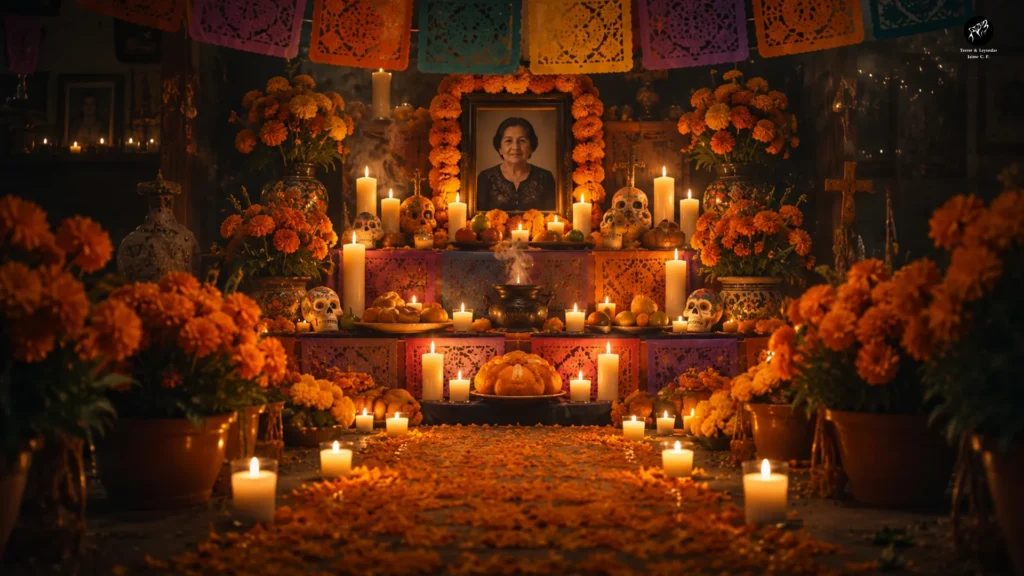
The marigold flower is considered one of the main elements of Mexican ofrendas.
During the Day of the Dead, many families place paths of petals from the entrance of their homes to the altars.
Tradition has it that:
- The bright color attracts souls.
- The scent serves as a spiritual guide.
- The petals mark the way to the offering.
- The flower symbolizes the memory of those who have departed.
In many villages in Mexico there is still a belief that souls return following the trail of the flowers.
The symbolism of the hummingbird in legend
The hummingbird has a special meaning in the Mexica cosmovision.
For the ancient Mexica, these birds were related to:
- The dead warriors.
- The sun.
- Vital energy.
- Spiritual messages.
That is why, in the legend, Huitzilin returns as a hummingbird to visit Xóchitl.
Even today, some people believe that the unexpected presence of a hummingbird may represent the spiritual visit of a loved one.
Historical origin of the cempasúchil flower
Beyond the legend, the cempasúchil flower has an ancestral origin in Mesoamerica.
Pre-Hispanic peoples already used this plant in religious rituals, funeral ceremonies and medicinal practices.
The Mexica associated the color yellow with:
- The Sun.
- Death.
- Spiritual renewal.
- The cycle of life.
With the arrival of the colonial era, many indigenous traditions were mixed with Catholic celebrations, giving rise to the current Day of the Dead.
What does the name cempasúchil mean?
The word “cempasúchil” comes from the Nahuatl word cempohualxochitl.
Its most accepted meaning is:
“flower with twenty petals”.
Although it can also be interpreted as:
“Flower of many petals”.
This refers to the abundance and characteristic shape of the flower.
Characteristics of the cempasúchil flower
The marigold flower belongs to the genus Tagetes.
Among its main characteristics are:
| Característica | Descripción |
| Color | Amarillo y naranja intenso |
| Aroma | Fuerte y penetrante |
| Temporada | Otoño |
| Uso principal | Altares y decoración del Día de Muertos |
| Origen | México y Centroamérica |
In addition to its cultural value, it also has medicinal and ornamental uses.
Why is the marigold flower so important in Mexico?
The marigold flower represents identity, tradition and memory.
Its presence during the Day of the Dead not only has a spiritual, but also an emotional and cultural meaning.
Every year millions of people decorate:
- Altars.
- Cemeteries.
- Houses.
- Streets.
- Ceremonial arches.
In many Mexican regions, the cempasúchil season also boosts the local economy thanks to the production and sale of flowers.
Curiosities about the marigold flower
1. It is also used as a medicinal plant
Some communities use the marigold to prepare traditional remedies.
2. There are different varieties
Although the most famous is the intense yellow one, there are orange and reddish variants.
3. Its aroma helps to repel insects.
For this reason it is also used in orchards and gardens.
4. It is one of the most representative flowers of Mexico.
Along with the dahlia, the cempasúchil is an important part of the Mexican floral identity.
Conclusion
The Leyenda de la Flor de Cempasúchil is much more than just a romantic story.
It represents the union between love, memory and Mexican ancestral traditions.
Thanks to this legend, the cempasúchil flower became one of the most powerful symbols of the Day of the Dead and a representation of the eternal bond between the living and the departed.
Each yellow petal is a reminder that love and remembrance can survive even the passage of time and death.
YOU MAY BE INTERESTED IN: Legends of Mexico