
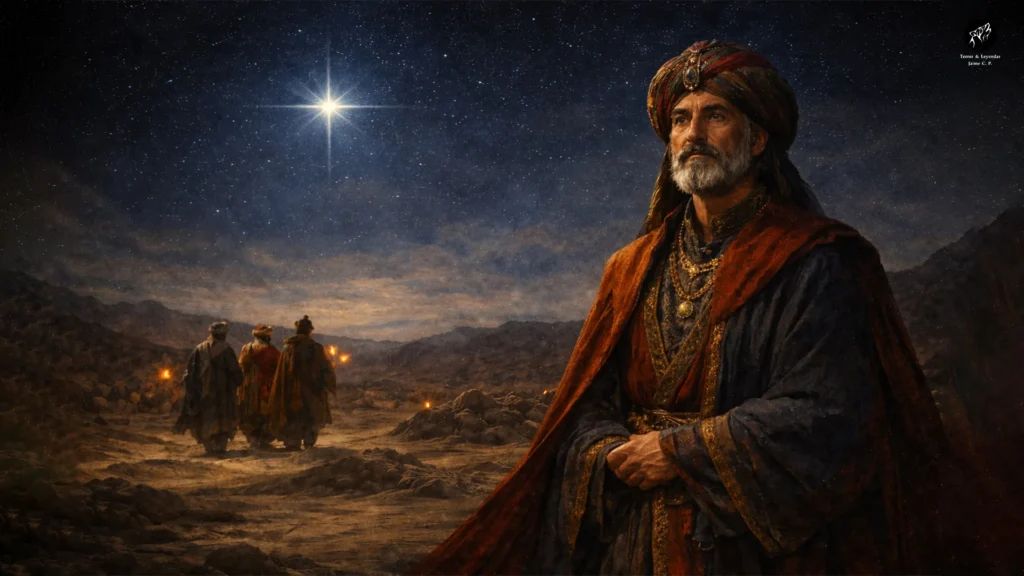

It is said that, in addition to Melchior, Gaspar and Balthasar, there was a fourth wise man from the East named Artaban.
Artaban was a Persian wise man who, like the other Wise Men, observed in the sky the star that announced the birth of the Messiah. Understanding its meaning, he decided to set out on a journey to Bethlehem to pay homage to it.
Before leaving, he gathered three jewels of great value:
A diamond, a ruby and a jasper.
These treasures were to be his offering to the baby Jesus.
However, when he began his journey, his path was different.
During the journey, Artaban found a badly wounded man by the side of the road. No one stopped to help him. Although he knew that stopping meant being delayed, Artaban could not ignore his suffering. To save his life, he gave the diamond he had set aside for Christ and stayed with him until he was safe.
When he resumed his march, it was too late. Artaban arrived in Bethlehem after the child had been taken to safety.
Some time later, he witnessed the horror provoked by the order of King Herod, who had the little children killed. In the midst of the tragedy, Artaban found a desperate mother trying to save her son. Without hesitation, she gave up her ruby to allow the child to escape.
Years passed and Artaban continued on his way helping those he met. Finally, as an old man, he arrived in Jerusalem. There he saw a young slave girl condemned to a life of suffering. Moved by compassion, he gave his last jewel, the jasper, to buy her freedom.
Then Artaban was left without riches, without gifts and without ever having seen the child Jesus.
He thought he had failed.
He never reached the manger.
He never saw the Messiah.
He never delivered his offerings as he had planned.
But according to legend, at that moment he understood a deeper truth. Christ would have revealed to him:
“What you did for your brothers, you did for me.”
And so Artaban understood that true greatness is not in coming first,
but in serving without expecting anything in return.
Note
This legend is based on the book The Other Wise Man, written in 1896 by Henry van Dyke, a work of spiritual character that gave rise to the story of the so-called Fourth Wise Man.