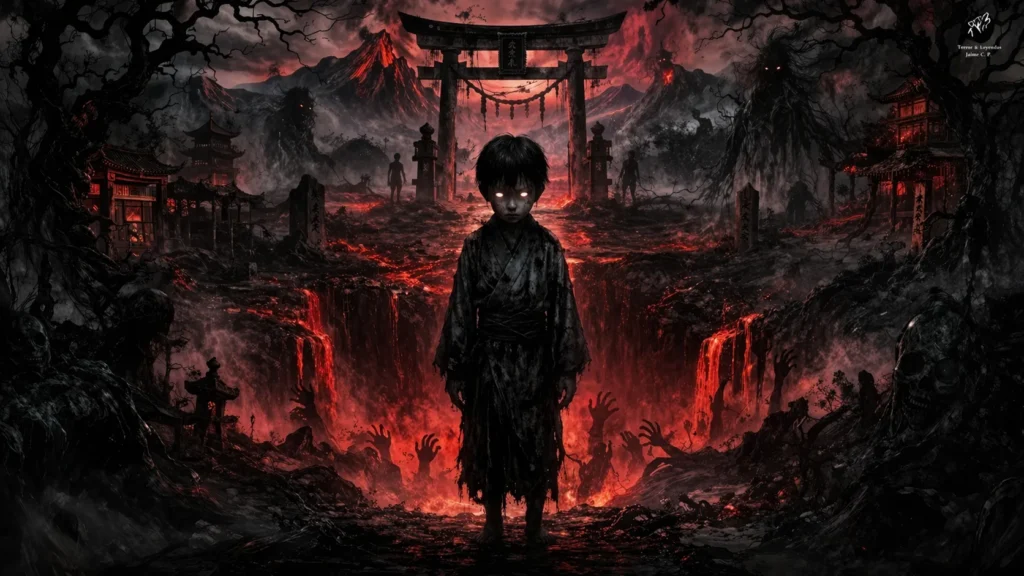

There is a Japanese poem that has disturbed thousands of people around the world. Not because it is forbidden, but because of the warning that surrounds it: some claim that reading it aloud can lead to strange consequences.
It is Tomino’s Hell(Tomino no Jigoku), a work that has gone from literature to become a modern horror phenomenon on the Internet.
What is Tomino’s Hell?
Tomino’s Hell is a Japanese poem written by Saijō Yaso in 1919, published in the collection Sakin (砂金).
Although many people consider it a legend or a forbidden text, it is actually a modern literary work that was eventually reinterpreted as a horror story on the internet.
What happens if you read Tomino’s Inferno aloud?
There is no scientific evidence that reading the poem aloud causes physical or supernatural harm.
However, some people report sensations such as:
- Discomfort or anxiety
- Emotional tension
- Intense mental images
- Feeling of restlessness
This can be explained by the effect of suggestion and the symbolic load of the poem.
Is Tomino’s hell real or just a legend?
As a supernatural phenomenon, it is not real.
As a cultural phenomenon, it is.
The idea that this poem is cursed arose on the internet and was popularized on platforms such as YouTube and Reddit.
It is now considered a modern creepypasta, that is, a viral horror story spread online.
Meaning of the poem Tomino no Jigoku
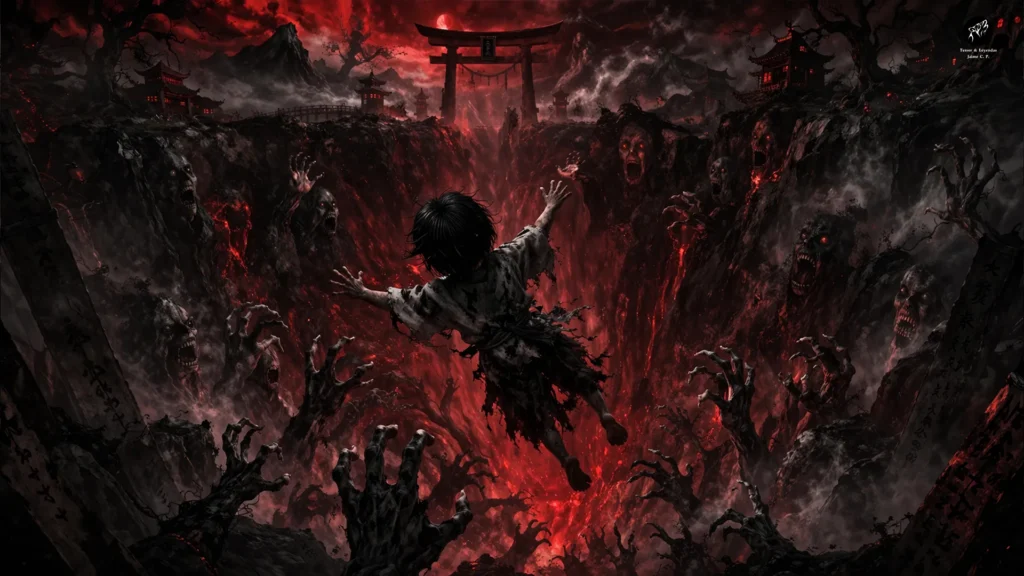
The poem “Tomino no Jigoku” does not describe a literal hell, but an emotional or psychological state.
Among its most widely accepted interpretations are:
- Guilt and internal punishment.
- Childhood trauma
- Loss of innocence
- Loneliness and suffering
Elements such as blood, fire and the solitary journey function as symbols of human pain.
Origin of the poem and its author
Saijō Yaso was a Japanese poet of the Taishō period, known for his symbolic and emotional style.
His work is characterized by the use of intense imagery that seeks to provoke a reaction in the reader, which explains the dark tone of this poem.
Why does this poem cause fear?
The poem’s impact is due to several factors:
- Violent and symbolic imagery.
- Ambiguity in the narrative
- Disturbing rhythm in Japanese
- Influence of suggestion
Fear does not come from a real curse, but from the personal interpretation of the reader.

YOU MAY BE INTERESTED IN
Teke Teke: the Japanese legend of the spirit that lost its legs and seeks revenge
Teke Teke is one of the most disturbing urban legends of contemporary Japan. It tells the story of a young woman who died tragically when she was run over by a train and, unable to find rest, returned as a vengeful spirit.
Warning
This poem has been linked to an alleged curse spread on the internet.
This content is for informational purposes only. Reading it aloud is at the reader’s own risk, and any psychological or suggestive effects derived from its interpretation are entirely subjective.
Reader discretion is advised.
Tomino’s complete poem in Japanese and English
Original version (kanji and kana)
トミノの地獄
姉はを吐く、妹は火を吐く、
かわいいトミノは宝石を吐く。
一人地獄に落ちゆくトミノ、
地獄くらやみ花もなき。
鞭で叩くはトミノの姉か、
鞭の朱総が気にかかかる。
叩けや叩けやれ叩けやれ、
無間地獄は一つ道。
暗い地獄へ案内を、
金の羊に、鶯に。
皮の嚢にやいくらほど、
詰めて行くやら地獄まで。
春が来て候林に谷に、
暗い地獄谷七曲り。
籠にや鶯、車にや羊、
かわいいトミノの眼にや涙。
啼けよ、鶯、林の雨に
妹恋しと声限り。
啼けば反響が地獄に響く、
狐牡丹の花が咲く。
地獄七山七谷越えて、
かわいいトミノの一人旅。
地獄ござらばもて来てたもれ、、
の御山の留を。
赤い留針だてには刺さぬ、
かわいいトミノの目じるしに。
English translation
The hell of Tomino
The older sister vomits blood,
the little sister spits fire,
and little Tomino vomits jewels.
Only Tomino falls into hell,
a dark hell without flowers.
Who whips him with whips? His sister?
I am uneasy about the red of those whips.
Strike, strike, keep striking,
endless hell is only one way.
Lead him into the darkness of hell,
the golden sheep, the nightingale.
How much has he put on his leather jacket
for the journey to hell?
Spring comes to the forest and the valley,
but the valley of hell is dark and twisted.
The nightingale in the cage, the sheep in the wagon,
and tears in little Tomino’s eyes.
Sing, nightingale, in the rain of the forest,
sing your longing for your sister.
If you sing, the echo will resound in hell,
and the hellish peonies will bloom.
Crossing seven mountains and seven valleys of hell,
little Tomino travels alone.
If there is hell, bring him here,
the spires of the mountain of spires.
The red needles are not in vain,
they are the mark of little Tomino.
Conclusion
Tomino’s Inferno is a literary work that has transcended its original context to become a global cultural phenomenon.
It is not a cursed poem in the literal sense, but it is a deeply disturbing piece that demonstrates how suggestion and interpretation can transform a work into a legend.
YOU MAY BE INTERESTED: Urban Legends of Japan (Spanish Edition).