
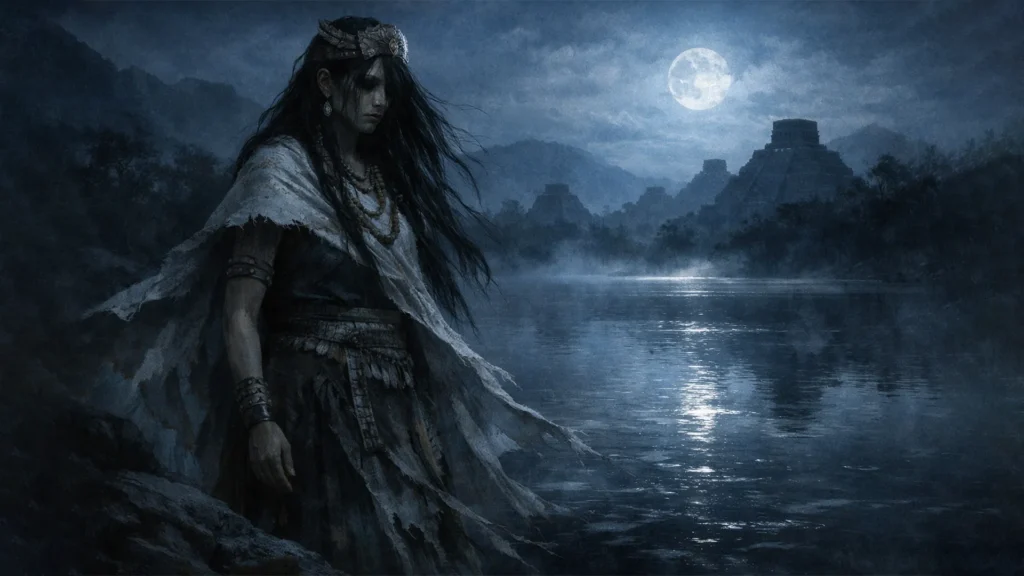

Long before the legend of La Llorona took the form of a woman dressed in white who wanders the rivers at night, there were already stories in Mesoamerica about a female figure linked to weeping, motherhood and death.
Far from being a myth that emerged during the Colonial period, the oldest origin of La Llorona is found in pre-Hispanic beliefs, where the crying of a supernatural woman was interpreted as an omen of misfortune and destruction.
Understanding this origin is fundamental to understanding why the legend has survived for centuries and why her lament continues to be one of the most haunting in Mexican folklore.
Early references to female weeping in Mesoamerica
In pre-Hispanic cultures, weeping was not only an expression of human pain. It was also a divine sign, a warning sent by higher forces.
The weeping of certain female entities was related to loss, war, death and the end of a cycle.
Among the Mexica peoples there were stories about a supernatural woman who wandered at night crying for her children, announcing calamities for her people. These stories were collected after the Conquest by chroniclers who documented indigenous beliefs, preserving fragments of a much older tradition.
Cihuacóatl: the weeping mother
One of the most important figures linked to the pre-Hispanic origin of La Llorona is Cihuacóatl, whose name can be translated as “snake woman”.
She was a deity associated with motherhood, childbirth, war and death, as well as the protection of children.
Paradoxically, she was also deeply linked to grief for the loss of children.
Cihuacóatl was considered the symbolic mother of the Mexica people, but at the same time she was a feared figure, for her weeping heralded misfortune. She did not cry out of weakness, but as a warning: her voice presaged the end of something important.
YOU MAY BE INTERESTED IN
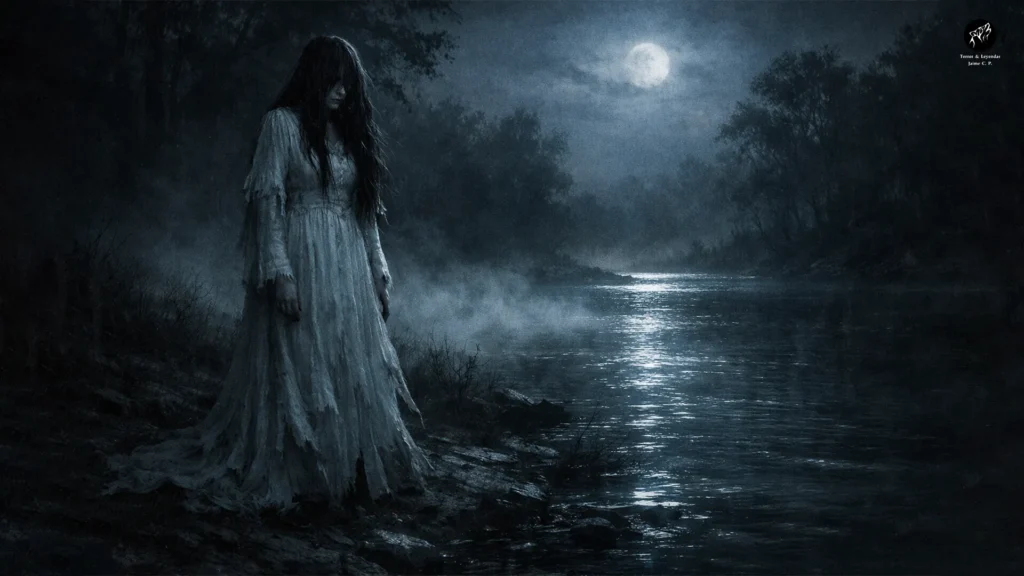
La Llorona: real origin and history of the Mexican legend
Few figures in Mexican folklore are as disturbing as La Llorona, that presence that seems to manifest itself when the night becomes too silent and the water reflects more shadow than light.
Weeping as a harbinger of the fall of the Mexican world.
According to 16th century chronicles, including those compiled by Bernardino de Sahagún, before the arrival of the Spaniards, the cry of a woman crying for her children was heard at night.
The stories describe that this figure appeared at night, wept inconsolably, walked near the water and announced the end of an era.
This cry was later interpreted as one of the omens of the fall of Tenochtitlan and the collapse of the Mexica world.
The woman was not weeping for individual children, but for an entire people destined to disappear.
Relationship with water and the underworld
In the pre-Hispanic cosmovision, water was both a sacred and dangerous element.
Rivers, lakes and canals not only gave life, but also functioned as thresholds to the underworld.
That this female figure always appeared near water was no coincidence.
Water represented the transit between worlds, ritual death and rebirth.
This symbolism explains why, even in later versions of the legend, La Llorona always appears next to rivers, lagoons or canals, keeping intact one of the oldest keys to the myth.
Motherhood as sacred pain
In Mexica thought, motherhood was not only seen as a biological act, but also as a sacrifice.
Women who died during childbirth were considered warriors and their spirit possessed a special power.
Cihuacóatl embodies this vision: a powerful mother, but also a tragic one.
Her weeping does not represent weakness, but sacred pain, the lament of one who loses that which she was meant to protect.
This concept survived the passage of time and was transformed during colonial times, when the divine mother was reinterpreted as a woman punished for losing her children. However, the symbolic background never disappeared.
From deity to specter: the transformation of the myth
After the Conquest, pre-Hispanic deities were reinterpreted from a Christian viewpoint.
Figures such as Cihuacóatl ceased to be understood as divine entities and began to be transformed into souls in pain, punished spirits and nocturnal apparitions.
Thus, sacred weeping became condemnation, and the divine mother became a spectral woman.
This process marked the transition between the pre-Hispanic myth and the colonial legend of La Llorona, as it is known today.
The pre-Hispanic origin of La Llorona and its permanence
The fact that La Llorona has such an ancient origin explains why she appears almost everywhere in Mexico, adopts different regional forms and maintains constant elements such as crying, water and night.
It is not an isolated story, but a myth deeply rooted in the Mesoamerican cosmovision, adapted over time to new times and beliefs.
Conclusion
The pre-Hispanic origin of La Llorona shows that this figure existed long before the Colonial period and that her lament was not born of an individual tragedy, but of a collective pain.
Before being a punished woman, she was a divine mother who wept for the destruction of her people.
That is why, when her lament is heard today in rivers and lonely roads, it is not only a legend of terror, but the echo of a civilization that disappeared, but that still cries in the memory of Mexico.
YOU MAY BE INTERESTED IN: Legends of Mexico