
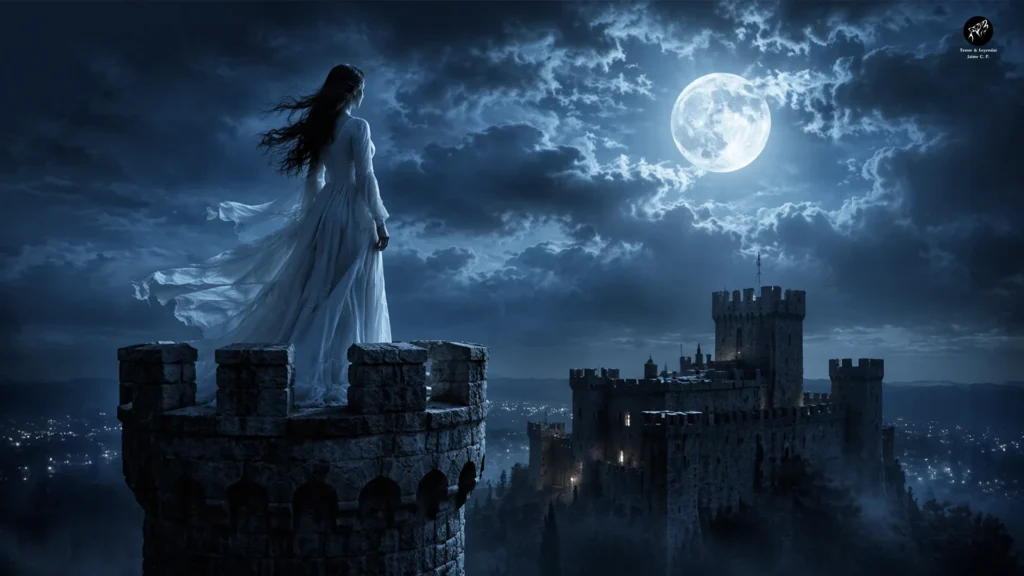

“In some castles in Italy, there are visitors who claim they are not alone… even if no one else is there.”
This is not an isolated story.
The Lady Bianca is not a single ghost, nor a single legend.
It is a more complex phenomenon: a collection of stories, testimonies and historical figures that, over time, have shaped one of the most haunting presences of Italian folklore.
What really is the Dama Bianca?
The Dama Bianca (White Lady) is a recurring figure in Italy that represents the spirit of a woman linked to an emotional tragedy, almost always related to love.
However, unlike other legends, it does not correspond to a single case.
It is a category of apparitions that share similar characteristics:
- Women dressed in white
- Presences in castles, palaces or historical sites
- Stories marked by betrayal, jealousy or impossible love
This pattern has allowed different stories, in different regions of Italy, to be grouped under the same name.
Historical and cultural origin of the Lady Bianca
To understand this legend, it is necessary to situate oneself in the Middle Ages.
During this period, marriages in noble families did not respond to love, but to political and economic interests. This generated deep emotional conflicts, especially in women who could not decide their own destiny.
In this context, stories of:
- Forbidden relationships
- Family betrayals
- Extreme punishments
- Hidden deaths
Many of these stories were passed down orally for generations, until they became accounts of apparitions.
Lady Bianca, in this sense, is not only a ghost….
she is the symbolic representation of an era.
Best known versions of the Lady Bianca
Giulia Occhini: the historical Dama Bianca
In the 1950s, the Italian press began to use the term “Dama Bianca” to refer to Giulia Occhini, a woman who was the subject of a media scandal following her relationship with cyclist Fausto Coppi.
Both were married, which provoked a strong reaction in Italian society at the time. The case was so controversial that it was even condemned by Pope Pius XII.
Although not a paranormal apparition, this case demonstrates how the term “Dama Bianca” can also represent a female figure associated with forbidden love.
The White Lady of Corte Lucatello
A local legend tells of a nobleman’s wife being discovered with a young lover.
The husband, overcome by jealousy, murdered her and hid her body in a well inside the property.
Since then, her spirit is said to haunt the place, wandering restlessly.
This version fits perfectly with the classic pattern of Lady Bianca: love, betrayal and violent death.
Aristocratic ghosts in Italian castles
Similar tales exist in different regions of Italy.
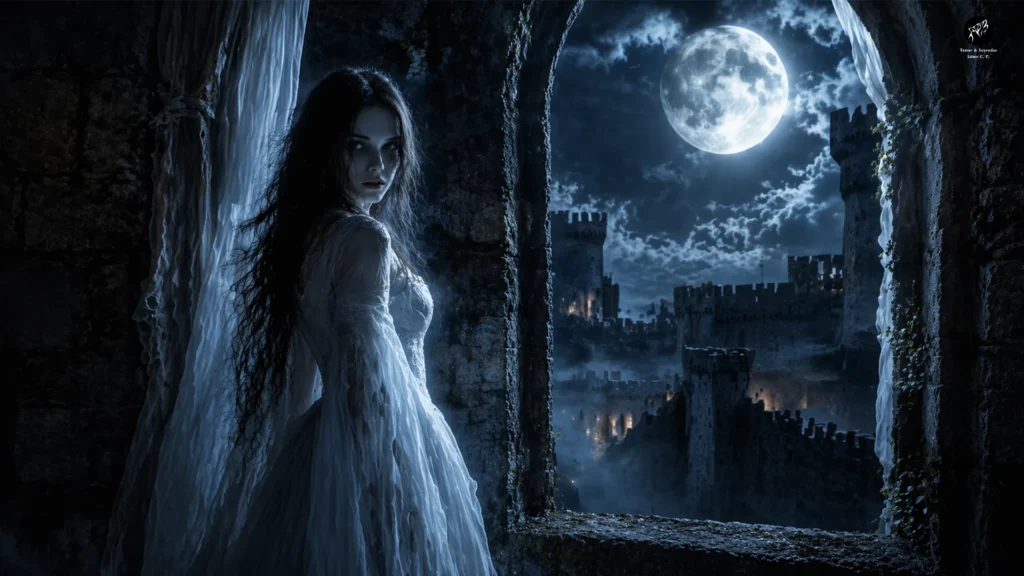
Noblewomen dressed in white appear in ancient castles, walking along corridors or peeping out from towers.
In many cases, these figures are associated with:
- Jealousy murders
- Forbidden relationships
- Desperate suicides
Although the details change, the core of the story remains intact.
Bianca Lancia and Federico II
Another related figure is Bianca Lancia, who maintained a relationship with Emperor Frederick II.
Some mythological versions suggest that she used strega (witchcraft) related practices to secure his love.
Although there is no conclusive evidence, her story has been reinterpreted within the imaginary of the Lady Bianca, reinforcing the link between love, power and tragic destiny.

YOU MAY BE INTERESTED IN
The true legend of Valentine’s Day: the dark story that February 14 doesn’t want to tell
Every February 14 the world is filled with flowers, promises and sweet words. However, the original story of St. Valentine’s Day is far from modern romanticism. He was born in a time of persecution, punishment and death; in a Rome where loving, believing and disobeying could cost one’s life.
How does Lady Bianca manifest herself?
The testimonies about the Dama Bianca present consistent patterns.
Those who claim to have had close experiences describe:
- Apparitions of a female figure dressed in white.
- Sudden cold sensation
- Abnormal silence in the environment
- Perception of being watched
In some cases, the figure appears in high points, as towers or balconies, looking fixedly towards the emptiness… or towards the one who observes it.
Common themes in all legends
Despite the different versions, there are elements that are repeated:
- The color white as a symbol of innocence or death.
- Ancient spaces: castles, palaces, fortresses
- Love tragedies or intense emotional conflicts
- Presences that seem to be “trapped” in time
These elements are key to understanding why the legend has persisted for centuries.
Is Lady Bianca a legend or a real phenomenon?
There is no scientific evidence to confirm the existence of Lady Bianca as a paranormal entity.
However, there are factors that keep the discussion alive:
- Real places with documented history
- Consistent testimonies over time
- Personal experiences that are difficult to explain
This places Lady Bianca somewhere between history, psychology and the unknown.
Conclusion
Lady Bianca is not a single ghost, nor a single story.
It is a collection of stories that reflect a constant: human emotions taken to the extreme.
Love, betrayal, loss and memory.
Perhaps that is why his figure keeps appearing, again and again, in different places in Italy.
Not as a coincidence… but as a reminder that some stories never end.