
In Chinese mythology there is a figure who silently observes the affairs of the human heart. From the moon, with infinite patience, he is in charge of uniting people destined to meet, even if their paths seem impossible to cross.
His name is Yue Lao (月老), also known as Yue Xia Lao Ren, “the old man under the moon”. Considered the Chinese god of love and marriage, he is the central figure behind the legendary Red Thread of Fate, the invisible tie that binds fated souls.
In this article you will discover who Yue Lao is, his historical origin, his most famous legend, his iconography, and why his cult is still alive today.
Who is Yue Lao?
Yue Lao is a Chinese folklore deity associated with love, marriage and romantic destiny. He is often compared to the “Chinese Cupid,” although his role is much more profound and solemn.
He does not provoke sudden flirtations or fleeting passions.
His mission is to ensure that people destined to unite meet, regardless of time, distance or obstacles.
Destiny can be delayed, but not avoided.
YOU MAY BE INTERESTED IN
The Legend of the Moon Elder and the Red Thread of Destiny
According to an ancient Chinese legend, there is an old man who lives on the moon and silently observes the fate of human beings. His name is Yue Lao, the god of marriage and fated bonds.
Facts about Yue Lao
- Domain: Love and marriage
- Distinguishing symbol: Red thread of destiny (紅線)
- Epoch of origin: Tang Dynasty (618-907 AD)
- Attributes:
- Marriage book (姻緣簿)
- Red threads
- Staff
- White beard
- Associated festivities:
- Qixi Festival (七夕)
- Mid-Autumn Festival
The book of destiny and the red thread.
According to legend, Yue Lao possesses a sacred book of marriage, where the names of all fated couples are written. Next to it he keeps invisible red threads, with which he binds those people together from birth.
The red thread:
- Can be stretched
- Can become entangled
- It can be stretched until it hurts
But it never breaks.
In Chinese tradition, this thread is tied to the ankles of people destined to meet, a key difference from the later Japanese version.
Origin and legend of Yue Lao
The best-known account of Yue Lao appears in the work Xu Xuan Guai Lu, written during the Tang dynasty.
The story narrates that a young scholar named Wei Gu met one night an old man reading a book under the moonlight. The old man was Yue Lao. When asked what he was reading, Yue Lao explained that it was the record of predestined marriages.
Yue Lao also showed him a bag full of red threads, which he used to bind destined couples together.
The old man revealed to Wei Gu who would be his future wife. The young man, incredulous and upset by the prediction, attacked a girl who had been pointed out to him as his destiny.
Years later, Wei Gu married a noblewoman. When he lifted the veil during the wedding, he discovered a scar on her forehead: the same wound he had caused in his youth.
Destiny had been fulfilled.
Iconography and attributes of Yue Lao
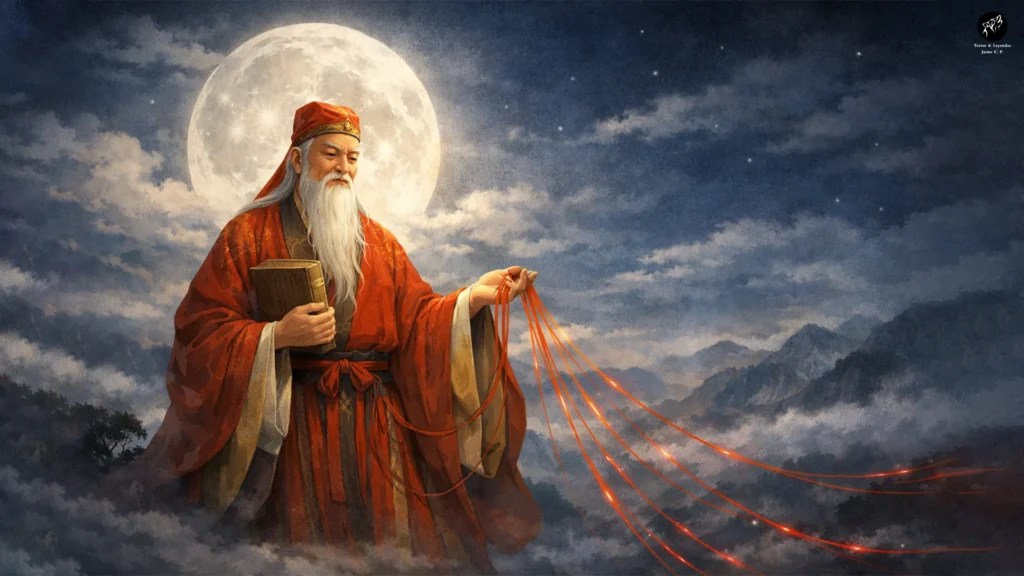
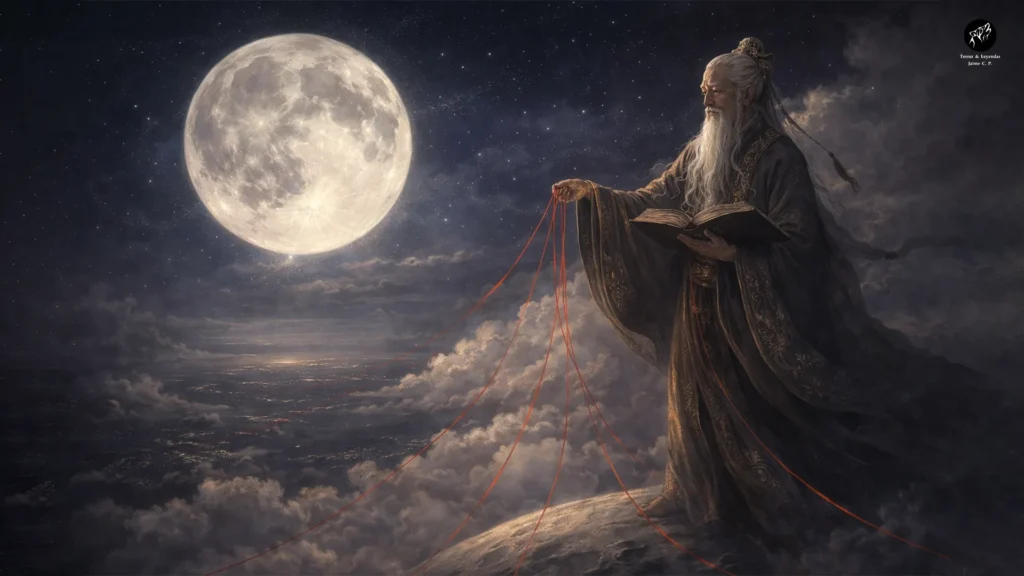
Yue Lao is usually depicted as:
- An old man with a white beard.
- With a kind and serene expression
- Dressed in red or yellow robes
- Carrying a book with the names of the partners
- Holding red threads of destiny
Often appears under the moon, symbol of his constant vigilance over the affairs of the human heart.
Cultural significance and cult of Yue Lao
The cult of Yue Lao is still very popular in China, Taiwan and other regions of East Asia. Many people flock to Taoist temples to ask for his blessing in love.
Among the best-known temples are:
- Xia-Hai Temple in Taipei.
- Wong Tai Sin Temple in Hong Kong.
During the festivities, devotees tie red threads, wear symbolic bracelets or perform rituals to find a mate or strengthen their marriage.
Yue Lao and the Red Thread of Destiny
The legend of Yue Lao is considered the oldest origin of the Red Thread of Destiny. From this myth later versions emerged, such as the Japanese reinterpretation known as Akai Ito.
While Japan transformed the story into a poetic metaphor for fated love, the Chinese tradition retains a more solemn approach:
fate is not defied without consequences.
Contemporary relevance
Today, Yue Lao continues to inspire:
- Asian films and dramas
- Romantic novels
- Modern rituals
- Cultural practices related to love
Her figure represents a persistent belief in Chinese culture: some encounters are not casual, they are written from before birth.
Conclusion
The legend of Yue Lao, the Elder of the Moon, is one of the deepest roots of the myth of the Red Thread of Destiny. It is not only a love story, but a reflection on time, fate and the bonds that define a life.
Perhaps the thread can’t be seen….
but many claim to have felt it tighten at one time or another.