
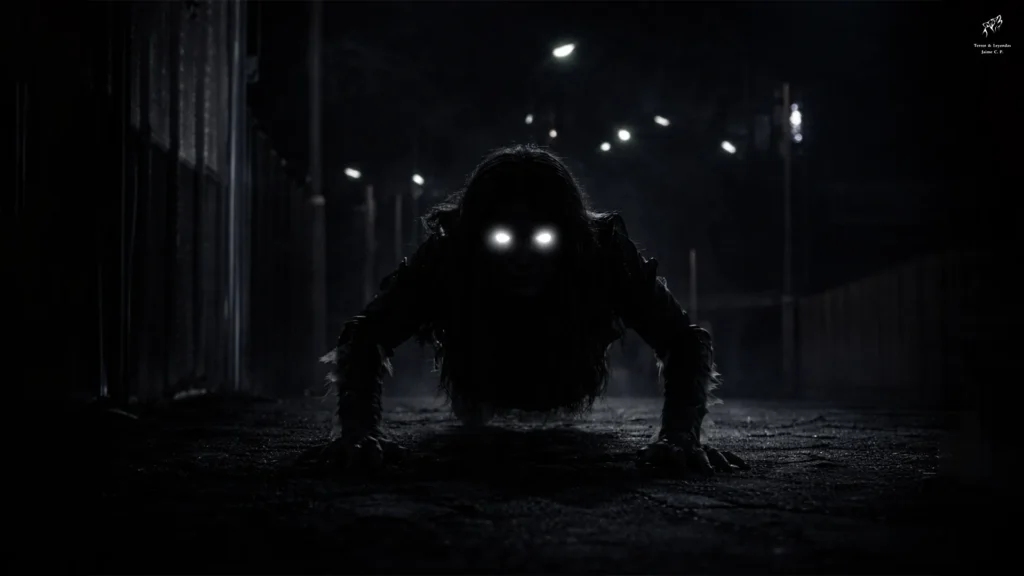

Teke Teke is one of the most haunting urban legends of contemporary Japan. It tells the story of a young girl who was tragically killed when she was run over by a train and, unable to find rest, returned as a vengeful spirit.
Her name comes from the sound she makes as she moves:
“teke… teke… teke… teke…”, the thud of her hands or elbows against the ground as she crawls.
Although widely circulated on the Internet today, the Japanese Teke Teke legend has been widespread since the mid-20th century, especially among students.
What is Teke Teke?
Teke Teke is a ghost of Japanese urban folklore that represents a woman split in two by a train. As she has no lower body, she moves using only her arms, moving with unnatural speed.
Within Japanese tradition, she fits the figure of the vengeful spirit: souls who die with resentment and return driven by trauma.
Origin of the legend of Teke Teke
The legend began to spread strongly in Japan during the second half of the 20th century. There is no documented historical case to confirm the original incident, but the narrative gained traction in school settings.
The best known version relates that:
- A young girl fell or was pushed onto the train tracks.
- The train broke her in half.
- She remained conscious for a few moments.
- She bled to death or died from the cold.
- Her rancor transformed her into a vengeful spirit.
Some variants place the origin in Hokkaidō, although the exact place changes according to the region.
Who is Teke Teke according to Japanese legend?
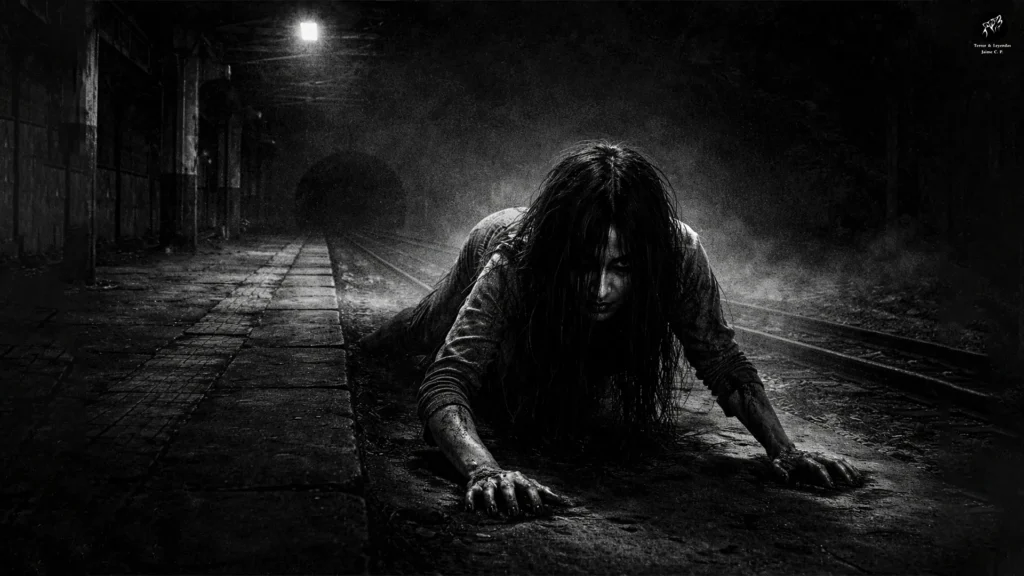
In most accounts, Teke Teke is described as:
- A young student.
- Long dark hair.
- Pale or expressionless face.
- Legless.
- Able to move extremely fast despite crawling.
In certain versions it carries a scythe or blade with which it attacks its victims.
The image is simple but powerful: an incomplete body that moves with impossible speed.

YOU MAY BE INTERESTED IN
Kuchisake Onna: the Japanese legend of the woman with the severed mouth
Kuchisake Onna is one of the most disturbing and persistent Japanese urban legends in modern folklore. Its story, passed down for generations, unfolds in everyday settings – quiet streets, school roads, residential neighborhoods – where a simple question can become a sentence.
How does Teke Teke attack?
According to Japanese legend, he appears mainly in:
- Train stations.
- Lonely streets.
- School roads.
- Deserted urban areas at night.
If someone sees it, the chase is on.
No matter how fast you run, it can catch up with you.
When it does, it cuts its victim in half, replicating the way she died.
How to defeat Teke Teke?
This is one of the most sought-after questions: can Teke Teke be defeated?
The answer depends on the version of the legend.
The classic version: you can’t beat
In the more traditional form of the tale, Teke Teke is unstoppable.
- He asks no questions.
- She offers no warnings.
- She cannot be defeated.
Once you see it, you are its target.
The chase ends when it catches up with you.
The essence of terror lies precisely in that inevitability.
The modern variant associated with Kashima Reiko
Over time, the legend of Teke Teke began to merge with another Japanese urban figure known as Kashima Reiko.
In these more recent versions, the encounter changes.
The question
The entity may ask:
“Where are my legs?”
Some versions indicate that answering correctly could save you. Answers vary according to the account:
- “On the railroad track.”
- “On Meishin Road.”
- “At the place where you died.”
There is no universally accepted answer, as this part belongs to the modern evolution of the legend.
The name trap
In certain variants it is warned that if she asks who she is and “Kashima Reiko” is answered, it may be a trap that triggers the immediate attack.
This dynamic belongs mainly to the Kashima Reiko tradition, although today the two stories are often confused.
So, can it be defeated?
In the original version, no.
In the modern variants, there are supposed answers that could save you… but they change depending on who is telling the story.
And that ambiguity is part of what keeps the legend alive.
Difference between Teke Teke and Kashima Reiko
Although they are often conflated today, they were originally separate stories:
- Teke Teke: spirit split by a train that chases and cuts its victims.
- Kashima Reiko: an entity that asks questions about its mutilation.
The Internet ended up merging both figures, generating the hybrid version that many know today.
Cultural significance of the Japanese Teke Teke legend
Beyond the superficial fear, the story reflects deep collective fears:
Fear of the train
Japan has one of the most extensive railway systems in the world. Turning it into a horror scenario connects to a real vulnerability.
Body horror
Mutilation generates an immediate visceral reaction.
The vengeful spirit
In Japanese tradition, dying with resentment prevents the soul from resting.
School anxiety
Many Japanese urban legends arise and are passed on in student environments.
Teke Teke is not just a ghost: it is a representation of trauma turned myth.
Is the legend of Teke Teke real?
There are no verifiable historical records to confirm the original case. It is considered a modern urban legend.
However, its permanence demonstrates the narrative power of contemporary myths.
YOU MAY BE INTERESTED: Urban Legends: Japan